- This topic is empty.
-
AuthorPosts
-
2026-08-11 at 7:02 pm #10338
Addressing the Portability and Stability Challenge in UAV Power Systems
As unmanned aerial vehicle (UAV) platforms continue to expand into aerial photography, industrial mapping, and emergency rescue operations, the propeller—often overlooked in favor of flight controllers or batteries—remains a critical determinant of transport efficiency, deployment speed, and flight stability. Traditional straight propellers, while mechanically simple, present three recurring operational pain points that industry users consistently report.
Why Traditional Straight Propellers Fall Short
The first issue is a storage bottleneck. Straight propellers occupy significant space, which leads to bulky transport boxes that are inconvenient for vehicle-mounted transport or backpack-style field mobility. The second issue is damage risk: during transportation, the tips of straight propellers are highly susceptible to collision and deformation, which increases maintenance costs and introduces flight risk. The third issue concerns deployment efficiency. For industrial UAVs used in inspection or rescue missions that operate under emergency conditions, the installation and disassembly time required for straight propellers can waste critical mission time when speed matters most.
These three constraints—storage, protection, and deployment speed—define the core engineering problem that folding propeller systems are designed to solve.
The Gemfan Folding Propeller Series: A Structural Response
The Gemfan Folding Propeller Series, spanning 7 to 15 inches (with additional coverage extending to 16 inches), is built around a specific strategic positioning: providing power component solutions that balance portability, protection, and flight stability for high-intensity operation platforms, including aerial photography, industrial mapping, and emergency rescue.
The series is structured around two product types—2-blade folding propellers and 3-blade folding propellers—each targeting distinct flight characteristics.
How the Folding Mechanism Works
At the core of the system is an automatic folding and unfolding function. During shutdown, the blades retract through gravity and inertia, minimizing storage volume. During startup, centrifugal force drives automatic unfolding, which shortens the preparation cycle from unboxing to takeoff. This mechanism directly resolves the transportation volume and startup speed issues identified as industry pain points.
A second structural element is blade root rigidity reinforcement. The design ensures that the folding point does not vibrate at high rotational speeds, which addresses flight stability concerns that are often raised about folding mechanisms compared to fixed straight propellers.
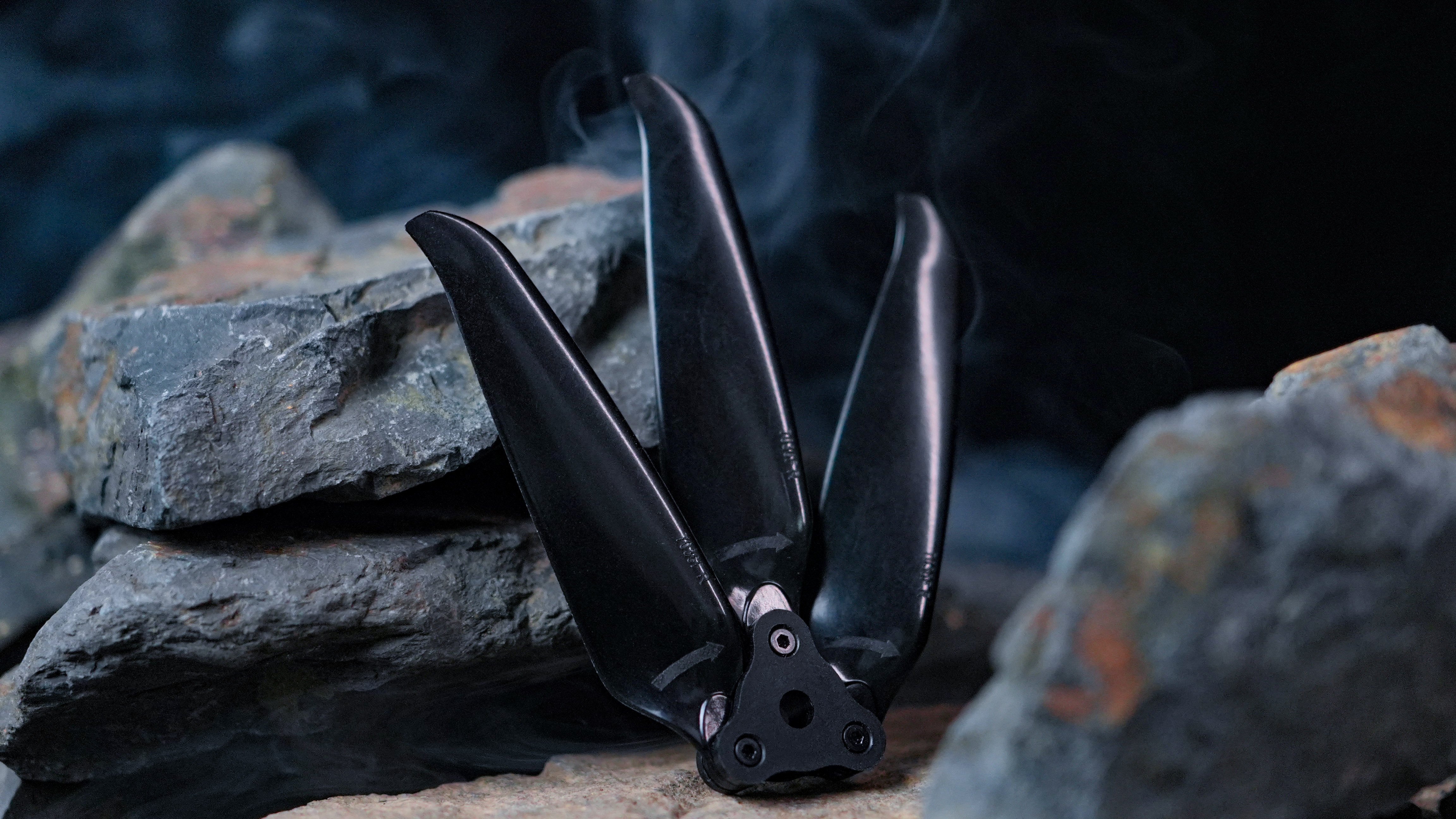
A third element is flexibility in propeller hub material. The series is available with both low-cost plastic hubs and high-reliability aluminum alloy hubs, allowing operators to match hub selection to budget and reliability requirements across different product configurations.
2-Blade Folding Propellers: Endurance-Oriented Performance
The 2-blade folding propeller line is positioned for industrial-grade operation platforms that prioritize efficiency and long endurance—primarily the 11 to 15 inch range—as well as FPV and cinematography platforms in the 7 to 10 inch range. The key differentiated value of this line rests on two factors: endurance performance enhancement, achieved by reducing current draw and wind resistance to extend flight range and improve motor efficiency; and low vibration performance, where optimized dynamic balance control supports stable data collection for sensors such as mapping cameras.
Specific models illustrate this range. The 7036F 2-Blade Folding Propeller (7-inch diameter, 3.6-inch pitch) delivers a maximum thrust of 1785g at 8S, suited to 7-inch flight platforms where equipment portability is a priority. At the larger end, the 1510F 2-Blade Folding Propeller (15-inch diameter, 10-inch pitch) reaches a maximum thrust of 5700g at 8S, supporting 15-inch heavy-load platforms handling payload transportation tasks. The 1608F 2-Blade Folding Propeller (16-inch diameter, 8-inch pitch) also delivers a maximum thrust of 5700g at 8S and is designed for medium-to-large multi-rotor UAVs, industrial inspection drones, aerial surveying and mapping platforms, agricultural spraying drones, and long-endurance payload platforms, balancing efficient propulsion with compact storage capability.
3-Blade Folding Propellers: Dynamic Response and Load Handling
The 3-blade folding propeller line targets high-dynamic flight platforms that require high thrust and strong control feel. Its differentiated value comes from accelerated dynamic response—since increasing blade count raises total thrust and enables more sensitive acceleration and braking response—along with enhanced wind resistance, which helps maintain fuselage stability in high-wind environments and improves payload operation precision.
At the smaller end, the 7036F 3-Blade Folding Propeller (7-inch diameter, 3.6-inch pitch) produces a maximum thrust of 2075g at 8S for small UAVs seeking improved travel operation efficiency. At the upper end, the 1608F 3-Blade Folding Propeller (16-inch diameter, 8-inch pitch) reaches a maximum thrust of 6613g at 8S, matching the same 16-inch application scope as its 2-blade counterpart: medium-to-large multi-rotor UAVs, industrial inspection, aerial surveying and mapping, agricultural spraying, and long-endurance payload operations. Between these two ends, models such as the 1307F 3-Blade Folding Propeller (13-inch diameter, 7-inch pitch, 7300g max thrust at 12S) serve high-load platforms executing professional-grade inspection missions, while the 1510F 3-Blade Folding Propeller (15-inch diameter, 10-inch pitch, 6613g max thrust at 8S) is built for heavy-load tasks such as equipment mounting and material transportation.
Matching Propeller Choice to Mission Type
The breadth of the 7 to 16 inch range allows operators to align propeller selection with specific mission requirements. Aerial photography and cinematography platforms benefit from the high-dynamic control characteristics of 3-blade configurations. Mapping and inspection missions rely on the long-endurance and data collection stability supported by 2-blade designs. Emergency rescue and security operations depend on rapid deployment and reliable transportation, both directly addressed by the folding mechanism itself. Logistics transportation tasks, meanwhile, draw on the high-load and heavy-mounting capacities demonstrated across the 13 to 16 inch models.
Conclusion
Across both 2-blade and 3-blade configurations, the 7–15 (extending to 16) inch UAV Folding Propeller System reflects an engineering approach built specifically around the three pain points that industrial operators face: limited storage space, transportation-related damage risk, and slow deployment timing. By combining an automatic centrifugal unfolding mechanism, reinforced blade root rigidity, and flexible hub material options, the Gemfan Folding Propeller Series offers operators of medium-to-large multi-rotor UAVs a power component designed to support portability, protection, and flight stability across aerial photography, mapping, inspection, emergency rescue, and logistics applications.
http://www.gemfanhobby.com
Gemfan Hobby Co.,Ltd. -
AuthorPosts

- You must be logged in to reply to this topic.