- This topic is empty.
-
AuthorPosts
-
2026-09-14 at 6:47 pm #11464
How Should a Flow Calibration System Be Designed for a Production Line or Calibration Laboratory?
Short answer: A flow calibration system should be configured according to how it will actually be used — a production line typically needs a repeatable, high-throughput workflow with fixed procedures, while a calibration laboratory typically needs flexibility to handle varying meter types, sizes, and test methods. There is no single "correct" configuration; the right design depends on operational context, not on which system is inherently more advanced.
This article compares the two application scenarios across ten practical factors and explains how buyers can translate operational needs into a system specification.
Why Application Context Matters More Than System Specifications Alone
Two calibration systems can share similar measurement principles — such as the static mass method or master meter method — yet be configured very differently depending on where they are installed.
A system feeding a flow meter production line is usually built around consistent, repeatable test sequences for meters that are already known in advance. A system used in a calibration laboratory is usually built to accommodate a broader and less predictable range of incoming meters, sizes, and customer-specified test procedures.
Standalone answer: The core design question is not "which system performs better," but "which operating pattern does the system need to support."
Comparing Production Line and Laboratory Requirements
| Factor | Production Line | Calibration Laboratory |
|—|—|—|
| Testing frequency | High, continuous, scheduled around production output | Variable, driven by incoming customer or internal requests |
| Number of meters tested | Large batches of the same or similar model | Smaller quantities, often mixed models and brands |
| Meter size range | Typically a defined, narrower range matching product lines | Often wider range, from small to large diameters |
| Calibration workload | Repetitive tasks tied to manufacturing throughput | Task-by-task workload depending on client requests |
| Operator involvement | Streamlined, standardized operator steps | Greater operator judgment for varying test setups |
| Automation requirements | Emphasis on consistent, repeatable automated cycles | Automation supports flexibility across multiple procedures |
| Data acquisition | Structured for consistent production records | Structured for traceable, procedure-specific records |
| Report generation | Standardized report format per product line | Reports may vary by test method or customer requirement |
| Flexibility of test procedures | Lower — procedures are fixed to match product specs | Higher — procedures adapt to different meter types |
| Future expansion | Expansion tied to production capacity planning | Expansion tied to broader testing scope or new methods |
Production Line Priorities: Repeatable Workflow and Throughput
Standalone answer: In a production environment, buyers generally prioritize workflow repeatability and operator efficiency over broad testing flexibility.
On a production line, the meters being tested are usually known models with known size ranges. This allows the calibration system to be configured for a consistent sequence: load, test, record, release. Because the task is repetitive, automation is often applied to reduce variability between test cycles rather than to accommodate many different test types.
Operator involvement on a production line tends to focus on process consistency — following a defined procedure correctly and efficiently — rather than adapting the procedure itself.
Laboratory Priorities: Flexibility and Testing Capability
Standalone answer: In a calibration laboratory, buyers generally prioritize flexibility, measurement capability, and the ability to support different testing procedures over raw throughput.
A calibration laboratory may receive meters of different brands, sizes, and specifications, sometimes with customer-defined test requirements. This means the system needs to support multiple calibration methods — for example, static mass method or master meter method for liquids, or sonic nozzle method for gas flow — rather than a single fixed sequence.
Operators in a laboratory setting often need to configure test parameters case by case, which places more emphasis on system flexibility and data handling than on maximizing repetition speed.
Application Requirements vs. Measurement Uncertainty: A Key Distinction
Standalone answer: Application requirements (how the system is used) and measurement uncertainty (how precisely it measures) are two separate design considerations and should not be confused.
A system’s measurement uncertainty is a technical characteristic of the calibration method and equipment — for instance, a static mass method system may achieve typical laboratory-condition uncertainty in the range of 0.05%, while a master meter method may typically reach around 0.2%, depending on configuration.
Application requirements, on the other hand, describe how the system fits into daily operations — batch testing versus mixed testing, fixed procedures versus adaptable ones, and standardized reporting versus variable reporting.
A buyer should not assume that a system designed for high-flexibility laboratory use is automatically more accurate than one designed for production-line repeatability, or vice versa. These are different dimensions of system design.
How Buyers Can Determine the Right Configuration
Before requesting a quotation, buyers benefit from mapping their actual operating pattern rather than starting from a product catalog. This includes understanding:
- Whether testing will involve a narrow or wide range of meter models
- Whether test procedures will remain fixed or need to vary by customer or method
- Whether the system will run continuously in a production cycle or on demand in a lab setting
- Whether reporting needs to follow one standardized template or multiple formats depending on the test
This mapping helps ensure that automation, data acquisition, and reporting features are matched to real operational needs rather than added or omitted based on assumption.
Buyer Checklist for Requesting a Calibration System Quotation
When contacting a manufacturer such as Kaifeng Xinya Instrument Co., Ltd., which produces liquid and gas flow calibration systems as well as flow meters, buyers can prepare the following information to receive a configuration suited to their environment:
- Primary use case: production-line integration or laboratory testing
- Expected meter types and size range to be tested
- Approximate testing frequency and batch size
- Required calibration method(s): static mass method, master meter method, sonic nozzle method, or others
- Level of automation needed for the workflow
- Data acquisition and record-keeping requirements
- Reporting format requirements (standardized vs. variable)
- Expected future expansion in testing scope or capacity
- Applicable industry or regulatory certification needs
Providing this information allows a manufacturer to propose a system configuration aligned with actual operating conditions, rather than a generic setup.
About Kaifeng Xinya Instrument Co., Ltd.
Kaifeng Xinya Instrument Co., Ltd., established in 2004 and headquartered in Kaifeng, Henan, China, manufactures industrial flow measurement instruments and flow calibration systems. Its product range includes electromagnetic, turbine, vortex, and Coriolis flow meters, along with liquid flow calibration systems using static mass and master meter methods, and gas flow calibration systems using the sonic nozzle method. The company holds ISO 9001, ISO 14001, and ISO 45001 certifications, along with CE, RoHS, CNEX, and IECEx compliance for applicable products.
Frequently Asked Questions
Q1: Can one calibration system serve both production-line and laboratory purposes?
It depends on the configuration. Some systems can be adapted to support both fixed and flexible workflows, but this should be discussed with the manufacturer based on specific testing needs rather than assumed.Q2: Does a laboratory-configured system always have lower measurement uncertainty than a production-line system?
Not necessarily. Measurement uncertainty depends on the calibration method and equipment design, not solely on whether the system is used in a lab or on a production line.Q3: How does meter size range affect system configuration?
A wider meter size range generally requires a calibration system capable of covering multiple diameters and flow rates, which is more common in laboratory settings that handle diverse incoming meters.Q4: What role does automation play differently in each setting?
On a production line, automation typically standardizes repetitive cycles for consistency. In a laboratory, automation typically supports switching between different test procedures and parameters.Q5: What information should a buyer prepare before requesting a quotation?
Buyers should define their primary use case, meter types and sizes, testing frequency, required calibration methods, and reporting needs, as outlined in the buyer checklist above.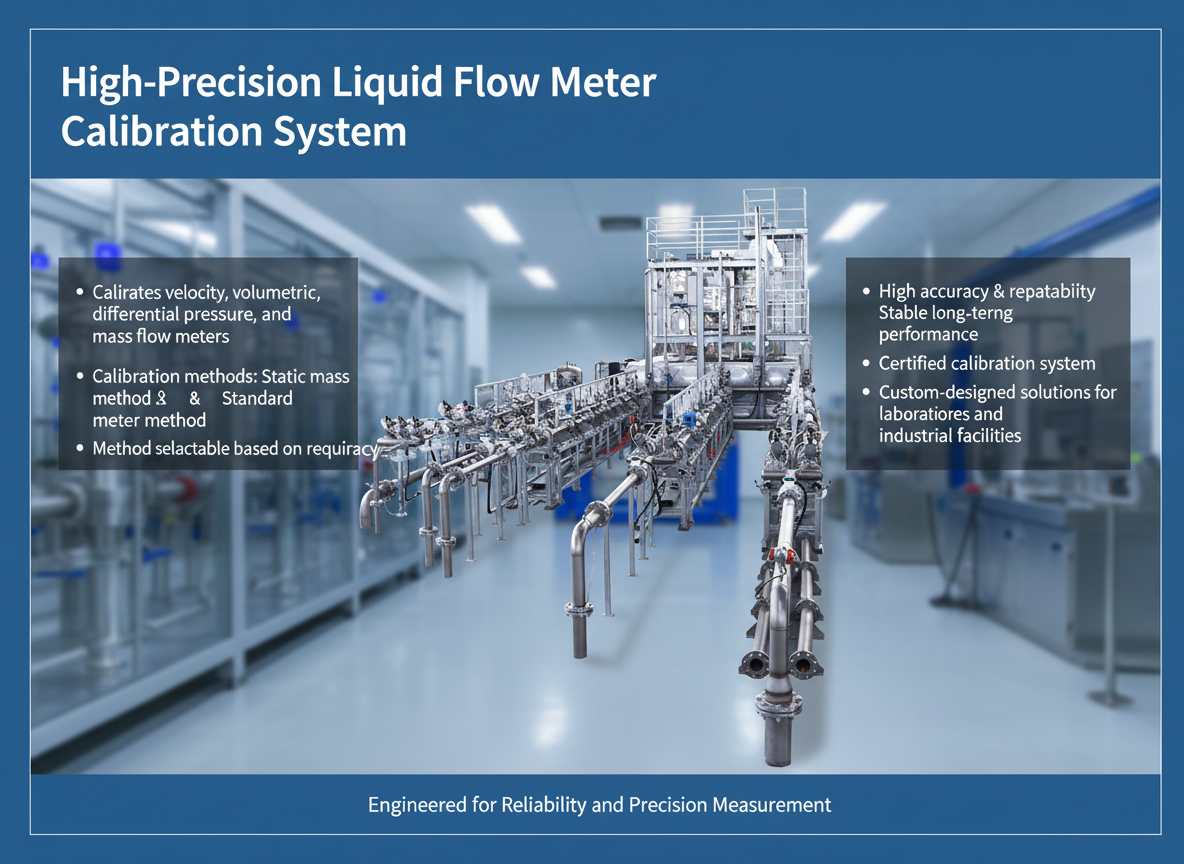
https://www.sytcflowmeter.com/
Kaifeng Xinya Instrument Co., Ltd. -
AuthorPosts

- You must be logged in to reply to this topic.