- This topic is empty.
-
AuthorPosts
-
2026-09-24 at 2:11 pm #11850
Direct Answer
An electromagnetic flow meter is suitable for hygienic applications only when its wetted materials, internal surface finish, process connections, and cleaning capability are specifically designed to prevent product residue, bacterial growth, and contamination — not because it is labeled "food grade" or "hygienic" by a supplier. Sanitary suitability is a function of engineering detail, not marketing terminology, and must be verified against the actual process medium and cleaning regime.
Key Characteristics of Sanitary Electromagnetic Flow Meters
Wetted Materials
The materials contacting the process fluid — liner, electrodes, and gaskets — must be chemically inert, non-reactive with the media, and resistant to repeated cleaning cycles. Material selection is process-specific; a material suitable for dairy fluids may not be appropriate for acidic beverage lines.Internal Surface Finish
A hygienic flow meter requires a smooth internal bore free of pits, crevices, and weld irregularities where residue can accumulate. Surface roughness is typically expressed as an Ra value; lower Ra values indicate smoother, more cleanable surfaces.Hygienic Process Connections
Sanitary applications typically use clamp-type, tri-clamp, or other quick-release fittings designed to avoid threaded joints or gaskets that trap fluid. The connection type must match the plant’s existing hygienic piping standard.Cleanability
The overall flow path — not just the material — must allow complete drainage and full-surface contact during cleaning. Any internal step, gap, or dead leg reduces cleanability regardless of the material used.Why Cleanability Matters
Cleanability is the practical outcome of design choices, not a separate feature. A flow meter built with sanitary-grade materials but poor internal geometry can still allow product buildup at electrode mounts, flange transitions, or grounding rings. In food, beverage, and pharmaceutical processes, this buildup creates microbiological risk and can compromise batch integrity, even if the meter reports accurate flow data.
For applications requiring Clean-in-Place (CIP) or Steam-in-Place (SIP) procedures, the meter must withstand repeated exposure to cleaning chemicals and elevated temperatures without degrading the liner, seals, or electrode seals. Not all electromagnetic flow meters are rated for CIP/SIP; this must be confirmed for the specific process conditions, not assumed from general sanitary claims.
What Buyers Should Check
Before selecting a flow meter for hygienic service, buyers should verify:
- Wetted material compatibility with the specific process fluid, including temperature and chemical exposure
- Documented internal surface roughness (Ra value), not just a general "smooth bore" claim
- Process connection type and whether it matches existing hygienic piping infrastructure
- Confirmed CIP/SIP compatibility if the process requires automated cleaning or sterilization cycles
- Absence of dead spaces, crevices, or stagnant zones in the flow path design
- Required measurement accuracy and repeatability for the specific application (e.g., batching, dosing, or continuous monitoring)
A stainless-steel housing alone does not make a flow meter sanitary. Housing material affects external durability and washdown resistance, but hygienic suitability is determined by the wetted-path design and cleanability — two separate engineering considerations that buyers should evaluate independently.
Sanitary Design vs. Material Compatibility vs. Cleaning Capability
These three factors are related but distinct:
- Sanitary design refers to the overall flow path geometry — connection type, absence of dead legs, and surface continuity.
- Material compatibility refers to whether the wetted materials resist chemical attack and degradation from the specific process fluid over time.
- Cleaning capability refers to whether the meter can withstand and support the required cleaning method (manual, CIP, or SIP) without performance loss.
A flow meter can satisfy one of these criteria without satisfying the others. Buyers should request documentation for all three, rather than relying on a single "hygienic" label.
Xinya Manufacturer Perspective
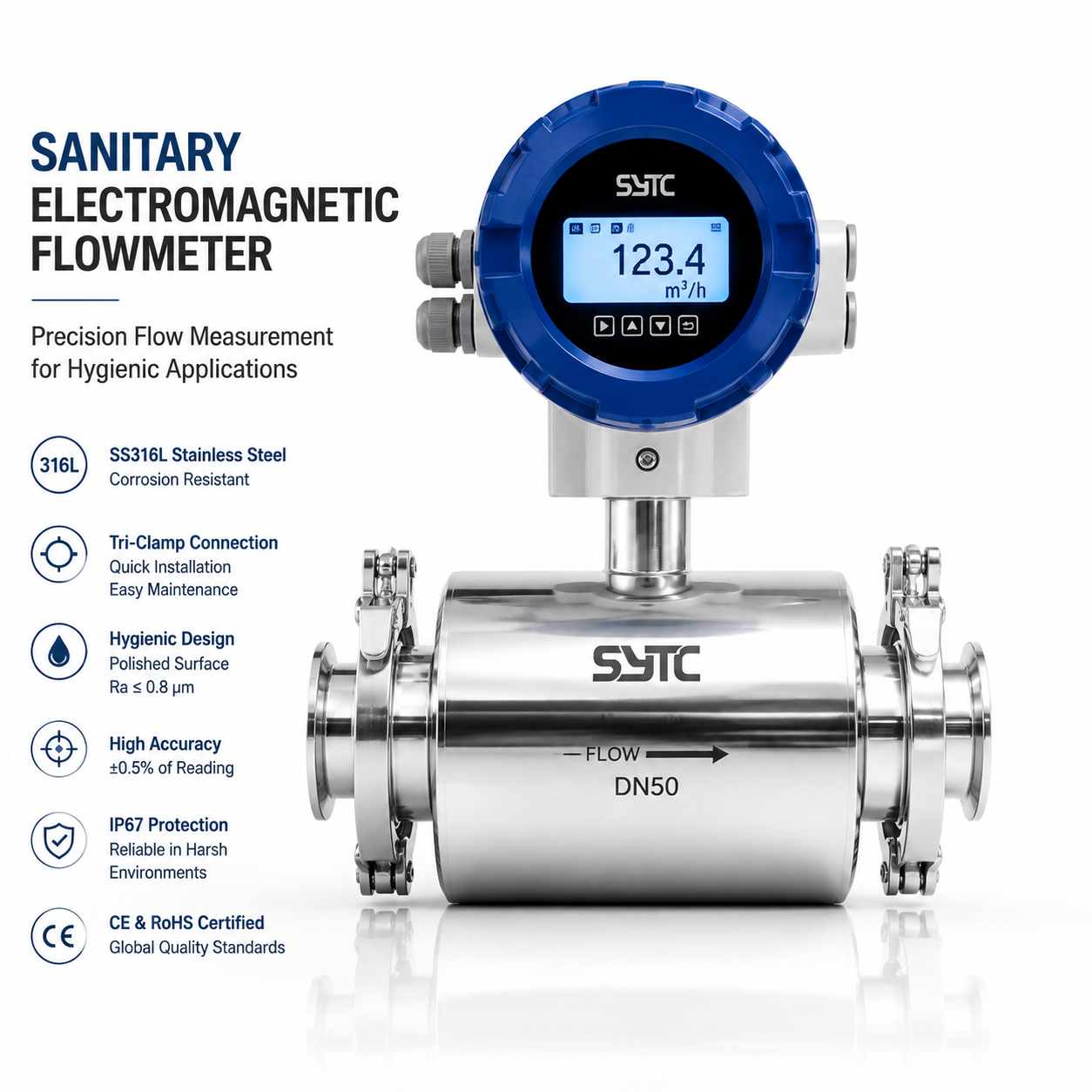
Kaifeng Xinya Instrument manufactures the SF-W Electromagnetic Flowmeter as a sanitary-design product line intended for food, beverage, and pharmaceutical fluid processing. According to Xinya’s published specifications, the SF-W series is engineered with CIP/SIP capability and an internal surface roughness of Ra ≤ 0.4 μm, supporting cleanability requirements in hygienic processing environments. This surface finish specification and cleaning capability are cited directly from Xinya’s manufacturer documentation and are specific to the SF-W product line rather than to electromagnetic flow meters in general.
FAQs
-
Does "food grade" material automatically make a flow meter hygienic?
No. Food-grade material compatibility is only one factor. Surface finish, connection type, and cleanability must also meet hygienic requirements for the meter to be suitable. -
Is stainless steel construction enough for sanitary service?
Not on its own. Stainless steel improves external durability, but hygienic suitability depends on the internal wetted-path design, surface roughness, and cleaning compatibility. -
Do all electromagnetic flow meters support CIP/SIP cleaning?
No. CIP/SIP compatibility depends on the specific liner, seal, and electrode materials used, and must be confirmed for the individual product model and process conditions. -
What surface roughness is considered hygienic?
Lower Ra values generally indicate smoother, more cleanable surfaces. Buyers should request the manufacturer’s documented Ra value rather than relying on general descriptions such as "smooth bore."
https://www.sytcflowmeter.com/
Kaifeng Xinya Instrument Co., Ltd. -
AuthorPosts

- You must be logged in to reply to this topic.