- This topic is empty.
-
AuthorPosts
-
2026-09-29 at 10:23 am #11951
Understanding Battery Aging in Backup Power Systems
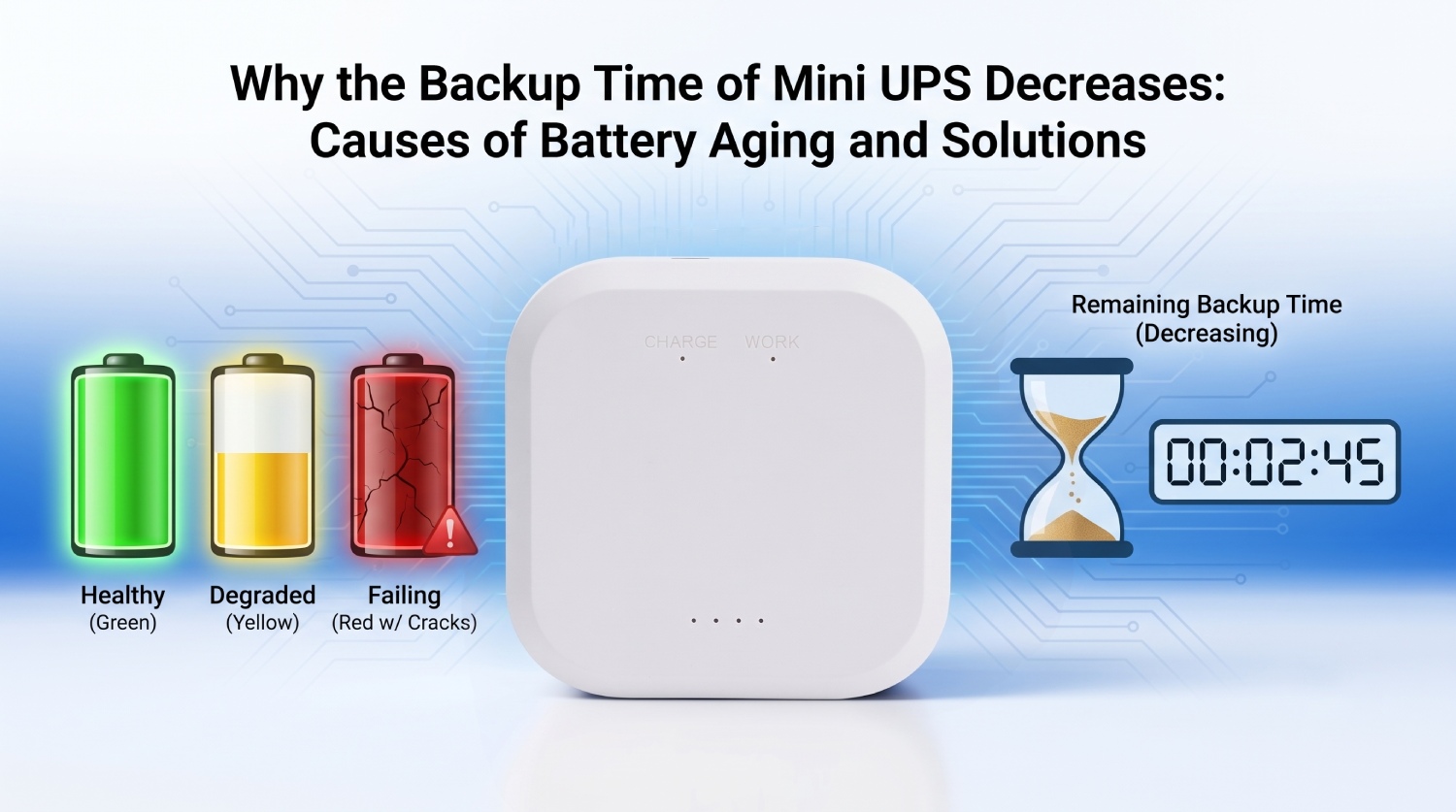
Every mini UPS used to protect routers, ONTs, modems, gateways, and CPE devices relies on an internal battery to deliver power the moment grid electricity drops out. Over repeated charge-discharge cycles, the usable energy that a battery can store and release naturally declines. This gradual reduction in available capacity is what is generally understood as battery aging, and it directly influences how long a mini UPS can keep a networking device running once main power is interrupted. For professional buyers evaluating backup power for telecom, ISP, broadband, fiber networking, or security applications, understanding this relationship is essential to avoiding avoidable selection risks.
Shanghai Mylion New Energy Co., Ltd., operating under the brand MYLION, has built its business specifically around this pain point: network equipment such as routers, modems, and ONTs often reboot or lose service during short power outages, voltage drops, or unstable grid conditions, and improper UPS selection regarding voltage, current, peak load, or connectors can lead to application failure. As a global B2B provider of Mini UPS products and DC backup power solutions, MYLION positions itself as a partner for telecom operators, Internet Service Providers, broadband network companies, fiber network operators, and system integrators who need dependable backup runtime even as batteries age over their service life.
Why Backup Time Depends on More Than Just Rated Capacity
Backup time is not determined by battery capacity alone. It is the product of the energy a battery can deliver and the actual working current drawn by the connected device. A mini UPS rated with a specific Wh capacity will provide a shorter runtime for a high-draw device and a longer runtime for a low-draw device, and as the battery ages and its effective capacity decreases, this gap between rated performance and real-world performance becomes more noticeable. This is why MYLION emphasizes evaluation of solutions based on real device voltage, working current, peak or startup behavior, and installation environment, along with technical confirmation and connector or cable matching, to reduce selection errors before deployment rather than after a battery has already aged in the field.
Battery Chemistry and Capacity Choices That Support Long-Term Reliability
MYLION’s product portfolio spans 12V DC systems up to 60W, incorporates LiFePO4 chemistry integration, and is expanding into USB-C PD 100W input and 65W output capabilities. LiFePO4 chemistry is used in select products, including the AC-input ML1202AC and the 24V/48V telecom backup direction represented by MU248, both of which are built around this chemistry to support demanding, long-term deployment scenarios.
Because MYLION’s battery capacities are documented in precise Wh values across its lineup, project customers can match a device’s real power draw against a battery’s rated energy with clarity. The 12V Standard Series, including MU26W (18.72Wh), MU48W (29.6Wh), and MU68W (44.4Wh), addresses entry-level to mainstream broadband backup needs. The 12V Long-Runtime Series, represented by MU635W and MU635L at 75.6Wh, is built for prolonged service continuity on standard CPE devices, which is particularly relevant in scenarios where extended runtime margin helps compensate for gradual capacity reduction over a battery’s service life.
For higher-load equipment, the 12V High-Power Series (MU65W) delivers 4A continuous output with 56.16Wh of battery energy, while the 12V High-Power Long-Runtime Series (MU35W/MU35L) combines 60W output with 75.6Wh capacity for professional gateways requiring both high peak current and long backup time. The 12V + USB Multi-Output Series, including MUJ46 (37.44Wh) and MUJ435 (50.4Wh), supports simultaneous backup for 12V and 5V devices within an 18W system limit, suited to small office and home office setups.
Matching Backup Power to Equipment Needs Over the Service Life of a Deployment
Selecting a mini UPS with adequate headroom in battery capacity relative to a device’s actual working current is one of the most direct ways project customers can plan for consistent backup performance across a product’s deployment lifetime. MYLION’s differentiated approach centers on this principle: rather than offering a single generic product, the company provides a structured range of series, each positioned for a specific combination of output current, energy capacity, and connector configuration, so that customers can select a model whose specifications align closely with the device it is protecting.
This same evaluation approach extends to MYLION’s development and project-evaluation directions. The MUC85, a USB-C PD Mini UPS under development, is designed for modern WiFi 6/7 devices requiring USB-C Power Delivery, with 92.16Wh of battery energy and dual USB-C outputs. The MU248, addressing higher-voltage wireless CPE and radio bridge equipment, uses LiFePO4 chemistry with independent 24V and 48V outputs and 102.4Wh of battery energy. Both directions reflect a continued focus on aligning battery energy and output specifications with the operating demands of the equipment being backed up.
Quality Assurance Supporting Consistent Backup Performance
MYLION’s products are supported by industry certifications including UN38.3 and MSDS on a model-specific basis, reflecting adherence to lithium battery transport documentation and compliance requirements. These certifications are part of the company’s broader emphasis on data security and compliance, giving project customers a documented basis for evaluating battery safety and handling requirements as part of their procurement process.
Technical Support and OEM/ODM Services for Project-Based Deployment
With 13+ years of experience in lithium battery technology and 10+ years of experience in Mini UPS development, MYLION offers B2B project support, OEM/ODM services, and sample validation. Its service scope includes requirement analysis, model matching, sample testing support, connector and cable matching, private labeling, and documentation coordination, along with managed pilot evaluation and mass-production preparation. This structured service model allows telecom operators, ISPs, distributors, brand owners, and OEM/ODM customers to validate a chosen mini UPS model against their specific equipment and power conditions before committing to large-scale deployment, which is particularly valuable when planning for consistent backup performance over the full service life of the batteries involved.
Conclusion
Battery aging is an inherent characteristic of lithium-based energy storage, and its effect on mini UPS backup time is a practical consideration for any organization deploying backup power across a fleet of network equipment. By offering a detailed range of 12V, LiFePO4, and USB-C PD products with clearly documented Wh capacities and output specifications, along with technical evaluation, connector matching, and OEM/ODM project support, MYLION provides project customers with the tools needed to select backup power solutions suited to both immediate device requirements and longer-term reliability expectations. More information on MYLION’s Mini UPS product range and project support services is available at http://www.myliontech.com.
http://www.myliontech.com
Shanghai Mylion New Energy Co.,Ltd. -
AuthorPosts

- You must be logged in to reply to this topic.