- This topic is empty.
-
AuthorPosts
-
2026-10-16 at 3:46 pm #12501
Ceramic Lined Flowmeter for High Solids Slurry: 6 Key Checks
Direct answer: A ceramic-lined electromagnetic flowmeter can be a feasible choice for high-solids slurry when the carrier liquid is conductive enough to produce a stable signal and mechanical abrasion is the dominant wear mechanism. It is not automatically the right choice, and the solids percentage alone cannot determine suitability. Whether ceramic lining works in a given line depends on particle hardness, size and shape, actual flow velocity, conductivity, temperature, pressure and liquid-phase chemistry, assessed together rather than one at a time.
This article explains where ceramic lining helps, where it does not, and what a buyer must measure before specifying a meter for slurry service.
Why High-Solids Slurry Is a Difficult Measurement Duty
Slurry is not simply "dirty water." It is a two-phase flow in which solid particles travel inside a conductive liquid, and each phase attacks the flowmeter differently.
Liner abrasion
Abrasion is mechanical, not chemical. Particles sliding along the pipe wall remove liner material progressively, and the wear rate depends on particle hardness relative to the liner, particle size, particle shape (angular vs. rounded), solids loading and — critically — flow velocity. Wear is usually worst at the inlet, at flange transitions and wherever the flow profile distorts.
Particle impact on electrodes
Electrodes sit flush with the wetted surface, so larger or harder particles strike them directly. Impact can cause two problems: physical erosion of the electrode surface, and short, sharp signal spikes as a particle disturbs the local electric field. These spikes show up as erratic readings rather than as an obvious failure.
Signal disturbance from solid particles
Even where the liner survives, particles crossing the electrode zone create transient noise sometimes described as "cuspidal disturbance." A meter without suitable signal conditioning can report unstable or jittery flow values in exactly the conditions where operators need dependable numbers.
Non-uniform and changing flow profile
Slurries are prone to settling at low velocity and to swirling, pulsating flow at higher velocity. Deposits on the pipe floor, entrained air, or uneven velocity distribution all shift the relationship between measured signal and true volumetric flow. A high-solids line therefore has to be specified for the velocity range it will actually run at, not only for its design maximum.
Solids Percentage Is Not a Selection Criterion
Buyers often ask for a maximum allowable solids concentration. There is no universal threshold, and any figure quoted without the other variables is meaningless.
Two slurries at the same solids percentage can behave completely differently:
- Hardness. Fine silica or mineral tailings can abrade a liner far faster than an equal mass of soft organic solids.
- Particle size. Coarse particles cause impact damage; very fine particles can polish a surface gradually across a large area.
- Particle shape. Angular, crystalline grains cut; rounded grains tend to roll.
- Abrasiveness as a system property. Hardness, size, shape and concentration combine with velocity to determine real wear.
- Carrier chemistry. pH, dissolved salts and temperature drive corrosion of electrodes and, in some cases, chemical attack on the lining itself.
A 20% solids stream of rounded, soft particles at low velocity may be a mild duty. A 5% stream of angular hard particles at high velocity may destroy a poorly chosen lining quickly. Concentration is one input among several — not a pass/fail test.
Process Data That Determines the Configuration
Before any liner or electrode material is proposed, these parameters should be established from the actual process, not from a nameplate:
| Parameter | Why it matters |
|—|—|
| Minimum, normal and maximum flow rate | Sets the real velocity range. Very low velocity risks settling; very high velocity accelerates abrasion. |
| Actual flow velocity | The single strongest driver of abrasive wear in slurry service. |
| Conductivity of the liquid phase | Electromagnetic flowmeters require a conductive liquid. A slurry whose carrier is non-conductive — or nearly so — cannot be measured by this principle regardless of lining material. |
| Temperature (normal and excursions) | Affects liner material selection, electrode behaviour and the electronics’ environment. Ceramic and elastomeric linings tolerate very different thermal conditions, including thermal shock. |
| Pressure and vacuum conditions | Influences lining thickness, bonding and the mechanical design of the sensor body. |
| Liquid-phase chemistry | Determines electrode material and whether the lining faces chemical attack in addition to abrasion. |
| Pipe size, orientation and straight-run available | Affects installability and flow profile quality. |
| Solids description | Particle size distribution, hardness, shape and typical concentration. |Where possible, the same data should be confirmed for startup, normal operation and upset conditions, because many liners fail during the abnormal events rather than in steady state.
What Ceramic Lining Does — and Does Not — Do
Ceramic lining is a material-wear answer. Technical ceramics are hard and dimensionally stable, which makes them attractive where fine, hard particles would otherwise erode a softer surface.
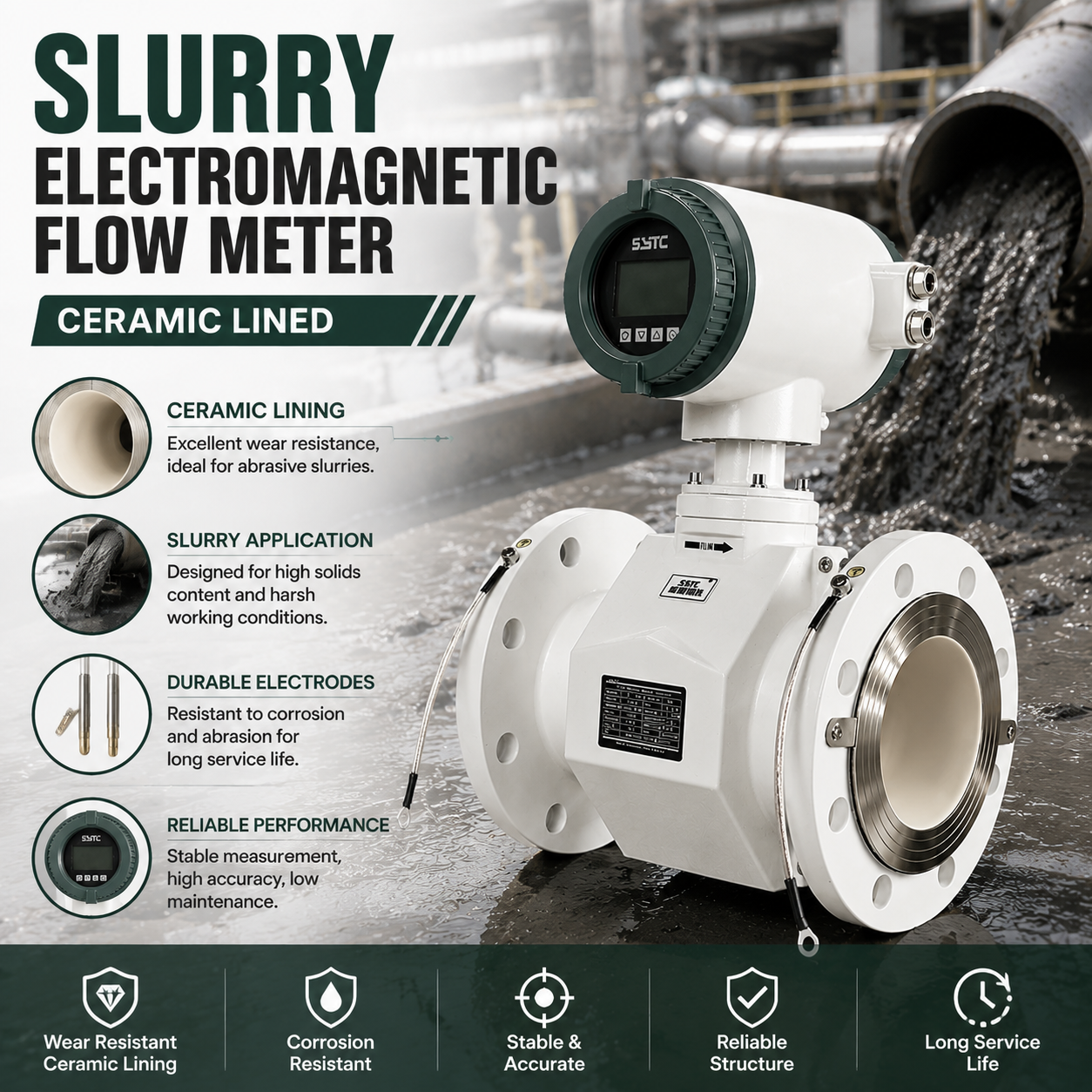
It does not:
- Make a non-conductive liquid measurable. If the carrier phase does not conduct, an electromagnetic flowmeter is the wrong instrument, whatever the lining.
- Guarantee stable readings in every slurry. Signal quality still depends on electrode design, grounding, signal conditioning and flow profile.
- Suit every particle regime. Hard, brittle linings can be vulnerable to impact from coarse or large particles, where an elastomeric lining such as polyurethane or rubber can absorb energy by deforming. Neither material is universally superior; the correct choice follows the particle spectrum and velocity.
- Come in every size and option. Ceramic lining is generally available across a narrower range of nominal diameters and pressure ratings than rubber or PFA, and electrode and output options can be restricted in ceramic-lined builds.
Grounding is also part of the picture in slurry service. Grounding electrodes or grounding rings help stabilise the reference potential in lined or non-conductive piping, and meters intended for abrasive slurries commonly apply suppression algorithms to filter spike disturbance from solid-grain friction.
Information to Provide Before Selection
A practical checklist to send with an enquiry:
- Line data: nominal diameter, pipe material and schedule, orientation, available straight-run upstream and downstream.
- Flow range: minimum, normal and maximum volumetric flow, plus any expected low-flow or no-flow periods.
- Solids: typical and maximum concentration, particle size distribution, particle hardness or mineral type, particle shape, and whether the stream is variable.
- Liquid phase: composition, conductivity, pH, chloride or other aggressive species.
- Conditions: normal and maximum temperature, thermal cycling, normal and maximum pressure, vacuum if applicable.
- Duty: continuous or intermittent, expected hours per year, cleaning regime (CIP, pigging, flushing).
- Outputs and integration: required analogue, pulse/frequency, RS485, or wireless connection to a monitoring platform, plus the control system it must talk to.
- Environment: indoor/outdoor, ambient temperature, washdown, submersion risk, and power availability at the point of installation.
- Standards: required flange standard, ingress protection rating, and any industry-specific compliance the site enforces.
With these inputs, a lining and electrode combination can be matched to the application instead of being guessed from a solids figure.
About Kaifeng Xinya Instrument Co., Ltd.
Kaifeng Xinya Instrument Co., Ltd. is a manufacturer of industrial flowmeters and flow calibration equipment. Its product range covers electromagnetic flowmeters for industrial, municipal and hygienic duties, including slurry-oriented configurations, together with battery-powered and remote-monitoring units.
Its ceramic-lined electromagnetic flowmeter configurations can be evaluated against actual application requirements — that is, against the line data, flow range, solids description, conductivity, temperature, pressure and chemistry described above. Availability should always be confirmed against current published product documentation for the exact configuration being quoted: ceramic lining is not offered across every nominal diameter, pressure rating, electrode material or output option in a product family, and Xinya’s documentation currently lists ceramic among custom lining options in defined size bands alongside various rubber linings.
Frequently Asked Questions
Does a higher solids percentage always mean ceramic lining is required?
No. Concentration tells you how much solid material is present, not how damaging it is. A modest percentage of angular, hard particles at high velocity can wear a liner faster than a much higher percentage of soft, rounded particles at low velocity. Hardness, size, shape and velocity should be weighed together with concentration.Can a ceramic-lined meter work if the slurry has almost no liquid?
Electromagnetic flowmeters measure a conductive liquid moving through a magnetic field. If the continuous liquid phase is insufficient or non-conductive, the meter has nothing reliable to measure, and lining choice cannot change that. These duties usually need a different measurement principle.Is ceramic better than polyurethane or rubber for slurry?
It depends on the particle spectrum. Ceramic offers high hardness for fine, hard-particle abrasion, while elastomeric linings such as polyurethane and rubber can absorb impact from coarser particles. For mixed or coarse slurries, both options deserve evaluation against the same process data.Will a ceramic-lined meter read steadily in every slurry?
Not automatically. Reading stability also depends on grounding, electrode configuration, signal conditioning and flow profile. Meters designed for slurry duty typically combine a suitable lining with spike-suppression processing and grounding provisions.Can a ceramic lining be supplied in any pipe size?
No. Ceramic-lined builds are generally concentrated in smaller and mid-range diameters, with more limited pressure and option availability than rubber or PFA. Confirm the exact size, rating, electrode and output combination against current documentation before specifying.Recommendation
There is no universal answer to whether a ceramic-lined electromagnetic flowmeter suits a high-solids slurry — only a verified answer for one specific line. Gather the process parameters listed above, confirm the slurry’s conductivity and particle characteristics, and submit those details for configuration review. The most defensible selection is the one made against measured data rather than an assumed solids percentage.
https://www.sytcflowmeter.com/
Kaifeng Xinya Instrument Co., Ltd. -
AuthorPosts

- You must be logged in to reply to this topic.