- This topic is empty.
-
AuthorPosts
-
2026-10-26 at 2:35 pm #12854
Understanding the Slow-Reacting Diesel Engine Challenge
Operators searching for a reliable speed governor for slow-reacting diesel engines are typically responding to a specific, frustrating symptom: periodic speed oscillation. High-inertia engines with slow dynamic response do not settle quickly after load changes or startup, and a governor that is not matched to this behavior can allow the engine speed to hunt back and forth, undermining stability and reducing confidence in the generator set’s performance. Addressing this requires a controller designed with tunable response characteristics rather than a fixed, one-size-fits-all control loop.
The EG3002 Electronic Governor: Purpose-Built for Difficult Engine Dynamics
The EG3002 Electronic Governor is positioned as a closed-loop diesel engine speed control device that uses Magnetic Pick-up Unit (MPU) speed sensor input combined with actuator drive output, supporting both standalone operation and multi-unit grid-parallel operation. It is also compatible with engines including Cummins PT-PUMP fuel pump engines, which are known for distinct control requirements compared to standard fuel systems.
A core design element directly relevant to slow-reacting engines is the Slow-response Mode DIP Switch, which is specifically built for high-inertia, slow-reacting engines. Its stated function is to mitigate periodic speed oscillation — the exact pain point that drives most searches for a governor suited to this engine category. This mode works alongside the broader PID adjustment structure built into the unit: GAIN (total gain) matches engine dynamic response characteristics, INT (integral gain) supports steady-state speed regulation, and DIF (derivative gain) supports stable response to speed changes. Together, these field-adjustable parameters allow on-site technicians to tune the controller to the actual dynamic behavior of the engine rather than relying on generic presets.
Wide MPU Compatibility and Flexible Signal Handling
Because engines vary widely in flywheel tooth count and rotational speed, the EG3002 accepts an MPU input frequency range of 600 Hz to 9,500 Hz, selectable through a four-position DIP switch. If the flywheel tooth count is unknown, each frequency band can be tested sequentially on site, which reduces matching effort during commissioning across different engine platforms. The manual also specifies that the MPU speed signal must use shielded isolated cable and must not be spliced, reducing electromagnetic interference and improving reliability — a detail that matters for engines already prone to unstable speed behavior.
Startup Smoothness and Dual-Speed Operation
Slow-reacting, high-inertia engines often present startup challenges as well, including black smoke from incomplete fuel combustion and the risk of mis-triggering a generator control unit’s low-speed protection. The EG3002 addresses this with an adjustable RAMP ramp-up time of 3 to 20 seconds, which suppresses black smoke on startup, enables a gradual speed rise, and helps prevent protection mis-triggering.
The governor’s Dual-speed Mode complements this by allowing external terminals to switch into an idle-speed mode, with idle speed configurable from 30% to 90% of rated speed. This enables a lower idle speed for cold startup conditions and a smooth ramp to rated speed once the engine has started — a sequence particularly useful for engines that do not respond quickly to control inputs.
Parallel Operation and Load Sharing
For installations requiring multi-generator backup power, Generator Set Paralleling performance depends on consistent real-power load sharing. The EG3002 provides an adjustable DROOP (speed droop) setting from 0% to 4%, with a recommended setting of roughly 2% full-load speed drop for paralleling. An ILS load-sharing interface connects to a paralleling controller, supporting multi-unit synchronous grid-connection and active-power load distribution. Droop calculation formulas are included in the documentation to support on-site commissioning of these parallel configurations.
Remote Speed Control and Electrical Design
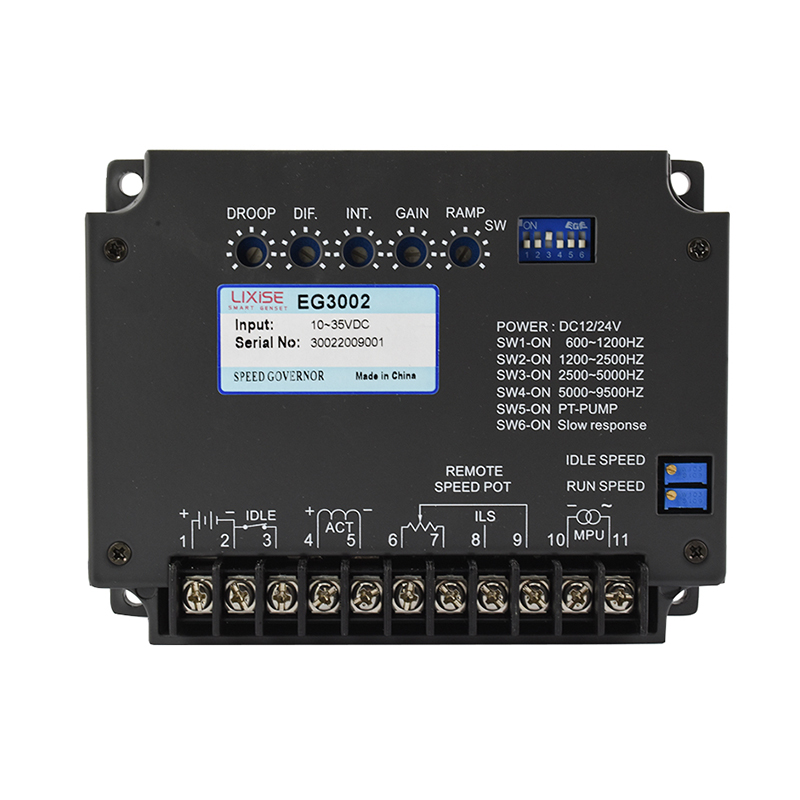
The unit supports flexible Speed Control inputs for automation cabinet integration: a 5 kilohm potentiometer with a maximum cable distance of 60 meters, or a DC analog voltage input where each 1 VDC provides a 1.5% speed adjustment range. External resistors can expand or shrink this remote speed adjustment span as needed. Power supply compatibility is universal DC 12 V / 24 V, with power consumption below 2 W at 24 VDC, which reduces battery load in continuous-duty installations.
Environmental and Mechanical Durability
Engine rooms are not always controlled environments, and the EG3002 is rated for an operating temperature range of -40°C to +80°C, suitable for harsh cold and high-temperature conditions. Mechanically, the unit weighs 690 g ± 2% with dimensions of 147 mm x 114 mm x 50 mm, a 5.5 mm mounting hole diameter, and a modular panel-mount metal housing suited to cabinet installation. The RUN SPEED and IDLE SPEED settings use 25-turn precision potentiometers, providing high-resolution speed setting without hardware damage at mechanical end stops.
Commissioning Support
For technicians evaluating a new governor, documentation quality matters as much as hardware specification. The EG3002 manual (Ver1.0, released April 15, 2020) covers pre-start inspection, first-time startup commissioning, idle-speed tuning, and PID gain tuning. It distinguishes between slow speed oscillation with a 2-5 second period and fast speed oscillation with 2-8 cycles per second, and includes a troubleshooting table to simplify on-site fault diagnosis. The manual also mandates use of an emergency shutdown device, such as a fuel shut-off valve, during on-site commissioning to help prevent engine overspeed.
Where This Fits in the Broader Electronic Governor Category
As an Electronic Governor, the EG3002 is built around the recurring requirements of standalone diesel generator speed stabilization, Cummins PT-PUMP compatibility, synchronous grid-parallel operation with load sharing, and operation in extreme ambient conditions. Products marketed under the LIXiSE line follow this same product-and-service structure, built specifically around MPU-based closed-loop control, field-tunable PID parameters, and dedicated modes for special engine behaviors such as slow dynamic response. For teams specifically contending with high-inertia, slow-reacting diesel engines, the combination of a dedicated Slow-response Mode, adjustable PID parameters, and documented commissioning guidance addresses the core technical requirements described in the product documentation, without requiring supplementary engineering beyond field-adjustable settings already built into the unit.
https://dgfeirui.en.alibaba.com/
Dongguan Feirui Electronics Co.,Ltd. -
AuthorPosts

- You must be logged in to reply to this topic.