- This topic is empty.
-
AuthorPosts
-
2026-10-28 at 5:14 pm #13019
Defining Battery Requirements for Robotics with Motor Loads
The Hidden Complexity Behind Robotics Battery Selection
As robotic systems become more deeply embedded in industrial automation, smart manufacturing, and field operations, the demand for reliable, device-matched power solutions has grown significantly. Unlike consumer electronics, robotics platforms—particularly those driving motors, actuators, and multi-sensor arrays—impose a unique and often underestimated set of demands on their battery systems.
The core challenge is not simply selecting a battery with a high enough voltage or capacity rating. It is the intersection of peak-current dynamics from motor startup, continuous runtime under variable load, thermal behavior within a compact mechanical enclosure, BMS communication requirements, and the safety certifications needed for global transport and deployment. When any one of these factors is handled in isolation, the result is typically a mismatch: a battery that trips its BMS during motor inrush, a pack that overheats under sustained load, or an assembly that physically cannot fit the robot’s chassis.
Industry experience consistently shows that equipment manufacturers developing robotic platforms lose significant time and resources due to incomplete or conflicting battery requirements defined too early—or not defined rigorously at all. Recognizing this gap, engineering-oriented suppliers like MYLION (Shanghai Mylion New Energy Co., Ltd.) have built structured methodology specifically around translating complex robotics use cases into validated battery specifications before any sample is produced.
A Structured Framework for Defining Robotics Battery Requirements
Defining battery requirements for robotic systems with motor loads requires treating the battery not as a standalone component but as an integrated subsystem. The following technical dimensions represent the full scope of what must be reviewed and confirmed.
Electrical Architecture and Load Profiling
The first step is characterizing the actual electrical load the battery must support. For robotics, this means distinguishing between the continuous current draw of motors during normal operation and the peak inrush current during startup or directional change. Standard battery pack ratings often reflect only steady-state discharge; they do not account for the brief but intense current spikes that motor loads generate. If the BMS protection threshold is set below these peak values, the system will trip unexpectedly—a critical failure mode in autonomous or semi-autonomous robots.
From this load profile, the correct series and parallel cell configuration can be determined. Voltage must match the motor drive system’s input requirements, while total capacity must support the required runtime under the defined load cycle. MYLION’s engineering process specifically addresses custom series/parallel configuration, ensuring that pack architecture is derived from real device measurements rather than generic assumptions.
Chemistry and Cell Format Selection
Not every cell chemistry or format is appropriate for every robotics application. LiFePO4 chemistry offers thermal stability and long cycle life—advantages that matter in high-use industrial robots—but its flat discharge curve and specific charging requirements mean that the charger and BMS must be evaluated together. 18650 and 21700 cylindrical cells provide high energy density in compact cylindrical formats, suited for robots where space constraints are severe but current handling is moderate. LiPo cells enable custom form-factor designs, useful when the robot chassis demands a non-standard battery shape.
The selection of cell chemistry and format must be validated against the actual operating environment: temperature range during motor operation, duty cycle, vibration exposure in field-use robots, and whether the device will be transported internationally (triggering UN38.3 documentation requirements). Skipping this chemistry review and defaulting to a "generic LiFePO4 replacement" is one of the most cited causes of charger or BMS incompatibility in robotics deployments.
BMS Function Matching
The Battery Management System is not a universal component. For robotics applications, the BMS must be evaluated against: overcharge and over-discharge protection thresholds, continuous and peak discharge current ratings, cell balancing strategy, communication interface requirements (if the robot’s controller needs state-of-charge data), and the specific inrush tolerance needed during motor load spikes. Mismatched BMS protection settings are a direct cause of unexpected shutdowns in robotic systems—a failure that is difficult to diagnose without tracing the original requirement definition.
Mechanical and Interface Integration
Defining battery requirements for robotics also involves confirming the physical form of the pack: enclosure dimensions relative to the chassis, connector type and pinout matched to the robot’s internal wiring, cable routing and length, and mounting or retention mechanism. In compact robotic devices with strict shape and cable-routing constraints, standard packs frequently create mechanical conflicts or assembly inconsistencies that delay production.
MYLION’s engineering approach reviews enclosure, mounting, and connector design as a unified assembly task—not a secondary consideration—ensuring that the mechanical integration is resolved before mass production begins.
Emerging Considerations in Robotics Battery Engineering
As robotic platforms evolve toward higher autonomy, longer field deployment, and more demanding operational cycles, battery requirement definition is becoming an increasingly specialized discipline. Several trends are shaping how this process must be approached.
Thermal management is becoming a primary design criterion. High-density motor loads generate heat both in the motor driver and within the battery pack. Systems without adequate thermal review during the requirement definition stage face accelerated capacity degradation and potential safety concerns under sustained operation.
Compliance requirements are tightening globally. International transport of lithium battery-powered robotics equipment requires UN38.3 documentation and MSDS/SDS safety data sheets. These requirements must be incorporated into the battery development process from the beginning, not retrofitted after engineering is complete.
Standardization in BMS communication is increasing. As robots become networked and data-driven, the ability of the battery BMS to communicate state-of-health, remaining runtime, and fault codes to the main controller is transitioning from optional to expected. Battery requirement documentation must now capture communication protocol specifications as a defined parameter.
How MYLION Supports Robotics Battery Engineering
MYLION approaches battery development for robotics and industrial automation as a controlled engineering process, not a catalog selection exercise. With more than 13 years of lithium battery industry experience, the company has evolved from standard battery-pack supply toward a structured custom-battery engineering model that begins with requirement definition and ends with change-controlled mass-production delivery.
In robotics applications specifically, MYLION has addressed integration challenges involving peak-current and thermal constraints in limited-space platforms supporting sensors and motors. The company’s service scope covers requirement analysis, feasibility review, solution definition, prototype development, testing support, specification approval, and mass-production coordination—a complete chain that systematically reduces the technical blockers most commonly encountered when battery and robot design teams work in isolation.
MYLION supports OEM, ODM, sample development, private label, and project-based custom supply models, with technical expertise spanning LiFePO4, 18650/21700 cylindrical, and LiPo battery architectures. Its compliance documentation support, including UN38.3 transport requirements, ensures that international robotics customers can meet logistics and safety requirements without delays. More information is available at http://www.mylionbattery.com.
Industry Recommendations for Robotics Equipment Manufacturers
Defining battery requirements for robotic platforms with motor loads is an engineering discipline that demands structured methodology, not ad hoc component selection. Based on the technical framework outlined above, the following recommendations apply to equipment manufacturers, product brands, and system integrators entering this process:
Start with load characterization, not catalog browsing. Document peak and continuous motor current requirements, runtime targets, and operating environment conditions before engaging any battery supplier. Without this data, specification errors are nearly unavoidable.
Treat the battery, BMS, charger, and mechanical structure as a single system. Evaluating each element independently leads to integration failures. Engage suppliers who review all four dimensions together.
Confirm chemistry selection against the full operating scenario. Voltage, capacity, and cycle life ratings from a datasheet are insufficient. Thermal behavior, charge compatibility, and transport compliance must be validated in the context of the final device.
Build change control into your development process. Specification freeze and version-controlled documentation before mass production prevent costly late-stage revisions. Suppliers who provide controlled specifications and BOM management reduce long-term supply risk.
Plan for compliance early. UN38.3 and MSDS documentation requirements are non-negotiable for international deployment. Including compliance review in the requirement definition phase eliminates downstream certification delays.
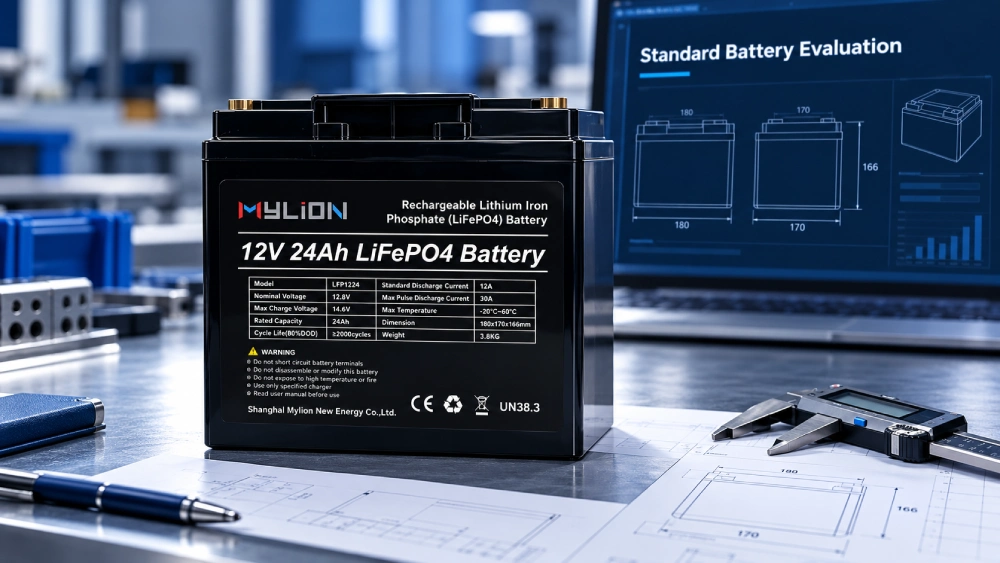
Robotic systems place some of the most demanding requirements on their power subsystems. A rigorous, system-level approach to battery requirement definition is not a premium option—it is a prerequisite for reliable, repeatable performance in the field.
Shanghai Mylion New Energy Co.,Ltd. -
AuthorPosts

- You must be logged in to reply to this topic.