- This topic is empty.
-
AuthorPosts
-
2026-10-28 at 8:47 pm #13074
Big Heat in Tiny Spaces: PTC Heating for Compact Small Appliances
Compact appliances argue the same three-way trade in every design review: heat fast, hold the temperature precisely, and stay safe inside an enclosure barely bigger than a hand. Full-size cabinets have room to compromise. An egg steamer, a hair curler or a hot glue gun does not.
Pinghu Xuyang Electronic Technology Co., Ltd. — Warmxuyang — builds PTC ceramic heating components for exactly that space, where a conventional element is too bulky, too hot, or too dependent on external control to trust.
Why compact appliances are a harder thermal problem
A cabinet heater has volume to spare; a countertop appliance does not. The element shares the housing with a motor, a PCB and a moulded shell, and every millimetre is already spoken for. The surface also has to stay touchable while the product is carried and put down, so an element that keeps climbing after the switch is off is a liability.
Control cost closes the argument. A wire-wound element has no intrinsic limit, so the appliance needs a thermostat, a thermal fuse and a control loop just to stay in range — three more parts, three more failure points, three more lines on the bill of materials.
What PTC ceramic heating changes
PTC ceramic is a resistive material whose resistance rises steeply near its Curie temperature. Driven at a fixed voltage, its power falls away as it heats, so the element settles at a stable operating point instead of running away.
In Warmxuyang’s components the dry-burn surface stays below 280 °C: no red-hot wire, no open ignition path, and self-limiting behaviour even if the control electronics fail. Add more than 10,000 hours of service life and a core that can be engineered to almost any footprint, and the element stops being the constraint in the design.
Four appliances, one heating principle
The same element behaves differently in each product, which is why the four cases are worth separating.
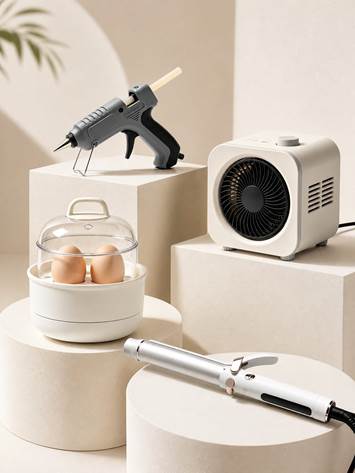
Around the house: hot glue gun, egg steamer, hot/cold fan and hair curler — four very different thermal envelopes, one PTC heating principle.
Egg steamers. Steam is only as good as the heater under it. A PTC plate comes up fast and then holds a temperature that gives steady steam instead of a burst and a slump — no need to overshoot the set point, and no pool of condensing water under the eggs.
Hair curlers and straighteners. Heat has to arrive fast and then stay put: a barrel that drifts hotter burns hair even when the timing is right. A self-regulating element reaches working temperature in seconds and holds it, so the surface stays in its band while the tool waits in its stand.
Hot/cold fans. A compact PTC core sits in the airflow without strangling it, giving useful heat from an enclosure the size of a lunchbox; in summer the same fan runs as a cooler with the heater off.
Hot glue guns. The tightest case of the four: adhesive has to melt in minutes, must not char on the nozzle, and everything lives in a handle. A small self-limiting element gets there quickly and holds, so the glue stays workable between jobs.
Designed into the housing, not bolted onto it
Heating components for small appliances are rarely catalogue parts. Element, insulation, terminals and mounting are designed together, because the space left after the battery, motor and PCB is an awkward shape rather than a neat rectangle. Warmxuyang’s non-standard service covers structural calculation and solution optimisation, with a proposal in about a week, and custom voltage from 5 V to 240 V lets one heater family run from a battery pack or from mains.
· Dry-burn surface below 280 °C, self-limiting by material
· Service life above 10,000 hours
· Custom voltage 5–240 V, with power and footprint matched to the cavity
· Custom geometry — element, insulation, terminals and mounting designed as one part
· Quality system ISO 9001:2015, with CQC, CE and SGS certification
Safety, certification and supply
For a consumer product, safety is a test result rather than a slogan: surface temperature, abnormal operation and material flammability have to be demonstrated against the standards of the market the appliance is sold into. Warmxuyang’s components are produced under ISO 9001:2015 and carry CQC, CE and SGS certification, and the company holds National High-Tech Enterprise status.
Capacity backs the paperwork: a 2,000-square-metre factory with more than 100 machines, 20,000 sets a day and above 7 million units a year, supplied as a direct-source factory for OEM and ODM programmes.
Conclusion
Compact appliances ask a heating element to heat quickly, hold a temperature and fail safely in very little room. PTC answers all three from the material itself.
If the heating element is the part that will not fit, send the envelope, the target temperature and the market you are selling into — a proposal usually comes back within a week.
https://www.warmxuyang.com/
Pinghu Xuyang Electronic Technology Co., LTD. -
AuthorPosts

- You must be logged in to reply to this topic.