- This topic is empty.
-
AuthorPosts
-
2026-10-30 at 10:36 am #13139
Adding imaging capabilities to an embedded device does not necessarily require a large camera or a complicated installation. In many industrial and electronic applications, developers need a compact camera that delivers sufficient image detail, supports different operating systems, and integrates easily with existing hardware.
A 5MP USB camera module can be a practical option for projects that require clearer image capture without significantly increasing equipment size. One example is the ELP-USB500W02M-AF60, a 5MP OV5640 UVC CMOS USB camera module featuring an autofocus lens and USB 2.0 connectivity.
Designed for applications involving Raspberry Pi, Android, Windows, and Linux systems, this module combines several useful imaging features in a compact board format.
1. 5MP Imaging for Space-Constrained Applications
Image resolution is an important factor when selecting a camera for industrial monitoring, embedded devices, and machine vision-related applications. A camera needs to capture enough detail for the intended task while remaining compatible with the processing capabilities of the host system.
The ELP-USB500W02M-AF60 is equipped with a 1/4-inch OV5640 CMOS image sensor and supports a maximum resolution of 2592 × 1944 pixels. Compared with basic low-resolution camera modules, its 5MP capability provides more image detail for applications that require clearer visual information.
The board measures approximately 38 × 38 mm, with a compatible 32 × 32 mm installation size. This compact design makes it easier to incorporate the camera into equipment with limited internal space.
For product designers, a small board camera can also provide more flexibility in positioning the imaging component within a device enclosure.
2. Why Autofocus Matters in Embedded Camera Applications
The focusing method can influence how effectively a camera performs in different working environments.
A fixed-focus camera is generally suitable when the subject remains at a consistent distance. However, applications involving moving objects, changing working distances, or different inspection positions may benefit from an autofocus solution.
The ELP-USB500W02M-AF60 features an autofocus lens, allowing the camera to adjust focus according to the subject distance. It uses an AF60 lens with an approximate horizontal field of view of 51 degrees.
This configuration can be useful when developers need to capture a specific working area rather than monitor a very wide scene. When selecting an autofocus camera, buyers should still consider the actual working distance, object size, lighting conditions, and focusing requirements of the application.
3. UVC Compatibility Simplifies System Integration
Hardware compatibility is another major consideration when choosing an embedded USB camera. Developers need to know whether the camera can communicate with the target platform and whether additional drivers or software development work will be required.
The ELP 5MP camera uses the USB Video Class (UVC) protocol. UVC is a widely supported standard that allows compatible cameras to work with many operating systems without requiring a proprietary camera driver in common configurations.
According to ELP, the module supports Windows, Linux, macOS, and Android platforms. It can also be used with compatible Raspberry Pi systems.
This makes the UVC USB camera module suitable for developers working with different hardware platforms, from desktop computers to single-board computers and embedded devices.
However, actual compatibility should be verified against the host system, operating system version, USB interface, and application software before deployment.
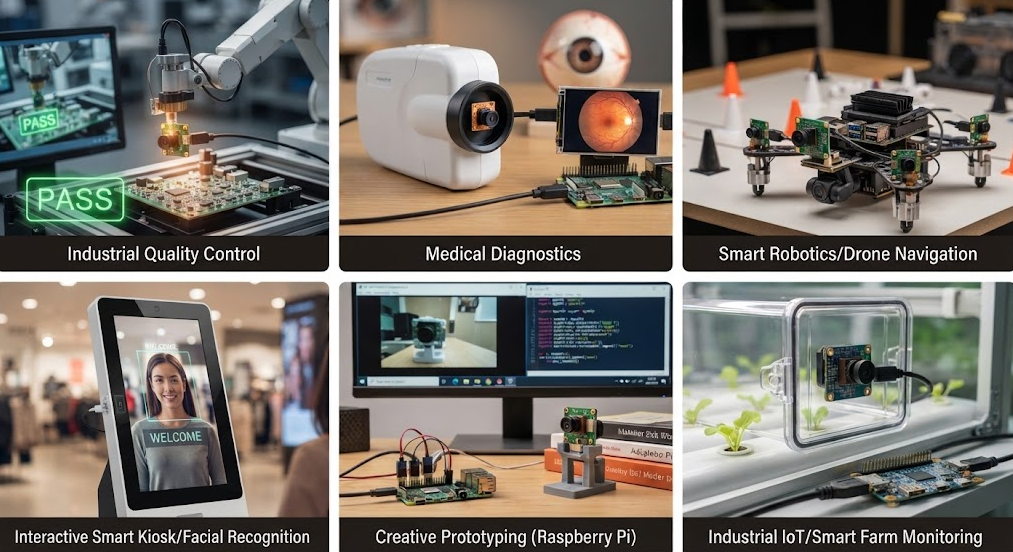
4. Applications Across Industrial and Embedded Equipment
Compact USB camera modules are used in a wide range of electronic products because they can be integrated directly into equipment rather than installed as separate webcams.
The ELP-USB500W02M-AF60 may be considered for applications such as:
-
Industrial machine monitoring and equipment inspection
-
Security and surveillance devices
-
Raspberry Pi imaging projects
-
Android-based embedded systems
-
Portable video and communication equipment
-
Automated equipment with integrated imaging functions
-
Educational and experimental development projects
-
Medical auxiliary equipment requiring image capture
For equipment manufacturers, the main advantage of a board-level camera is its integration flexibility. The module can be positioned inside a product enclosure and connected to the main control system through USB.
The final application suitability will depend on factors such as image quality requirements, installation conditions, lighting, and software compatibility.
5. Video Resolution, Formats, and Frame Rate
A camera's maximum resolution is only one part of its performance. Video format and frame rate also influence how the camera can be used.
The ELP-USB500W02M-AF60 supports MJPEG and YUYV output formats. Its listed video performance includes:
-
2592 × 1944: up to 15 fps in MJPEG
-
1920 × 1080: up to 30 fps in MJPEG
-
1280 × 720: up to 30 fps in MJPEG
These options allow developers to select a suitable balance between image detail and video smoothness.
For example, equipment monitoring and video communication may benefit from 1080p at 30 fps, while applications focused on capturing finer image details may make better use of the maximum 5MP resolution.
The appropriate configuration depends on the host processor, available bandwidth, storage capacity, and the requirements of the imaging software.
6. Power Consumption and Operating Conditions
Power requirements and environmental conditions should also be reviewed before integrating a camera into an embedded product.
The ELP-USB500W02M-AF60 receives power through its USB connection and operates at DC 5V. Its listed power consumption is approximately 150 mW at VGA resolution and 200 mW at QSXGA resolution, with an active current of around 140 mA.
The module weighs approximately 30 g and has a listed operating temperature range of -20°C to 70°C.
These characteristics can be useful in projects where installation space, power availability, and operating conditions need to be considered together. Nevertheless, equipment designers should evaluate the actual enclosure temperature, ventilation, and power supply stability under real operating conditions.
7. Key Factors to Check Before Purchasing a USB Camera
Choosing a 5MP autofocus USB camera module involves more than comparing sensor resolution. A camera that works well in one application may not be suitable for another because of differences in lens requirements, installation conditions, or system architecture.
Before purchasing, developers and equipment manufacturers should evaluate several factors:
-
Image sensor and resolution: Determine whether the available image detail meets the application's requirements.
-
Lens and field of view: Check the viewing angle and working distance to ensure the target area can be captured properly.
-
Focus method: Decide whether fixed focus or autofocus is more suitable for the operating environment.
-
Interface and protocol: Confirm USB connectivity and UVC compatibility with the host platform.
-
Video formats and frame rates: Make sure the selected output configuration can be processed by the system.
-
Physical dimensions: Check board size, mounting points, cable routing, and enclosure clearance.
-
Power and environmental conditions: Verify voltage, current, operating temperature, and actual installation conditions.
Taking these factors into account can help reduce integration problems during prototype development and later production.
ELP USB Camera Modules for Different Development Requirements
ELP is a camera brand operated by Shenzhen Ailipu Technology Co., Ltd., which has more than 20 years of experience in USB camera manufacturing. Its product range covers different image resolutions, sensors, interfaces, lenses, and camera configurations for industrial and embedded applications.
In addition to standard USB camera modules, the company provides OEM and ODM customization services. These options may be relevant to manufacturers that require particular board dimensions, lens specifications, cable configurations, or other camera adjustments for their products.
For businesses developing embedded imaging equipment, working with a manufacturer that offers multiple camera configurations can make it easier to identify a suitable solution as project requirements become more specific.
More information about ELP and its camera solutions is available on the ELP official website and the company profile page.
Conclusion
Selecting an embedded camera requires balancing image quality, focusing performance, connectivity, physical size, and system compatibility. A high-resolution sensor alone does not guarantee a successful integration if the lens, interface, or video output does not match the application.
The ELP-USB500W02M-AF60 combines a 5MP OV5640 CMOS sensor, autofocus lens, USB 2.0 interface, UVC support, and compact 38 × 38 mm board design. With compatibility options for Raspberry Pi, Android, Windows, and Linux systems, it provides a flexible imaging solution for various industrial and embedded projects.
For developers and equipment manufacturers looking for a 5MP OV5640 USB camera module, this model is worth evaluating when compact installation, autofocus capability, and straightforward USB integration are important requirements.
https://www.hdusbcameras.com/where-the-elp-5mp-ov5640-usb-module-fits-best.html
http://www.hdusbcameras.com
Shenzhen Ailipu Technology Co.,Ltd -
-
AuthorPosts

- You must be logged in to reply to this topic.