- This topic is empty.
-
AuthorPosts
-
2026-11-06 at 9:21 am #13418
Ask field engineers what causes most industrial router problems, and power comes up again and again. A supply that sags when a pump starts, a battery that runs down overnight, a vehicle that sends a spike through its electrical system when the engine cranks, an installer who connects the wires the wrong way round. A router can have the best cellular module in the world and still fail every day if its power arrangement does not fit the site.
When ordering from a 4G industrial router factory, power is therefore one of the first things to specify. This guide explains the main power options available on industrial 4G routers, when each makes sense, and how they are implemented across the E-Lins 4G range.
Option 1: Wide-Range DC Input
What it is
An input stage that accepts a broad span of DC voltages, so the same router can run from a 12V battery, a 24V cabinet rail, or other supplies without an external converter.
When it matters
Almost always in industrial settings, and especially where supply voltage fluctuates or varies between sites.
E-Lins implementation
Many E-Lins 4G routers, such as the H900t, accept 5 to 40V DC as standard, with a 5 to 60V DC option. The H685t accepts 5 to 40V DC by default, with a wider range available. Wide-voltage input is also offered as a modular add-on, and the M300t serial modem is specified with a wide-voltage DC input. In a large deployment for a leading Indian telecom operator, E-Lins equipment operated at sites where supply voltage fluctuated between 5V and 55V, reaching a 99.4% equipment online rate.
Option 2: Input Protection
What it is
Circuitry that protects the router from transients, reverse polarity, over-current, and over-voltage.
When it matters
Wherever installers connect power by hand, wherever motors and switching equipment share the supply, and wherever lightning-induced surges are possible.
E-Lins implementation
E-Lins lists transient and reverse-polarity protection, plus over-current and over-voltage protection, on its industrial routers.
Option 3: Dual Power Inputs
What it is
Two separate power inputs, with automatic switchover if the primary supply fails.
When it matters
At critical sites where a mains adapter and a battery or second supply can both be connected, or where the router must keep running during maintenance of one supply.
E-Lins implementation
Dual power inputs with automatic failover are available on models such as the H900t.
Option 4: Power over Ethernet In
What it is
The router is powered through its Ethernet cable from a PoE switch or injector, so a single cable carries both data and power.
When it matters
Pole-mounted and ceiling-mounted installations, outdoor CPE units, and any location far from a power socket.
E-Lins implementation
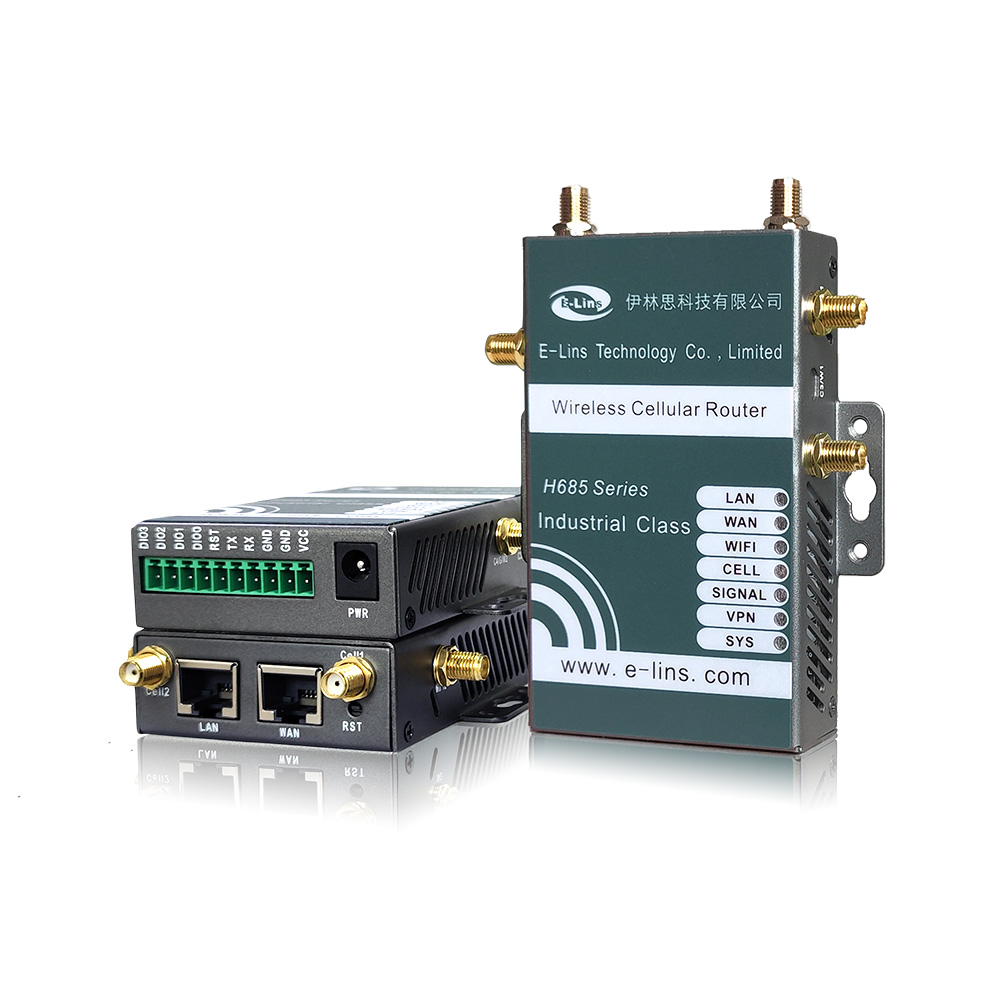
The H820QOt outdoor CPE has a built-in IEEE 802.3af/at PoE powered-device interface, so it can be powered from a cabinet at the foot of the pole. The H685t-P1 and H820t-P1 are 4G routers powered by PoE. The H900t supports passive PoE, and PoE is an option on the H685t.
Option 5: Power over Ethernet Out
What it is
The router supplies power to connected devices such as cameras, access points, or sensors.
When it matters
Camera sites and small cabinets where removing a separate PoE switch and power supply simplifies installation.
E-Lins implementation
The H820t-P2 provides active PoE Out with Modbus support and DIN-rail mounting, and the H900t-P2 combines PoE Out with dual SIM. Plan the power budget for connected devices carefully, including cold-start current for outdoor cameras with heaters.
Option 6: Ignition Sensing for Vehicles
What it is
An input that lets the router follow the vehicle’s ignition state, combined with protection against the electrical transients typical of vehicle supply lines.
When it matters
Buses, trucks, service vehicles and mobile equipment.
E-Lins implementation
The H900t, E-Lins’s H900 Gigabit Industrial 4G Router, is compliant with ISO 7637-2, the international standard for electrical transient conduction along supply lines in road vehicles, and includes ignition sensing. A Nordic public transport provider using E-Lins equipment for in-vehicle networking reduced network interruption to 0.3% in winters down to -32°C.
Power Consumption: Sizing Solar and Battery Sites
For off-grid sites, the router’s consumption decides how large the solar panel and battery must be. The H685t draws around 1.2 W at idle, around 2 W on average, and around 2.5 W at maximum at 12V DC. When sizing a system, use average consumption for daily energy, maximum consumption for the supply rating, and add the consumption of every connected device. Leave a margin for cloudy days and battery ageing.
Matching Power Options to Site Types
Site type
Recommended power arrangement
E-Lins 4G options
Indoor cabinet with stable supply
Wide-range DC with protection
H685t, H820t
Critical site with backup supply
Dual power inputs with failover
H900t
Pole or ceiling mount
PoE In from a ground-level switch
H820QOt, H685t-P1, H820t-P1
Camera cabinet
PoE Out with budget for cameras
H820t-P2, H900t-P2
Vehicle
ISO 7637-2 protection and ignition sensing
H900t
Solar or battery site
Low average consumption, wide input range
H685t, M300t
Common Power Mistakes
Sizing for average, not peak. A supply that handles average draw may fail when cameras with heaters start on a cold morning.
Ignoring the vehicle environment. A router without vehicle-grade protection may survive the bench and fail on the bus.
Forgetting the second input. Dual power inputs only help if a second supply is actually connected.
Long DC cable runs. Voltage drops along thin cables; check the voltage at the router, not at the power supply.
Mixing up PoE In and PoE Out. Order the variant that matches the site: a router powered by PoE cannot power cameras, and vice versa.
The Rest of the Router
Power is the foundation; the rest of the router must also be built for the site. E-Lins specifies industrial-grade components rated from -35°C to +75°C, 15KV ESD protection and 1.5KV electromagnetic isolation, and builds in hardware watchdog timers and link self-healing so that routers recover automatically after a power disturbance. Firmware is developed in-house with lifetime free upgrades.
The Factory
Shenzhen E-Lins Technology Co., Ltd. produces its routers in its own SMT factory and assembly lines in Shenzhen and supplies customers in more than 150 countries and regions, with desktop, wall-mount, and DIN-rail mounting kits available. When ordering from a 4G industrial router factory, specify the power arrangement for each site type as carefully as the cellular features. It is one of the cheapest ways to avoid failures in the field.
https://e-lins.com/
Shenzhen E-Lins Technology Co., Ltd. -
AuthorPosts

- You must be logged in to reply to this topic.