- This topic is empty.
-
AuthorPosts
-
2026-11-26 at 7:01 pm #14256
Choosing the right AC hose crimper is a decision that directly affects the leak-free performance of every finished hose assembly a shop produces. Whether the application is under-hood automotive repair, mobile field service, or bench assembly, the crimping tool must consistently deliver controlled, measurable crimp geometry across different hose constructions. Below are the key factors technicians and service managers should evaluate, illustrated through the engineering approach taken by NANJING IGEELY TOOLS CO.,LIMITED, maker of the iGeelee brand of hand-operated and manually actuated A/C hose crimping tools.
1. Hose and Fitting Compatibility
The first factor is whether the crimper supports the hose standards actually used in the shop. Industry work frequently involves both standard two-braid rubber hose and reduced-diameter nylon barrier hose, and these constructions require different crimp diameters and tolerances. A capable crimper should be compatible with SAE J51 A2 two-braid all rubber hose as well as SAE J2064 two-braid and reduced diameter nylon barrier hose. iGeelee’s Modular Hose Crimping System and 71500 Auto A/C Hose Crimper are both built around this dual compatibility, with standard crimp dies covering #6, #8, #10, and #12 hose sizes, including reduced-barrier variants for each size. This breadth matters because a shop servicing mixed vehicle fleets cannot afford a tool limited to a single hose family.
2. Crimp Force, Tolerance, and Measurability
A second, and arguably more technical, factor is whether the tool can actually achieve and verify a leak-free crimp. Crimping is not simply about squeezing a ferrule onto a hose; it requires precise, repeatable compression within tight tolerances. The Modular Hose Crimping System delivers up to 7,000 pounds of force and requires approximately 100 foot pounds of torque to fully close the jaws, giving operators a concrete target for complete closure. It also defines crimp diameter and hose wall thickness specifications for each hose size—for example, a #06-5/16" I.D. reduced diameter crimp targets .556" +/- .012", while a #12-5/8" I.D. 2-braid crimp targets 1.015" +/- .012". The system further recommends averaging three measurements around the center crimp ring to confirm the crimp falls within tolerance. This kind of built-in verification process is a meaningful differentiator, because it allows technicians to document crimp quality rather than relying on visual judgment alone.
The 71500 Auto A/C Hose Crimper takes a different but complementary approach suited to manual, non-powered operation. It applies 8T of force with a 15 mm trip across a pressure range of 3/8-7/8, using point hexagonal confining pressure to form the crimp, and specifies hydraulic oil No.7-32 for proper lubrication and maintenance. A finish line positioned approximately 1/8 in from the bottom yoke gives the operator a visible reference for judging required compression, which is a practical way to standardize crimp depth without instrumentation.
3. Operating Method: Manual Versus Powered Actuation
A third factor is how the tool is actuated, since this affects both portability and risk of damage. Some crimpers are designed to work with a 1/2 in drive air impact wrench, ratchet, or breaker bar, as with the Modular Hose Crimping System, giving shops flexibility to use common shop air tools or hand tools depending on what is available. Others, like the 71500 Auto A/C Hose Crimper, are operated manually through an arbor screw, explicitly avoiding impact or power drivers. This manual approach protects both the tool and the operator from the risks associated with uncontrolled power-tool torque, and it suits technicians who prioritize deliberate, controlled crimping over speed.
4. Access and Mounting Flexibility
Confined under-hood space and complicated hose-end shapes are recurring challenges in A/C hose service. A crimper’s die holder design directly determines whether it can reach these areas. The Modular Hose Crimping System features a removable die holder with latch plate, enabling access to special shapes and tight installations, while a spring-loaded locator flag positions the ferrule end for correct crimp location. Mounting flexibility matters as well: this system supports bench mount flange and pipe nipple, bench vise mounting, and on-vehicle operation with a 12 in minimum extension to the pipe nipple, allowing field service without removing hose assemblies from the vehicle. The 71500 Auto A/C Hose Crimper, by contrast, uses an open yoke with a removable pin for quick loading of hose and fitting assemblies, which supports fast turnaround when working through multiple jobs.
5. Die Changeover Speed and Identification
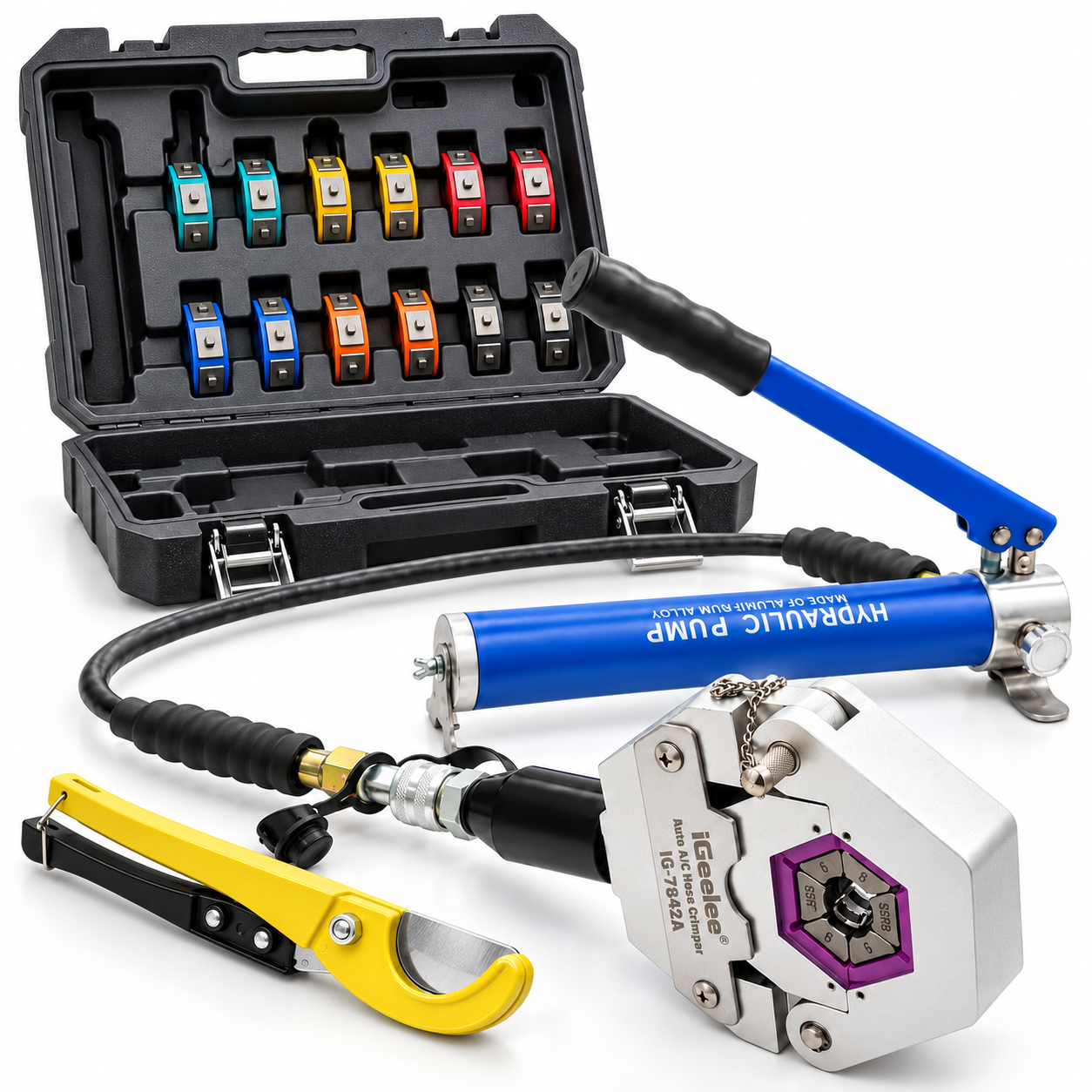
Shops handling multiple hose sizes need a system that minimizes downtime during die changes. A tool-free die change—achieved by squeezing the outer segments of each die half to remove it from the pins—reduces setup time considerably. Color coding also plays a practical role: iGeelee’s replaceable, flexible, color-coded polyurethane die carriers on the Modular Hose Crimping System, and the color-coded dies on the 71500 unit—#6 purple, #10 yellow, #8 red, #12 green—allow technicians to identify the correct die size quickly, reducing the chance of mismatched dies and incorrect crimps.
6. Durability, Maintenance, and Storage
Longevity under repeated use is another consideration. Features such as Teflon grease lubrication points help extend moving-part life on the Modular Hose Crimping System, while the 71500 unit’s high-strength plastic box organizes the tool and dies for transport and storage, protecting components between jobs. Replacement parts and die sets—covering individual configurations such as Die Set #6 (5/16"), Die Set #8 (13/32"), Die Set #10 (1/2"), Die Set #12 (5/8"), and their reduced-barrier counterparts—allow shops to restore crimp coverage or replace worn carriers without purchasing an entirely new unit.
7. Warranty and Service Support
Finally, warranty terms indicate how a manufacturer stands behind its equipment. The Modular Hose Crimping System carries a one-year warranty after delivery against defects in materials or workmanship under normal use, with repair or replacement at the manufacturer’s option. The 71500 Auto A/C Hose Crimper is covered by a one-year warranty from date of purchase, reduced to 90 days for professional contractor or rental use, with repair, replacement, or refund options available.
Conclusion
Selecting an AC hose crimper is ultimately about matching tool capability to the realities of the job: hose standards in use, required crimp tolerances, available power sources, access constraints, and die-changeover frequency. NANJING IGEELY TOOLS CO.,LIMITED, under its iGeelee brand, addresses these factors through a combined product line—the Modular Hose Crimping System and the 71500 Auto A/C Hose Crimper—supported by a full range of replacement dies, assemblies, and storage accessories, giving service technicians the components needed to maintain consistent, leak-free A/C hose crimps across both shop and field environments.
http://www.isiltools.com
NANJING IGEELY TOOLS CO.,LIMITED -
AuthorPosts

- You must be logged in to reply to this topic.