- This topic is empty.
-
AuthorPosts
-
2026-10-22 at 9:14 pm #12754

Image Source: statics.mylandingpages.co
You judge a Dapagliflozin and Empagliflozin intermediate supplier by verifiable data, not price lists. Three failure modes disqualify candidates: inconsistent stereochemical purity, undocumented process changes, and incomplete regulatory documentation. Qualification is a checklist you control. Use this guide to build that checklist for your 2026 sourcing decisions and to compare every Dapagliflozin and Empagliflozin intermediate supplier on equal terms.
Key Takeaways
- Verify chiral purity with lot data and your own lab test.
- Demand complete GMP and change control documents from the supplier.
- Test three commercial batches to confirm scale-up consistency.
Why These Intermediates Decide API Quality
The Role of Key Intermediates in SGLT2 Inhibitor Synthesis
You build Dapagliflozin and Empagliflozin from a small set of starting materials and building blocks. Each one sets a boundary on what your final API can achieve. The table below lists the intermediates that matter most in routine sourcing.
Intermediate CAS No. Role Status 2-(4-ethoxybenzyl)-4-bromo-1-chlorobenzene 461432-23-5 Key starting material for Dapagliflozin Commercial (5-bromo-2-chlorophenyl)(4-ethoxyphenyl)methanone 461432-22-4 Key starting material for Dapagliflozin Commercial Silylated D-gluconolactone derivative 32384-65-9 Intermediate for Dapagliflozin, Empagliflozin, and Canagliflozin Commercial (2-Chloro-5-iodophenyl)(4-fluorophenyl)methanone 915095-86-2 Key starting material for Empagliflozin Under development Stereochemistry: The Make-or-Break Parameter
The glucose ring carries several chiral centers. A supplier that controls only one of them ships a mixture you cannot fix downstream. Ask for enantiomeric excess and diastereomeric purity on every lot, not on a single qualification batch.
How Intermediate Purity Carries Through to the Final API
Impurity control at the intermediate stage can be justified by rejection data. Prove that a downstream step removes an impurity, and you need not carry that limit into the final API. The same logic applies to potentially genotoxic impurities. ICH Q3A, Q3C, Q3D, and M7 set the thresholds you work against.
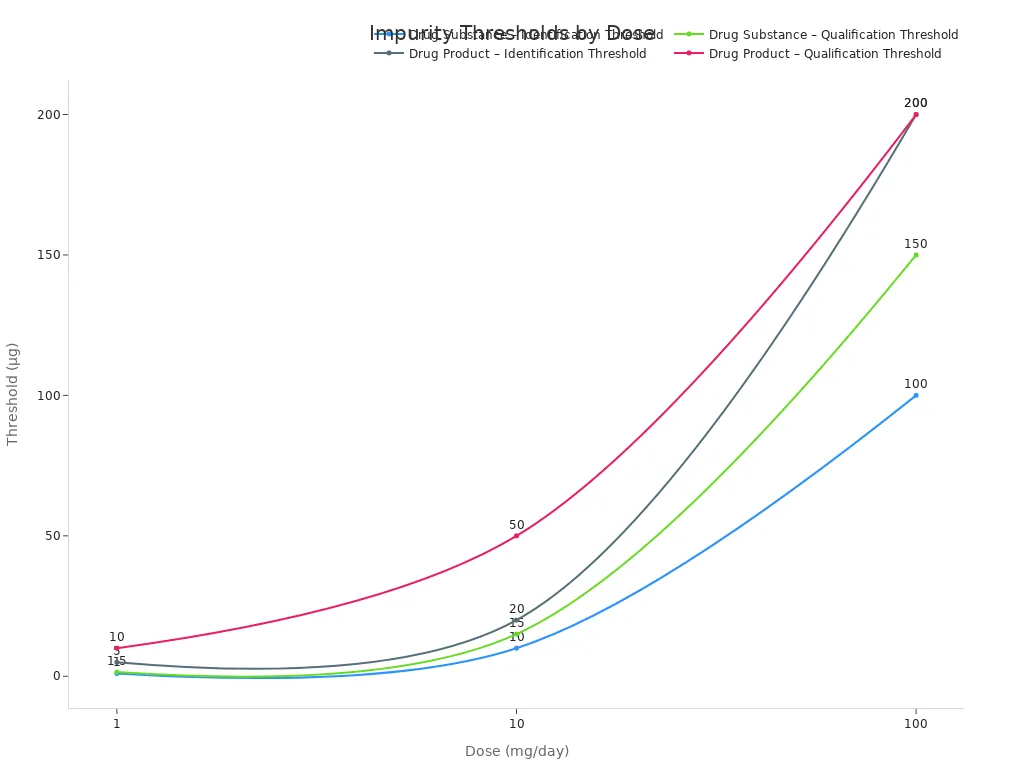
Image Source: statics.mylandingpages.co
Reading a COA Like a Buyer, Not a Spectator
A certificate of analysis arrives with every shipment. Most buyers glance at the assay value and file the document. That habit costs money. The COA is your first line of defense against a batch you cannot release. Read it the way a QA lead reads it: line by line, against the specification you agreed, with a calculator in hand.
Purity, Assay, and the Difference Between Them
Buyers confuse these two numbers all the time. They are not the same measurement, and they do not fail in the same way.
Purity comes from a chromatographic method, usually HPLC area percent. It tells you what fraction of the detected peak area belongs to your target compound. Assay comes from a titration or a calibrated quantitative method against a reference standard. It tells you how much of the material is actually the substance you ordered, expressed on a dried or as-is basis.
A batch can show 99.5% purity and 97.8% assay. That gap matters. Area percent ignores response factors, so a closely eluting impurity with a strong UV response can inflate or deflate the picture. Assay catches what purity misses: residual water, residual solvents, inorganic content, and anything the detector did not see.
Ask three questions on every COA. Which method produced the purity value? Which reference standard calibrated the assay? What is the moisture content, and did the supplier apply it to the assay calculation? A supplier who cannot answer these questions in writing has not thought carefully about the document they issued.
Watch the specification basis as well. An assay of 98.0% on an anhydrous basis looks different from 98.0% on an as-is basis once you account for 2% water. Confirm the basis before you compare two suppliers. Otherwise you compare two different numbers wearing the same label.
Impurity Profiles and Specified Limits
A single "total impurities ≤ 1.0%" line tells you almost nothing. You need the full profile: each named impurity, each unspecified impurity limit, and the method that resolves them.
Start with the specified impurities. These are the known process-related and degradation impurities the supplier has identified for that route. Each one should carry its own limit, and each limit should trace back to a qualification threshold. For a drug substance, ICH Q3A sets the identification threshold at 0.10% or 1.0 mg per day intake, whichever is lower, and the qualification threshold at 0.15% or 1.0 mg per day. Your intermediate limits should sit comfortably below the level that would push the final API past those thresholds.
Then look at the unspecified impurity limit. A typical value is 0.10%. Ask how the supplier set it. A limit copied from a template is a warning sign. A limit justified by spiking studies and method validation is a working control.
Check the chromatographic method details too. Column type, mobile phase, detection wavelength, injection volume, and run time all belong on the COA or in the method summary. A short run time can hide late-eluting impurities. A single wavelength can miss compounds with weak absorbance. Ask for the chromatograms on request, at least for the qualification batch and the first commercial lot.
A COA without method detail is a claim, not evidence. Treat it as a starting point for questions, never as a release document.
One more habit pays off. Compare the impurity profile across three consecutive lots. Stable profiles suggest a controlled process. Shifting profiles, even inside specification, suggest a process the supplier does not fully understand.
Chiral Purity and Enantiomeric Excess Data
The glucose-derived portion of these molecules carries multiple stereocenters. Each one can invert, epimerize, or arrive as the wrong diastereomer. Chiral control is therefore not a nice-to-have. It is the parameter that decides whether your downstream chemistry works at all.
Read the chiral data as two separate numbers. Enantiomeric excess, or ee, describes the ratio between two enantiomers at a single center. Diastereomeric purity describes the ratio between diastereomers, which involves two or more centers. A COA that reports only ee leaves the other centers unverified.
Demand the chiral method on the COA. Normal-phase or reversed-phase chiral HPLC with a specified column, a defined mobile phase, and a stated resolution between the target peak and its enantiomer belong in the document. Ask for the limit of detection and the limit of quantification for the chiral method. A method that cannot see 0.05% cannot prove a 99.5% ee claim.
Pay attention to the units and the calculation. Some suppliers report "chiral purity" as an area percent of the main peak. Others report ee as a percentage difference between the two enantiomer areas. The two numbers are not interchangeable. Convert everything to one basis before you compare suppliers.
Run a practical check on the incoming lot. If your lab has a chiral method for the intermediate, test the first shipment yourself. A supplier’s 99.5% ee claim and your 98.9% result is a conversation worth having early, not after you have scaled a batch.
Residual Solvents, Heavy Metals, and ICH Q3C/Q3D
These tests often sit at the bottom of the COA. They should not sit at the bottom of your attention. Solvent residues and elemental impurities can carry straight through multiple synthetic steps, and they can concentrate during isolation.
For residual solvents, work from ICH Q3C. Class 1 solvents should not appear at all. Class 2 solvents carry defined permitted daily exposure limits, and Class 3 solvents carry limits based on good manufacturing practice. The COA should list each solvent used in the final steps, the measured result, and the limit applied. A generic "residual solvents: complies" line is not enough. You need the numbers.
Parameter Typical COA Entry What You Should Verify Class 1 solvents "Not detected" Detection limit of the GC method Class 2 solvents Result in ppm against PDE-derived limit Which solvents were tested, and whether all process solvents appear Class 3 solvents Result in ppm against a 5000 ppm limit Whether the limit is applied per solvent or as a total Heavy metals / elemental impurities Result in ppm or ppb per element Whether the panel follows ICH Q3D risk assessment for the route Moisture Result in % w/w Method used (Karl Fischer) and whether assay is corrected for it For elemental impurities, work from ICH Q3D. The guideline asks for a risk assessment across the route, not a fixed panel of tests on every batch. Ask the supplier which elements their risk assessment identified as plausible for that process. A supplier who tests the same panel for every product has probably not done the assessment. A supplier who can explain why a specific element matters for a specific step has.
Keep the reference standards current. ICH Q3C and Q3D have both been revised since their first publication. A COA citing an outdated limit tells you the quality system has not reviewed its specifications recently. That is a small signal, and it is worth noting.
What a Qualified Dapagliflozin and Empagliflozin Intermediate Supplier Documents
GMP Status and Audit History
Paperwork proves a claim only when it names the site. Ask every Dapagliflozin and Empagliflozin intermediate supplier for the WHO-GMP certificate of the source manufacturing line. Confirm the certificate lists the exact production site that appears on your quote. A product-specific CoPP adds another layer. It ties regulatory approval to the actual manufacturing site through CDSCO channels. Pair these with the batch CoA, the Method of Analysis, a Free Sale Certificate, and a Certificate of Origin. Each document answers a different question, and together they close the gap between a brochure and a verified source.
GMP / Documentation Element What It Confirms for Buyers WHO-GMP certificate of the source line The named production line holds WHO-GMP certification Product-specific CoPP Product-level approval naming the actual manufacturing site Batch CoA and MoA Batch-specific release data and its analytical method Free Sale Certificate and Certificate of Origin Free sale in the country of origin and verified manufacture/dispatch country CTD / eCTD Module 3 Chemistry, manufacturing, and controls data for filings Stability data Support for the labeled shelf life DMF Support and Regulatory Filings
Define your sourcing route before you compare suppliers. An API requirement calls for technical and quality documentation. A finished-product requirement adds product-specific authorization, labeling, and packaging considerations. State the grade, pharmacopoeial standard, specification, COA, SDS, packaging, and retest period in your RFQ. Access to an intermediate does not by itself establish authorization to manufacture, market, import, or distribute a finished medicine. Identify the exact product route, destination market, and intended use first. Then evaluate the Dapagliflozin and Empagliflozin intermediate supplier against the right document set.
Change Control and Supply Chain Transparency
Ask how the supplier handles a process change. A qualified Dapagliflozin and Empagliflozin intermediate supplier notifies you before implementation, shares the comparability data, and offers a re-qualification batch. Request the change control procedure in writing. Map the supply chain back to the manufacturing site. Transparency here protects your filing and your production schedule.
Scale-Up: Where Supplier Quality Gets Tested

Image Source: unsplash
Consistency from Lab Batch to Commercial Lot
A gram-scale sample tells you what a supplier can do in a flask. A ton-scale lot tells you what their plant can do on its worst day. Ask for three consecutive commercial batch records before you commit. Compare the analytical results side by side. The numbers should track within the method’s normal variation. A supplier who cannot share commercial lot data has not yet proven scale-up.
Process Robustness and Critical Parameter Control
Robustness means the process tolerates small deviations without moving the impurity profile. Ask which parameters the supplier treats as critical: reaction temperature, addition rate, stoichiometry, agitation, and crystallization hold time. Then ask for the proven acceptable ranges. A supplier with defined ranges understands their own process. A supplier with single setpoints is still learning it.
Parameter What to Request Why It Matters Reaction temperature Range and control method Drives diastereomer formation Crystallization hold time Range and batch data Sets crystal form and particle size Chiral resolution step Yield and ee across lots Confirms stereochemical control holds at scale Red Flags in Batch-to-Batch Variability
Watch for shifting impurity profiles inside specification. A new unspecified peak that appears in lot three and grows in lot four signals a process the supplier does not control. Yield swings above ten percent between lots deserve the same scrutiny. So does a sudden change in particle size or crystal form without a documented reason.
A supplier who explains variability with "normal process drift" has just told you the process is not validated.
Request the deviation records behind any outlier lot. Transparent suppliers share them. Others change the subject.
Questions That Separate a Qualified Dapagliflozin and Empagliflozin Intermediate Supplier from the Rest
You have read the COA, checked the chiral data, and reviewed the change control file. Now you sit across the table from the supplier’s team. The questions you ask in that room decide whether the relationship survives its first commercial campaign. Split the interrogation by discipline. Each team answers for a different risk, and each set of answers exposes a different weakness.
Technical Questions for the Process Chemist
Start with the route. Ask the process chemist to walk you through the synthetic sequence from starting material to the advanced intermediate you plan to buy. You want to hear where the chiral centers are set, which step controls the diastereomeric ratio, and what happens to the mother liquors. A chemist who hesitates at the stereochemistry step has not owned that route.
Then probe the crystallization. Ask which solvent system they use, how they control supersaturation, and how they confirm crystal form on every lot. Polymorph drift is a quiet failure. It passes the COA and then breaks your drying step. Request the XRPD pattern for three consecutive lots and compare the peak positions yourself.
Ask about the chiral resolution step in detail. Which resolving agent do they use? What is the recovery yield after resolution? How do they handle the unwanted enantiomer — recycle it, discard it, or racemize it back into the process? The answer tells you how well they understand the economics and the impurity burden of their own route.
Push on the impurity fate. Name the two or three impurities you consider most likely for that route and ask the chemist to trace each one through the downstream steps. A strong answer identifies the step that purges the impurity and cites the rejection data that proves it. A weak answer repeats the specification limit and changes the subject.
Ask what happens when a reaction stalls. Which in-process controls do they run, and what corrective action do they take when a control fails? You want to hear about temperature adjustment, extended hold time, or re-charging a reagent. You do not want to hear that they "repeat the batch."
Finally, ask for the process development report. A supplier who developed the route in-house can share the optimization history, the rejected routes, and the scale-up challenges. A supplier who licensed the route will hand you a summary sheet. Both answers are useful. Only one tells you how the supplier will respond when your volume grows.
Quality Questions for the QA Team
Move to the quality team and open with the specification. Ask them to justify each limit on the COA. Why is the unspecified impurity limit set at 0.10% and not 0.15%? Which qualification threshold drove that choice? A QA lead who built the specification can answer in one sentence. A QA lead who inherited it will read the number back to you.
Ask about the analytical methods. Which methods are fully validated, and which are still under verification? Request the validation summary for the chiral HPLC method. You want the specificity data, the linearity range, the recovery results, and the limit of quantification. A method that cannot quantify below 0.05% cannot support a 99.5% ee claim with confidence.
Ask how they handle out-of-specification results. Walk through one real OOS event from the past two years. Which investigation tools did they use? Did they identify a root cause? What corrective action followed? A QA team that cannot recall a single OOS event either has a perfect process or a weak investigation culture. Ask which one it is.
Probe the stability program. How many lots sit on long-term and accelerated storage? Which conditions do they use, and how do they define the retest period? Ask for the stability summary for the intermediate you plan to buy. Pay attention to any trend in the impurity profile over time. A slow upward drift in a specified impurity tells you the retest period is optimistic.
Ask about the deviation and change control system. How many deviations did the site record last year? How many led to a change in a registered process? Request the change control procedure and read the notification clause. You want a supplier who tells you about a process change before it reaches your warehouse, not after.
Close with the audit history. Ask when the site last hosted a customer audit and what findings came out of it. Ask how they closed each finding. A supplier who shares the findings and the corrective actions has nothing to hide. A supplier who says "no findings" has either a young site or a selective memory.
Commercial and Continuity Questions for Procurement
Procurement owns the long game. Your job is to confirm that the supplier can carry your volume through a full commercial cycle without a surprise. The table below lists the questions to put in writing and the risk each one addresses.
Category Question procurement should ask Relevance to dapagliflozin/empagliflozin intermediates API quality Can the API consistently meet the required specification? Ensures consistent quality of the final SGLT2 inhibitor API Intermediate control Are critical intermediates and starting materials available from qualified sources? Directly addresses sourcing of dapagliflozin/empagliflozin intermediates Documentation Are CoA, specifications, analytical methods and relevant regulatory documents available? Supports regulatory filings and batch release Manufacturing Can the supply partner support commercial-scale requirements? Confirms scalability for commercial volumes Supply continuity Is there a robust alternative-source strategy? Mitigates single-source risk for key intermediates Commercial partnership Can manufacturers, distributors and pharmaceutical companies develop a sustainable supply relationship? Ensures long-term commercial stability Work through five assessment areas in sequence. First, supply security. Assess production planning, lead times, logistics, documentation, contingency planning, and continuity of supply. Ask what happens when a key raw material runs short. Ask how they allocate capacity when two customers want the same reactor time.
Second, commercial fit. Evaluate the target market, registration economics, distribution model, forecast volumes, and long-term partnership potential. A supplier who serves your destination market already understands the documentation your filing needs. A supplier who does not will learn on your timeline.
Third, manufacturing capability. Confirm capacity, technology, validation, quality systems, scalability, and technology-transfer capability. Ask for the reactor train dedicated to your product family and the current utilization rate. A supplier running at ninety percent utilization has no room for your growth.
Fourth, quality systems. Review the GMP systems, QC testing, specifications, analytical methods, stability programs, and batch consistency. You have already done this with the QA team. Procurement confirms that the commercial terms do not pressure the quality team into shortcuts.
Fifth, regulatory readiness. Build the registration strategy, technical documentation, product classification, and market-specific requirements into the conversation from the outset. A qualified Dapagliflozin and Empagliflozin intermediate supplier will ask you which market you file in before you ask them for a quote.
Ask one final question before you leave the room. What is their alternative-source strategy for the starting materials they buy? A supplier who depends on a single upstream source for a critical building block carries that risk into your supply chain. A supplier who has qualified a second source, or who manufactures the building block in-house, has removed a failure point you would otherwise inherit.
Verify stereochemistry and impurity data first. Confirm documentation second. Stress-test scale-up claims third. Audit access and transparent change control build the strongest supplier relationship, not the lowest unit price. Run the question checklist before you issue any purchase order. Re-qualify whenever a supplier reports a process change.
FAQ
How do I verify chiral purity claims before placing an order?
Request the chiral HPLC method, its limit of quantification, and three consecutive lot results. Test the first shipment in your own lab. A supplier confident in stereochemical control welcomes this check.
What should I do when a supplier reports a process change mid-contract?
Ask for the comparability data and a re-qualification batch before you accept any shipment. Review the change against your filing. Re-qualify the supplier fully if the impurity profile shifts.
Can one supplier cover both Dapagliflozin and Empagliflozin intermediate needs?
Many suppliers offer overlapping building blocks for both routes, such as silylated gluconolactone derivatives. Confirm each product’s documentation separately. Route-specific intermediates still need their own qualification and audit trail.
See Also
Avoid Making Incorrect Aluminum Casting Process Choices Ever Again
Tianming Pharmaceutical Group -
AuthorPosts

- You must be logged in to reply to this topic.