- This topic is empty.
-
AuthorPosts
-
2026-10-22 at 9:14 pm #12753
Moving a beverage bottling line to 12,000–36,000 bottles per hour changes which problems actually matter. Manual handling and contamination risk do not disappear at that output, but the constraints that decide whether the rated speed is genuinely held shift to four places: bottle infeed stability, fill accuracy as cycle time shortens, capping torque at a much shorter cycle time, and whether cleaning and changeover windows still fit inside a production day that now turns over far more bottles per hour. A rotary monoblock addresses the handling and hygiene side of that equation structurally, by removing the transfers between blowing, filling and capping. The infeed, filling, capping and cleaning side has to be engineered around it — which is where a high-speed line succeeds or quietly runs below its nameplate figure.
What a Rotary Monoblock Actually Integrates
A rotary blow-fill-cap monoblock carries out three stages inside one rotating unit: the preform is blown into a bottle, the bottle is filled, and the bottle is capped, without the container leaving the rotary path between stages. The alternative — separate blowing, filling and capping machines linked by air conveyors — introduces a transfer after blowing that is both a mechanical handling point and an open period during which the freshly formed bottle is exposed.
Rotary motion is the second part of the design logic. Because the unit turns continuously rather than indexing stop-start, the mechanical cycle stays uniform across the full output range, which is what allows the same platform to be rated from 12,000 up to 36,000 bottles per hour.
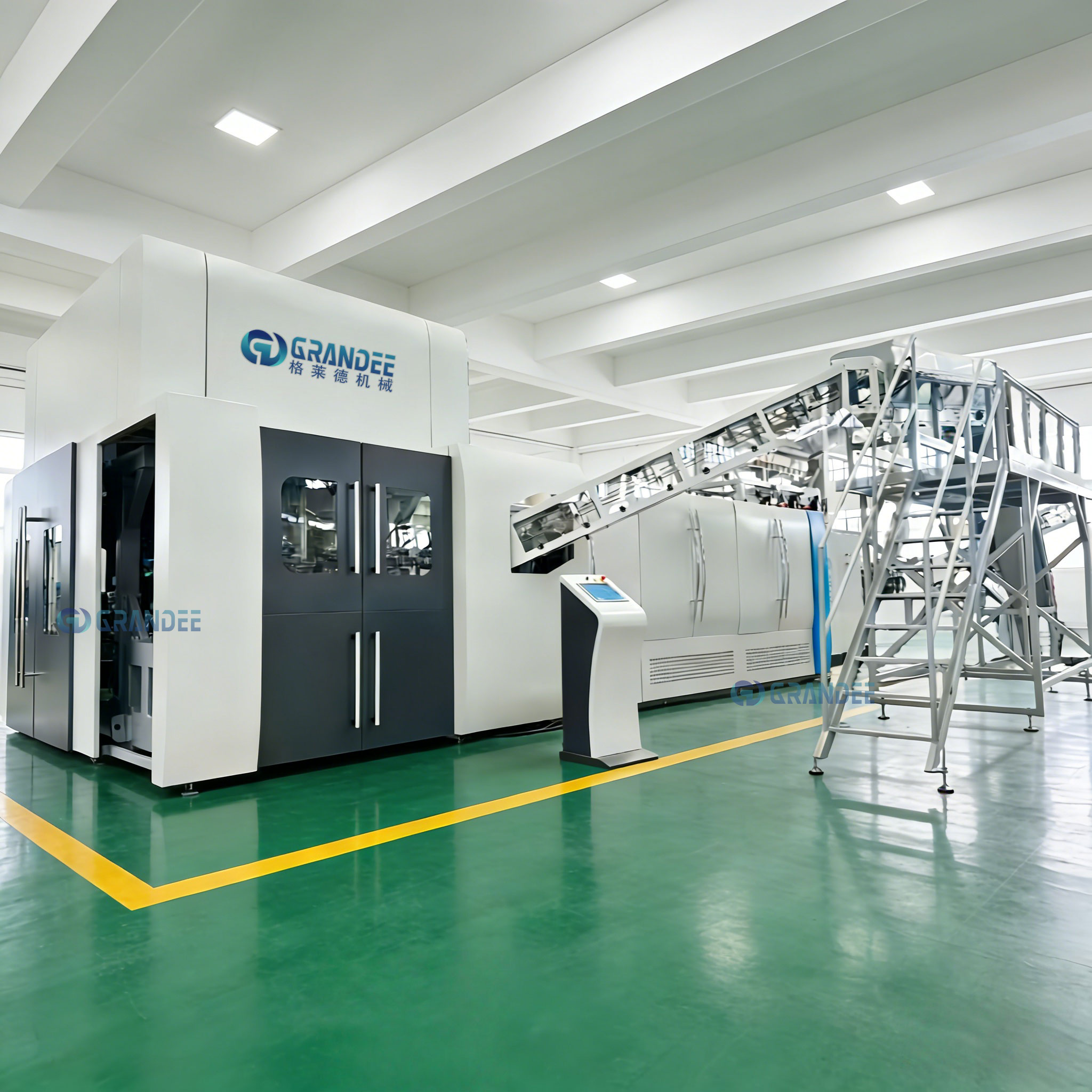
Core Technology in Grandee Machine’s Rotary Blow-Fill-Cap Monoblock
Zhangjiagang Grandee Machinery Co., Ltd., operating under the brand Grandee Machine, builds this platform for large-scale PET bottled water and carbonated beverage production, rated at 12,000–36,000 BPH.
Several engineering elements underpin the system:
- PLC/HMI touch-screen control: centralized operation and monitoring across the blowing, filling and capping stages from a single interface, so process parameters are set and read in one place rather than across three control panels.
- High-precision electronic volumetric filling valves: fill volume is set electronically rather than by mechanical stroke adjustment, which keeps dosing consistent when the cycle time shortens at higher output.
- 316L stainless steel liquid contact parts: selected for corrosion resistance, which matters for carbonated products as well as for long-term mechanical integrity in a continuously wet environment.
- ISO Class 6 cleanroom compliance: the filling environment is enclosed and filtered to this class, reducing contamination exposure at the point where the bottle is open.
On efficiency, the company’s in-house test data reports up to 30% electricity savings and up to 10% compressed air savings for this integrated configuration compared with conventional separate-machine setups. The mechanism is specific to blow-fill-cap integration: eliminating a standalone blower removes the preform heating load and the high-pressure air that dominates a separate blowing stage. These are internal test figures rather than third-party verified results, and the underlying records can be provided on request.
Where a project sits below the monoblock’s output range, or where bottle blowing is handled elsewhere in the plant, the same applications are covered by other configurations in the range — the 3-in-1 bottled water filling machine at 220 ml to 2,000 ml and 2,000–32,000 BPH, and the 3-in-1 isobaric carbonated filling machine at 2,000–25,000 BPH.
What Keeps Output Stable at 12,000–36,000 BPH
A nameplate rating is a capability, not a guarantee. At this output level, four operating variables determine how much of the rated capacity a plant actually sees.
Bottle infeed stability. At 36,000 bottles per hour the machine consumes 600 bottles per minute. Any interruption in preform or bottle supply propagates immediately into the rotary unit. The monoblock itself does not solve this; it depends on the accumulation and conveyor design upstream, which is why line layout belongs inside the project scope rather than being left to the buyer’s local contractors.
Fill accuracy as cycle time shortens. The window in which a valve can deliver its dose shrinks in direct proportion to speed. Electronic volumetric valves hold the set volume as that window narrows, whereas mechanical stroke-based valves tend to drift and require recalibration between shifts.
Capping torque at full rate. At high speed each cap sees a very short application window. Consistent torque across heads is what separates a line that runs at rating from one that stops for re-torquing and rejected bottles.
Cleaning and changeover windows. A line producing three times as many bottles per hour also generates contamination load proportionally faster across a production day. Automatic CIP built into the line as standard, together with a planned changeover sequence between bottle formats, is what keeps hygiene cycles from eating into output.
Turnkey EPC Delivery Around the Monoblock
The monoblock is normally supplied inside a complete line rather than as an isolated machine. Grandee Machine delivers it under a turnkey EPC model — one contract and one accountable partner covering the plant from initial design through to a running line.
The scope covers bottle design, factory layout, paperless 3D factory design, water treatment, bottle blowing, the blow-fill-cap stage, and downstream packaging including labeling, shrink wrapping and carton packing. End-of-line packaging such as palletizing is available on request rather than as a standard inclusion. Installation, commissioning and operator training are part of the same contract, and automated CIP is included as a standard line capability.
For a producer building a carbonated or large-format water line, that structure means the rotary unit arrives as one component of a coordinated plant rather than as a machine the buyer has to integrate alone.
Delivered Line Experience and Compliance
Project references published for the wider range include a complete carbonated soft drink filling line supplied and installed for a carbonated drink producer in Africa, and a 6,000 BPH bottled water line running 500 ml PET bottles in operation in Peru. Both are line-level deliveries rather than monoblock-only installations, and they are referenced here as evidence of the integration scope the company delivers around this platform.
Zhangjiagang Grandee Machinery Co., Ltd. has more than 20 years of export experience and operates a standardized production workshop exceeding 20,000 square meters in Zhangjiagang, Jiangsu, China. Production capacities across its nine machine types run from 150 to 36,000 units per hour. Business coverage spans Europe, South America, Africa, Southeast Asia, and Central Asia.
Equipment supplied for the European market carries CE certification. CQC (China Quality Certification Center) is a domestic Chinese certificate and is not presented here as an international qualification.
Conclusion
For a beverage producer planning a high-speed line, the rotary blow-fill-cap monoblock is the configuration that removes the transfer between blowing and filling and holds a continuous rotary cycle from 12,000 to 36,000 BPH. What determines whether that rating is realized in production is the engineering around it — infeed stability, fill accuracy at short cycle times, capping torque consistency, and cleaning windows that fit the production day. Zhangjiagang Grandee Machinery Co., Ltd., under the Grandee Machine brand, supplies the platform together with the layout, installation, commissioning and training needed to hold that output, backed by more than two decades of export experience.
Frequently Asked Questions
What output range and products does the rotary blow-fill-cap monoblock cover?
12,000 to 36,000 bottles per hour, for large-scale PET bottled water and carbonated beverage production, including still water and sparkling products.
How does a rotary monoblock differ from separate blowing, filling and capping machines?
Blowing, filling and capping happen inside one rotating unit instead of on three linked machines. The container is not transferred between stages, which removes both a mechanical handling point and the period after blowing when a freshly formed bottle is open to the room.
How is fill accuracy maintained at speeds up to 36,000 BPH?
Through high-precision electronic volumetric filling valves. Fill volume is set electronically rather than by mechanical stroke, so the dose stays consistent as the available fill time shortens at higher output, supported by PLC/HMI control that keeps parameters centralized between shifts.
What does the turnkey EPC scope include around the monoblock?
Bottle design, factory layout, paperless 3D factory design, water treatment, bottle blowing, the blow-fill-cap stage, downstream packaging including labeling, shrink wrapping and carton packing, installation, commissioning and operator training. Automated CIP is included as a standard line capability, and end-of-line packaging such as palletizing is available on request.
What is the basis for the 30% electricity and 10% compressed air figures?
They come from the company’s in-house test data, comparing this integrated configuration against conventional separate-machine setups. The mechanism is the elimination of a standalone blowing stage, which removes preform heating load and high-pressure air consumption. The figures are internal test results rather than third-party verified data, and the underlying records can be provided on request.
Next Step
For a plant planning a high-speed water or carbonated line, share the target output, bottle formats, and available factory layout, and Grandee Machine will prepare the line configuration and project scope for review.
https://www.grandeemachine.com/
Zhangjiagang Grandee Machinery Co., Ltd. -
AuthorPosts

- You must be logged in to reply to this topic.