- This topic is empty.
-
AuthorPosts
-
2026-10-29 at 6:21 pm #13124
Understanding CINESOLO Within the Toplite Technology Ecosystem
CINESOLO® is a brand operated by Toplite International Co., Ltd, a company headquartered at Panyu Innovation and Technology Park, Shilou Town, Panyu District, Guangzhou, P.R. China. Toplite’s strategic positioning centers on providing AR/VR optical solutions, optical engines, optical lenses, engineering development modules, and head-mounted displays with OEM/ODM and on-demand customization. The CINESOLO line of VR head-mounted displays represents the practical application of this broader technology platform, built around addressing industry pain points such as the need for lightweight, low-cost AR/VR optical architectures with reduced optical distortion, glasses-free viewing for nearsighted or farsighted users, and adjustable diopter and interpupillary distance for different users.
What Makes CINESOLO’s Optical Architecture Different
At the core of CINESOLO’s engineering is a set of proprietary optical technologies developed by Toplite. These include the TOPLITE patented visual tilt compensation technology, the single-piece Pancake optical module, and the single-lens Pancake imaging solution. Together, these technologies support a low-distortion VR optical design, with distortion values ranging from below 1% to below 5% depending on the specific model. This range matters because optical distortion directly affects visual comfort and image fidelity during extended VR use.
A second defining characteristic is diopter adaptability. CINESOLO devices and the underlying Toplite optical platform support continuous diopter adjustment from -12D to +5D, covering a wide range of nearsightedness and farsightedness. This is paired with interpupillary distance (IPD) adjustment from 55 mm to 70 mm, allowing the optical system to be tailored to individual users without requiring them to wear corrective eyewear underneath the headset.
If you want to learn more about related VR knowledge, visit the following URL: https://youtu.be/ZH8Azx8mkqk to get more related information.
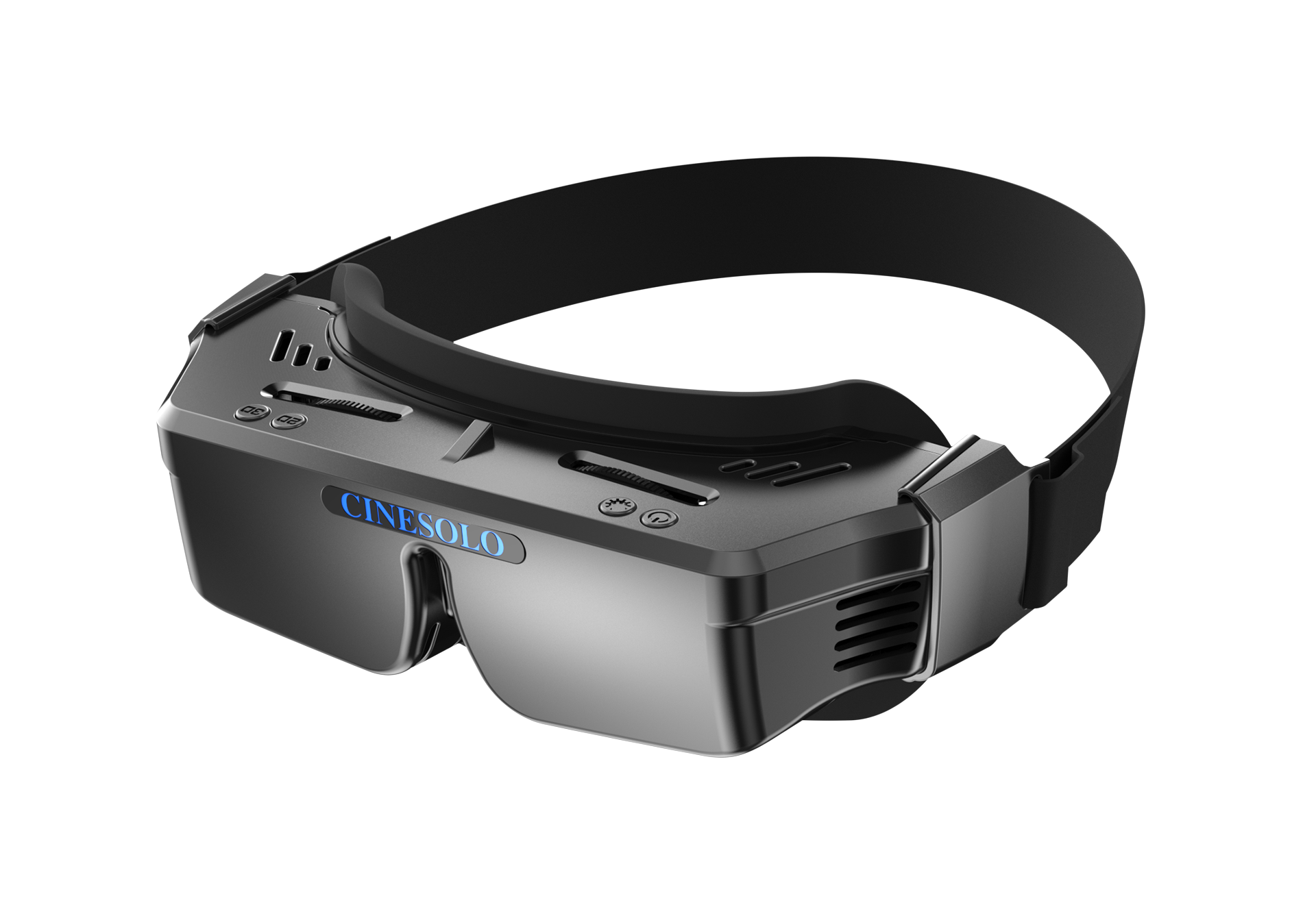
CINESOLO V1: Wireless Viewing Through WiFi Connectivity
The VR Head Mounted Display CINESOLO V1 is positioned as a high-definition, super lightweight, compact VR head-mounted display supporting WiFi connection and 2D/3D switching. It addresses two specific scenario pain points: glasses-free VR viewing for nearsighted and farsighted users, and wireless content sharing between a local wireless LAN and smart terminals.
Its key features include a high-definition optical lens module using multi-lens refractive imaging, which the company states delivers low distortion and high optical efficiency. Far-sighted and near-sighted users can wear this device directly without glasses, because the left and right focus can be adjusted continuously and independently across a range from +5D to -12D. Interpupillary distance adjusts continuously and synchronously from 55 mm to 70 mm. The device offers three brightness levels (high, middle, low) and supports naked-eye 3D viewing through a one-click 2D/3D switch. It connects to local wireless networks and smart terminals via WiFi for wireless content sharing.
In terms of specifications, CINESOLO V1 has a net weight of ≤145 g, a 0.71-inch Micro OLED display with 1920×1080×2 resolution, a 55° field of view, and a pixel density (PPD) of 40. Power is supplied via DC 5V 1A, and the device ships with an elastic strap as the default wearing accessory, with an optional head hanger available.
CINESOLO V2: Wired Precision Through USB Type-C
The VR Head Mounted Display CINESOLO V2 shares the same underlying optical philosophy as the V1 but is positioned around a wired connection model, supporting USB Type-C connection with DP protocol and 2D/3D switching. It addresses glasses-free VR viewing for nearsighted and farsighted users, as well as the need for wired connectivity through USB Type-C with DP protocol.
CINESOLO V2 is lighter than its sibling, with a net weight of ≤120 g, and uses a 0.49-inch Micro OLED display at 1920×1080×2 resolution, a 46° field of view, and a PPD of 48. Like the V1, it supports continuous and independent left/right focus adjustment from +5D to -12D, synchronous IPD adjustment from 55 mm to 70 mm, three-level brightness control, and one-click naked-eye 2D/3D switching. It connects through USB Type-C with DP protocol, and ships with an elastic strap by default, with an optional ear hanger.
The Technology Platform Behind the Products
Beyond the two head-mounted display models, Toplite’s broader technology platform includes the VR Open-source Optical Engine, which integrates the TOPLITE Single-Piece Pancake Optical Module, a BOE 0.49″ OLED display at 1920×1080 per screen, and a Lontium video driver. This engine achieves a minimum thickness of 22 mm, an optical solution weight of approximately 65 g, and a total engine weight including case of approximately 85 g. It supports full-protocol DP Type-C connectivity and includes a bionic view angle with a tilt angle compensation adjustment mechanism — a direct application of the patented visual tilt compensation technology.
Toplite also offers a line of VR Optical Lenses (V1 through V3, P1 through P3, and PW1 through PW3), each using either refractive imaging with multiple lens combinations or single-lens Pancake imaging. These lenses vary in field of view (from 46° to 96.4°), weight (as low as 10.5 g), and distortion (as low as below 1%), giving device developers a range of options depending on screen size and design priorities.
For engineering teams building custom VR headsets, Toplite provides VR Engineering Development Modules adapted to screens from major suppliers including BOE, MENGXIAN, SEEYA, and SONY. These modules come with built-in communication interfaces such as DP protocol Type-C or HDMI Micro USB, and are available in both monocular and binocular configurations.
Why This Matters for Developers and Users
The combination of patented tilt compensation, Pancake optical designs, wide diopter range, and flexible connectivity options addresses a practical set of needs: users who would otherwise require corrective lenses can wear CINESOLO devices directly, developers can select from open-source optical solutions or request OEM/ODM customization, and the modular lens and engineering development module lineup allows fast adaptation to OLED/LCD screens of different sizes.
Toplite’s service model reinforces this flexibility, offering open-source optical solutions, OEM/ODM services, and highly liberalized on-demand customization. For buyers and integrators evaluating VR optical technology, CINESOLO and its underlying Toplite platform represent a documented set of engineering choices — from tilt compensation to Pancake imaging — designed to reduce distortion, lower weight, and support a broader range of users without requiring glasses underneath the headset.
TOPLITE will be attending the 2026 LDI Show in the United States. We will be waiting for you at Booth #1509 and look forward to meeting you in Las Vegas from December 6–8, 2026! To see more of our Show videos, please visit the following link for more information:https://youtu.be/-I5p4XAL77g

https://en.led3d.com/
TOPLITE -
AuthorPosts

- You must be logged in to reply to this topic.