- This topic is empty.
-
AuthorPosts
-
2026-08-07 at 7:30 pm #10224
A battery-integrated mobile EV charger is worth evaluating when a fleet needs high-power DC charging at a location where the available electrical supply cannot deliver that power directly. The onboard battery decouples the charging output from the grid connection, so the charger draws energy slowly and delivers it quickly.
MPMC POWERTECH CORP. manufactures this equipment as its BCH Series. According to MPMC’s published product materials, the range covers 80 kW to 600 kW DC charging output with 70 kWh to 1,075 kWh of onboard storage. This guide explains how the architecture works, how to size a unit, and what to confirm before purchase.
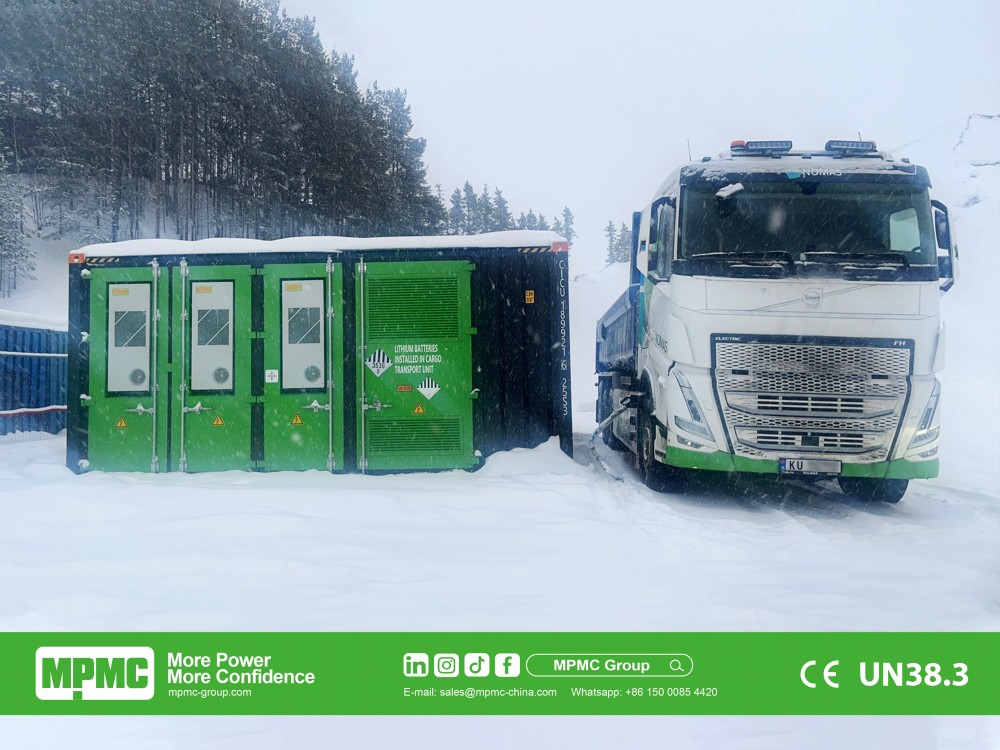
MPMC BCH Series mobile BESS charger supplying DC charging to an electric truck in a cold-climate deployment.
Why Industrial Fleets Reach for Mobile Charging
Industrial fleet electrification has moved ahead of charging infrastructure in many sectors. Electric trucks, forklifts, aerial work platforms, excavators and utility vehicles are now in service at sites that were never wired for the load they represent.
Three situations recur:
• The site has no permanent grid connection, or the connection is too weak for the charging power required.
• A grid upgrade is planned but the timeline does not match the vehicle delivery schedule.
• The charging demand is temporary, and permanent infrastructure would be stranded once the project ends.
In each case, the constraint is the connection rather than the vehicles. A mobile charger with onboard storage addresses the connection problem directly, which is why it is used as a bridge during infrastructure transition rather than as a permanent replacement for fixed charging.
How the Battery-Integrated Architecture Works
A conventional DC fast charger converts grid power to DC and delivers it to the vehicle in real time. Its output is therefore limited by the supply behind it. A 400 kW charger needs roughly 400 kW of available capacity at the point of connection.
A battery-integrated charger inserts storage between the two. Energy accumulates in the onboard battery from whatever source is available, then discharges at high power when a vehicle connects.
Element
Function
Practical consequence
Energy input
Accepts AC from grid, generator set or solar, and DC from a fast-charging station on applicable models
The input can be much smaller than the charging output
Onboard battery
Stores energy between charging events
Total daily energy, not peak power, becomes the sizing constraint
DC output
Delivers fast charging through CCS2 connectors
Charging speed is independent of the connection size
AC output
Supplies site loads in parallel on applicable models
The unit can serve as temporary site power as well as a charger
EMS and connectivity
Manages charge and discharge, supports remote monitoring
Utilisation can be scheduled around available supply and tariffs
The trade-off is straightforward. The architecture removes the peak power constraint but introduces an energy constraint. A unit can deliver high power only until its battery is depleted, after which the recharge rate governs how quickly it returns to service.
The MPMC BCH Range
MPMC’s published BCH specifications are summarised below. The model designation should not be read as the DC output rating, and the applicable configuration should be confirmed against the current datasheet for the target market.
Model
DC charging output
Battery capacity at 25°C
DC connectors
AC input rated power
Weight
BCH-80-70
80 kW
70 kWh
CCS2 260 A × 1
Not applicable (70 kW DC input)
880 kg
BCH-60-70
Not applicable
70 kWh
Not applicable
30 kW (60 kW optional)
900 kg
BCH-275-200
150 kW
203.5 kWh
CCS2 250 A × 2
80 kW
2,800 kg
BCH-600-400
400 kW
407 kWh
CCS2 350 A × 2
280 kW
8,300 kg
BCH-800-600
600 kW
610.6 kWh
CCS2 350 A × 2
280 kW
15,000 kg
BCH-500-1000
500 kW
1,075 kWh
CCS2 350 A × 2
560 kW
19,800 kg
All listed models use LFP cells rated at 6,000 cycles at 90% depth of discharge and are controlled by an EMS with 4G connectivity. OCPP 1.6 support is listed for BCH-80-70, BCH-275-200 and above. Optional CCS1, GB/T and CHAdeMO connectors are available for specific markets.
The weight column is worth reading alongside the capacity column. The BCH-500-1000 is a 20 ft container-format unit at 19,800 kg, which changes the site access, lifting and ground-bearing requirements compared with a trailer-mounted BCH-275-200.
Sizing a Unit: Energy First, Then Power
The most common sizing error is to match the charger’s DC output to the vehicle’s maximum charging rate and stop there. That sets the speed but not the throughput.
A workable sequence is as follows.
Step one: total the daily energy. Multiply the number of vehicles by the energy each needs per session, then by sessions per day. This is the figure the onboard battery and its recharge cycle must cover.
Step two: check the peak simultaneity. Establish how many vehicles need to charge at the same time. This drives the connector count and the DC output rating, not the battery size.
Step three: define the recharge path. Confirm what AC or DC supply is available and how many hours per day the unit can draw from it. Available input power multiplied by available hours gives the daily energy the unit can replenish.
Step four: compare. If daily demand exceeds daily replenishment, the answer is a larger battery, a larger input, longer recharge windows or an additional unit. No charger output rating solves this.
For illustration only, a site with an 80 kW AC input available for 10 overnight hours can replenish in the order of 800 kWh per day before conversion losses. Actual figures depend on the specific model, the input configuration and site conditions, and should be confirmed with MPMC for the proposed installation.
Vehicle and Connector Compatibility
The charger’s rated output is a ceiling, not a delivered figure. The vehicle’s battery management system determines the power it accepts, based on battery voltage, state of charge, temperature and its own charging curve.
Three checks are worth completing before purchase.
The first is the connector standard. MPMC’s BCH models list CCS2 as standard, which suits most European and Australian commercial vehicle fleets. Sites operating CCS1, GB/T or CHAdeMO vehicles need the optional connector confirmed for the specific model.
The second is the voltage window. MPMC lists DC 50 to 1,000 V output on BCH-275-200 and above, and DC 200 to 1,000 V on the BCH-80-70. Some construction machinery operates at lower pack voltages than road vehicles, so the window should be checked against the actual equipment.
The third is cable reach. Listed cable lengths are 7 m for the BCH-80-70, 3.5 m for the BCH-275-200 and 6 m for the larger models. Cable reach determines the parking layout, and it is a frequent source of on-site rework when overlooked.
Battery Design and Thermal Management
MPMC’s published materials describe the BCH battery as a blade LFP pack with a high-strength structural architecture, listing test coverage for fire, water immersion, high-impact collision and crush. Stated characteristics include a 65% larger heat dissipation area than conventional designs, 6.7°C temperature control precision and 390 Wh/L energy density.
Cooling is listed as LCAC across the BCH range. A sealed liquid-cooled pack limits dust ingress, which is the relevant characteristic for mining and construction environments. Fire protection is listed as aerosol (CE) on BCH-275-200 and above.
Operating limits should be checked against site conditions. MPMC lists the BCH-80-70 and BCH-60-70 at −20°C to +55°C with derating above 40°C and a maximum altitude of 4,000 m, and the BCH-275-200 and above at −20°C to +50°C with derating above 45°C and a maximum altitude of 3,000 m.
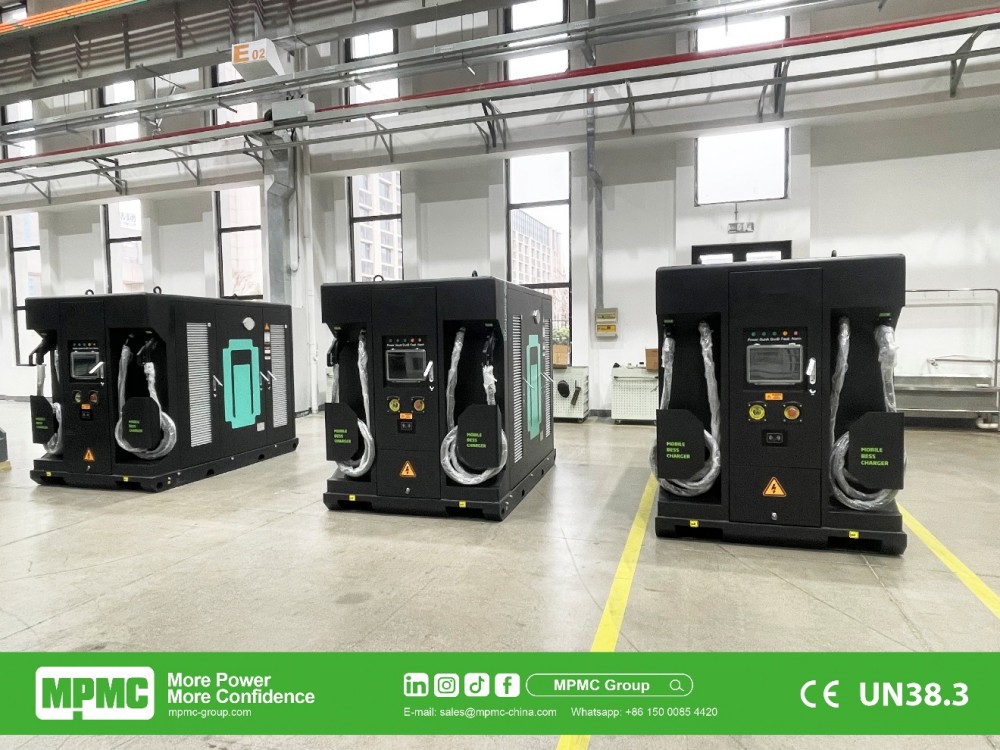
MPMC BCH Series mobile BESS charger-BCH-275-200
Documented Deployments
MPMC’s published project references for the BCH Series include the following.
Location
Configuration
Application
Norway
BCH Series, 2 MWh total; 500 kW and 1,000 kWh per unit; CCS2 output 360 kW / 400 A
Off-grid construction machinery charging without a diesel generator set
United Kingdom
BCH-275-200 × 8 units
Logistics port operations where the local grid limited EV truck charging
Netherlands
BCH-275-200 and BCH-500-1000
Grid-connected EV charging for port and logistics operations
MPMC also publishes an environmental comparison from the UK case. A documented total output of 3,457 kWh from a BCH-275-200 is compared against the fuel that a 150 kW diesel generator would consume to produce the same energy, listed at 976 litres of diesel and 3,123 kg of CO₂.
These figures relate to that installation and its utilisation. Emissions outcomes at a different site depend on the local electricity mix, the charging source and how heavily the unit is used.
Where the BCH Sits Against Alternatives
The main identified competitor in the mobile BESS charger segment is Life-younger, a Chinese supplier with established distribution in Europe and Australia and a mature mid-power iTrailer product line.
The practical distinction is range coverage. Mid-power mobile chargers are well suited to light and medium fleet duty. The higher-power BCH configurations, meaning BCH-600-400, BCH-800-600 and BCH-500-1000, address heavy construction machinery, mining fleets and port logistics, where the energy per session is larger.
This is a positioning difference rather than a quality ranking. Buyers should compare on the specific duty cycle, connector requirement, environmental rating and service arrangement rather than on supplier category.
Procurement Checklist
• Total daily charging energy and peak simultaneity for the fleet.
• Available AC or DC input power and the hours per day it can be used.
• Connector standard and DC voltage window for every vehicle type on site.
• Cable length against the intended parking layout.
• Unit weight, dimensions, lifting arrangements and ground-bearing capacity.
• Operating temperature and altitude against site conditions, including derating.
• Fire protection specification and any site-specific safety requirements.
• OCPP or API integration requirements with existing fleet management systems.
• Applicable product compliance documents for the destination market, including UN38.3 for battery transport.
• Warranty terms in writing. MPMC’s published terms list 3 years or 1.6 MWh/kWh total output for BCH-275-200 and above, with a 5-year or 2.57 MWh/kWh battery performance warranty and end-of-life capacity retention of at least 70%. The BCH-80-70 is listed separately at 1 year or 60 MWh total output, with a 3-year or 200 MWh battery performance warranty.
• Commissioning support, spare parts and remote diagnostic arrangements.
Frequently Asked Questions
What is a battery-integrated mobile EV charger? It is a transportable DC fast charger with an onboard battery. The battery is replenished from an available supply at low power and discharges at high power to the vehicle, which allows fast charging at sites where the connection alone could not support it.
Which energy sources can recharge an MPMC BCH unit? MPMC lists AC input from grid, generator set or solar on the applicable models, and CCS2 DC input for recharging from a fast-charging station. The BCH-275-200 is listed as reaching full charge in approximately one hour via DC input.
Does the charger’s rated output equal the charging speed a vehicle receives? No. The rated output is the maximum the charger can deliver. The vehicle’s battery management system sets the actual rate according to its own limits.
Can a BCH unit supply site loads as well as vehicles? MPMC lists AC output on models from the BCH-60-70 upward, ranging from 30 kW to 500 kW rated depending on the model. Whether this suits a specific site depends on the load type and the socket configuration required.
How is the unit monitored in service? MPMC lists an EMS with 4G connectivity across the range, OCPP 1.6 support on applicable models, and an open API for integration with third-party management systems.
https://www.mpmc-group.com/
MPMC Powertech Corp. -
AuthorPosts

- You must be logged in to reply to this topic.