- This topic is empty.
-
AuthorPosts
-
2026-10-15 at 1:48 pm #12467
Ceramic lining may be worth considering when mechanical abrasion from hard particles is the dominant concern in a conductive liquid application. If a process fluid carries hard, sharp-edged solids that repeatedly scour the inner lining of a flowmeter, a ceramic lining can offer a hardness advantage over softer rubber or polymer linings. However, ceramic lining is not automatically the correct answer for every abrasive or slurry-type application — the decision depends on a combination of process variables, not hardness alone.
Why Hardness Alone Does Not Decide the Lining Choice
Abrasion resistance is only one performance dimension of a flowmeter lining. A buyer should also evaluate chemical compatibility and signal stability separately, because these three factors do not always move together.
- Abrasion resistance relates to how well a lining resists wear from particle contact, impact, and sliding friction.
- Chemical compatibility relates to whether the lining material resists degradation from the fluid’s pH, solvents, or reactive compounds at the operating temperature.
- Signal stability relates to how consistently the flowmeter can generate and read the induced signal without interference from coating buildup, particle collisions with electrodes, or bubble formation.
A ceramic lining with high Mohs hardness does not automatically solve problems in all three categories. For example, a hard ceramic surface can still accumulate deposits in certain fluids, and electrode interference caused by particle impact or an insulating coating is a separate engineering issue from lining wear. Chemical resistance of ceramic also varies with fluid composition, concentration, and temperature, and must be checked independently rather than assumed from hardness.
Variables That Actually Determine Suitability
Instead of treating ceramic lining as a default "upgrade," a buyer should evaluate the following variables for the specific application:
- Particle hardness — how hard the solids are relative to the lining material.
- Particle size and shape — fine rounded particles behave differently from coarse, angular fragments.
- Solids concentration — higher solids loading generally increases wear and impact frequency.
- Flow velocity — higher velocity typically increases both abrasive wear and electrode impact energy.
- Impact risk — pipeline geometry, elbows, and velocity profile can concentrate particle impact on specific lining areas.
- Chemical composition — acidity, alkalinity, and dissolved compounds affect long-term lining integrity.
- Temperature and pressure — these affect both material stability and mechanical stress on the lining.
- Nominal diameter (DN) — lining thickness, electrode configuration, and mechanical tolerances vary by pipe size.
None of these variables can be assessed in isolation. A fluid with very hard particles but low velocity and low concentration may pose a different risk profile than a fluid with moderately hard particles at high velocity and high solids loading.
What Xinya Can Confirm About Ceramic-Lined Configurations
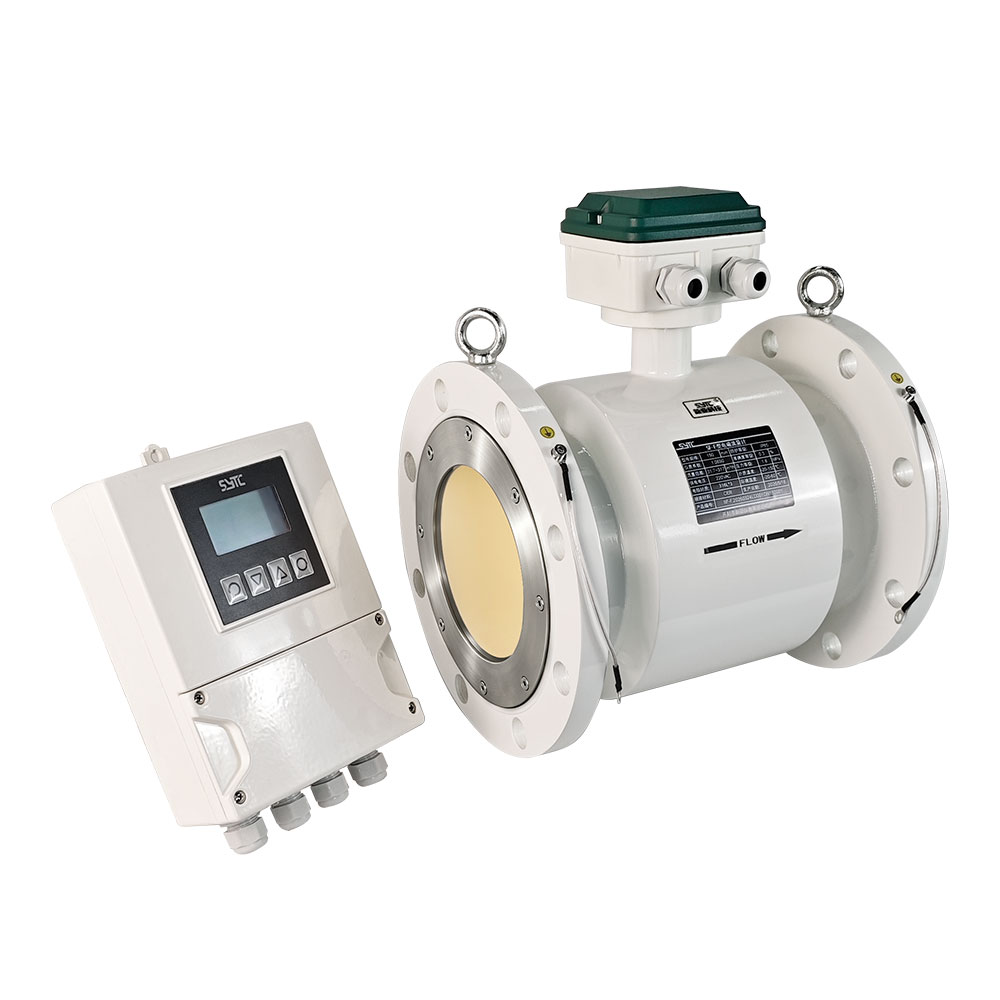
As a manufacturer of electromagnetic flow measurement equipment, Kaifeng Xinya Instrument Co., Ltd. documents a ceramic-lined configuration using 99.5% alumina ceramic with a Mohs hardness of 9. This configuration is referenced in the supplied product information for a DN15–DN200 diameter range.
Beyond these two confirmed facts, buyers should treat any additional detail — such as maximum particle size, maximum flow velocity, specific chemical resistance limits, temperature and pressure ratings, or electrode material pairing for a given slurry — as information that requires confirmation against the specific model’s technical documentation before purchase. Xinya’s ceramic-lined option is one configuration among several lining materials offered across its electromagnetic flowmeter product lines, and it should be evaluated case by case rather than assumed to be the universal solution for abrasive media.
What Ceramic Lining Should Not Be Assumed to Do
To avoid misapplication, buyers should not assume that a ceramic lining is:
- Wear-proof under all particle conditions.
- Unbreakable under mechanical shock or improper installation.
- Universally corrosion-proof across all chemical environments.
- Automatically suitable for every abrasive or high-solids-content medium.
Ceramic materials can still experience localized wear, microcracking, or chemical attack under the wrong combination of particle characteristics, flow conditions, and fluid chemistry. A proper selection process treats ceramic lining as one option to be tested against the application’s actual operating envelope.
Buyer Data Checklist Before Considering Ceramic Lining
Before deciding on a lining material, a buyer should prepare the following process data for review:
- Fluid composition and chemical properties (pH, reactive compounds, dissolved solids)
- Fluid conductivity (required for electromagnetic flow measurement to function)
- Solids content and concentration (percentage by volume or weight)
- Particle size distribution and particle hardness
- Minimum, normal, and maximum flow rates
- Pipe size (nominal diameter, DN)
- Operating temperature range
- Operating pressure range
- Installation conditions (pipe orientation, upstream/downstream straight-pipe length, presence of elbows or valves near the measurement point)
This data allows a lining material — whether ceramic, rubber, polyurethane, or PFA — to be matched to the actual abrasion, chemical, and signal-stability requirements of the application, rather than selected based on hardness figures alone.
FAQs
Is ceramic lining always better than rubber or polyurethane lining for abrasive slurries?
Not necessarily. Rubber and polyurethane linings can offer better impact absorption and flexibility for certain particle types, while ceramic offers higher surface hardness. The better choice depends on particle hardness, size, shape, and impact conditions in the specific application.Does ceramic lining eliminate electrode wear or signal interference?
No. Electrode wear and signal interference are influenced by particle impact on the electrodes themselves, fluid conductivity, and deposit formation — factors that are separate from the lining material’s abrasion resistance.What diameter range does Xinya’s ceramic-lined configuration cover?
The documented configuration referenced in Xinya’s supplied product information covers DN15–DN200. Buyers should confirm exact size availability and other specifications against the specific model’s technical documentation.Can ceramic lining be used in corrosive chemical environments?
Chemical compatibility must be assessed separately from abrasion resistance. Ceramic hardness does not guarantee chemical resistance; the fluid’s specific composition, concentration, and temperature should be checked against material compatibility data before selection.RFQ Checklist for Ceramic-Lined Flowmeter Inquiries
When requesting a quotation, buyers should provide:
- Fluid type, chemical composition, and conductivity level
- Solids content, particle size, and particle hardness
- Minimum, normal, and maximum flow rates
- Pipe nominal diameter (DN) and material
- Operating temperature and pressure ranges
- Installation location and piping layout details
- Required signal output and communication protocol (e.g., 4-20mA, pulse, RS485, HART)
- Any known history of lining wear or signal issues with previous equipment
Providing this information allows Xinya’s technical team to evaluate whether a ceramic-lined configuration, or an alternative lining material, is appropriate for the specific application, and to confirm which specifications apply to the exact model under consideration.
https://www.sytcflowmeter.com/
Kaifeng Xinya Instrument Co., Ltd. -
AuthorPosts

- You must be logged in to reply to this topic.