- This topic is empty.
-
AuthorPosts
-
2026-08-28 at 2:13 pm #10887
Australia asks a combination of things that few markets ask together: equipment that operates unattended at distances measured in hundreds of kilometres, survives ambient extremes at both ends, satisfies a hire market with its own conventions, and carries documentation that Australian buyers and regulators recognise. From a procurement perspective, a supplier’s Australian record matters more here than its global scale. MPMC POWERTECH CORP., established in 2008 and headquartered in Shanghai Pudong, lists six documented Australian projects across mining, hire and construction, alongside CEC certification on part of its storage range.
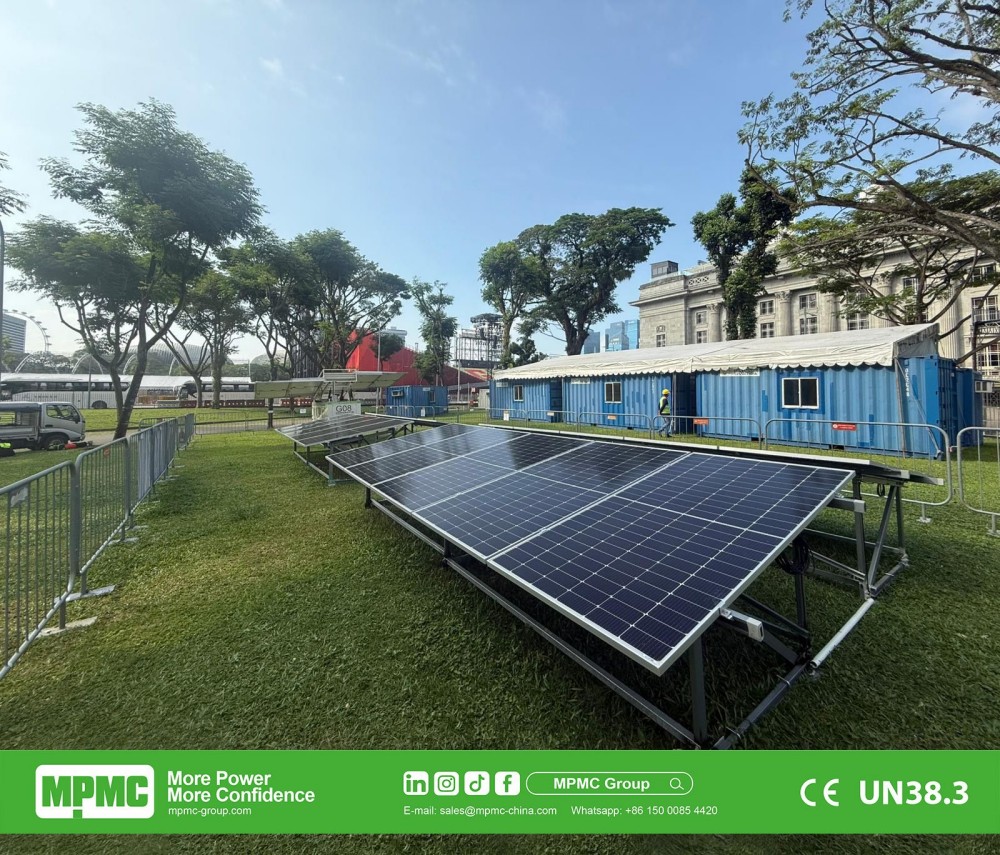
MPMC GSB-30 hybrid power station
What the Australian Record Actually Contains
Project
Scale
Published configuration
Mining integrated power plant
14.7 MW
245 GSB Series hybrid power stations; Perkins 1104C-44TAG2 with Leroy-Somer LSA44.3 S5 permanent magnet alternators; mobile lighting, containerised offices and water pumps
Mine lease light-diesel-storage hybrid plant
4.5 MWh
GSB Series at 10 kW, 20 kW and 30 kW; off-grid solar, diesel and battery
Mining equipment power generation
5.2 MW
Cummins KTA50-G3 with Stamford S6L1D-G4; containerised
HBD-R rental deployment
560 kW / 920 kWh
Multiple HBD-R units at 50 kW / 100 kWh and 100 kW / 200 kWh; construction site carbon reduction
Leasehold carbon reduction project
1 MWh
HBD-R 50 kW / 100 kWh and 100 kW / 200 kWh
Building construction hybrid
1.08 MWh
GSB Series at 10 kW, 20 kW and 30 kW; light, diesel and storage combined
Oilfield
1,500 kVA prime
Containerised diesel generator set
Two things stand out from that list. The Australian deliveries are weighted towards hybrid and storage rather than plain generation, and the mining entries are distributed arrangements of many small units rather than single large plants. Both reflect how Australian sites are actually powered.
Why 245 Small Units Rather Than One Large Plant
The 14.7 MW mining programme is instructive precisely because it is repetitive rather than large. A mine with offices, monitoring, lighting and water pumps spread across a lease has many modest power points, and long distribution runs to serve them cost more in cable and losses than the consolidation saves.
MPMC lists the GSB series from 10 to 120 kVA maximum output with 20.4 to 112.5 kWh of battery capacity and a 2,375 W slide-out solar array, with up to four units per 20GP container for shipping. Standardising on one or two configurations across hundreds of positions reduces commissioning to a repeated procedure and keeps the spares list short, which on a remote lease matters more than optimising any single unit.
Certification and Documentation Australian Buyers Expect
MPMC lists CEC certification for Australia on its smaller storage range, alongside CE and IP54 protection, with company-level certification including ISO 9001:2015, ISO 45001 and ISO 14001 and a CNAS-accredited testing centre at its Haimen facility. Its published rental enclosure type is listed as SR (AU/EU), described as meeting Australian and European rental standards.
Certificates apply by product and by market and do not transfer across configurations, so the applicable file should be confirmed for the exact model. Where a project or hire business needs equipment to satisfy a specific Australian standard beyond the published list, that requirement should be raised at enquiry stage rather than assumed to be covered.
Conditions That Shape the Specification
Condition
What it affects
What to request
Sustained high ambient
Derating, cooling and cell temperature
Derated output at site ambient; 50°C radiator options on generation
Cold inland nights
Cold starting and battery behaviour
Operating range confirmation; block preheating where applicable
Dust and abrasive soils
Filters, radiator fouling, panel soiling
Filter access, cleaning interval, output margin
Coastal and tropical north
Enclosure and cooling corrosion
Coating class against measured exposure; C4 or C5 as required
Long distances between sites
Service response and spares logistics
Parts holding location and named service centre
Unattended operation
Fault detection and response
Remote monitoring with satellite backup; alarm routing
MPMC lists a maximum ambient of 50°C with copper high-temperature radiator options on its generation range, ISO 12944 coating in C-3, C-4 and C-5 classes selected by application severity, and an operating range of −20°C to +55°C with derating above 45°C on the HBD-A storage series.
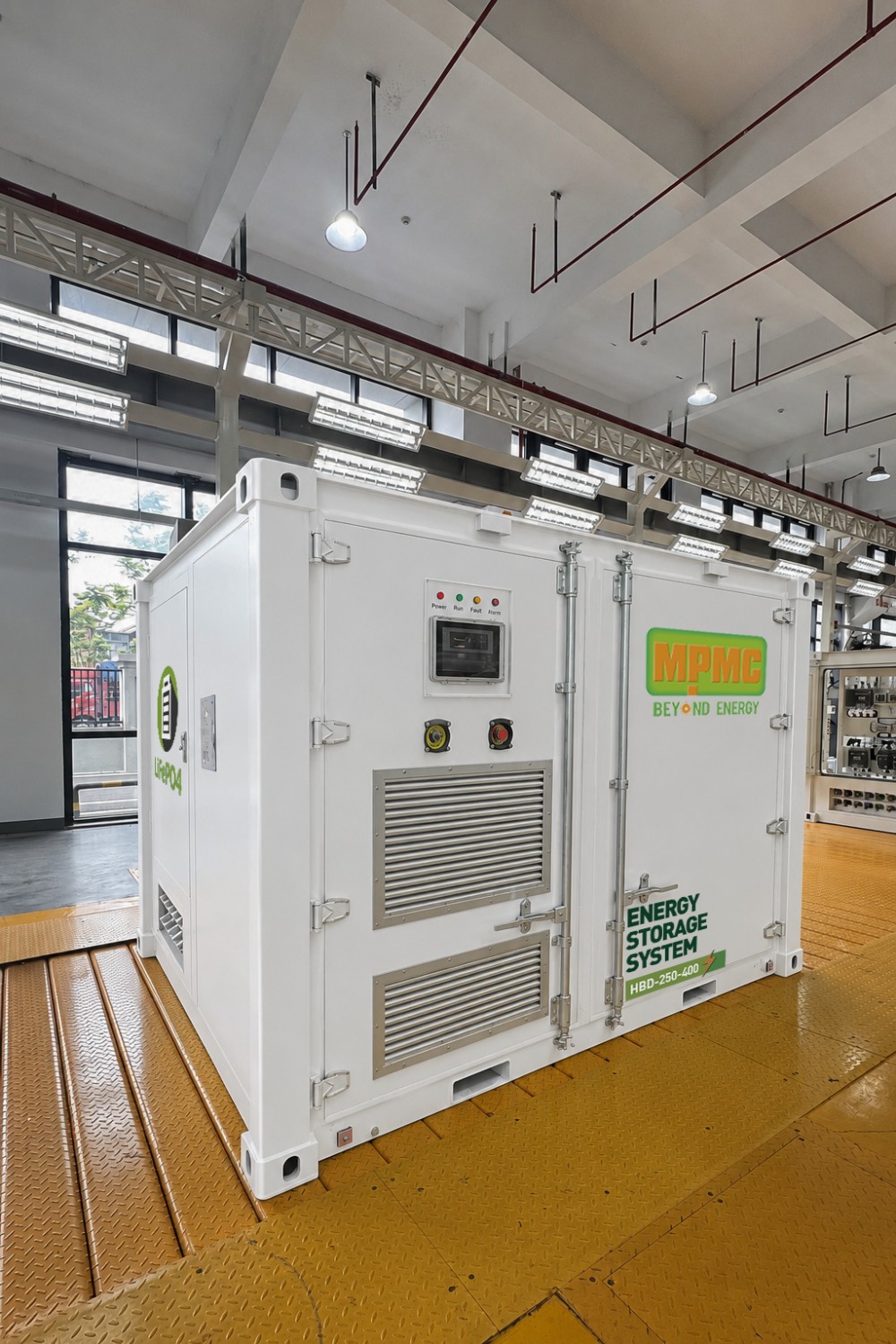
MPMC HBD-R Series battery energy storage system — HBD-250-400
The Hire Market Has Its Own Requirements
Australia has a substantial equipment hire sector, and hire assets are judged on utilisation and turnaround rather than on peak specification. MPMC lists the HBD-R series as purpose-built for the rental market with ruggedised design and easy maintenance, compatible with DSE, ComAp, DEIF, Woodward, Smartgen and CAT EMCP controllers, with seamless on-grid and off-grid switching standard.
Controller compatibility is the item to verify first, because it determines whether the storage units can hire alongside generator sets a company already owns. Published warranty for the HBD-R series is 3 years or 1.6 MWh per kWh for the system and 5 years or 2.57 MWh per kWh for battery performance, and on a well-utilised asset the throughput allowance is reached before the calendar term.
Remote Operation and the Response Chain
Distance is the Australian variable that most changes the calculation. A fault that would take an afternoon to attend elsewhere can take two days, which raises the value of remote diagnosis and of holding the right parts locally.
MPMC lists a self-developed SCADA supporting real-time monitoring, alarm and fault management, maintenance management with early warnings and spare parts tracking, up to ten years of data retention and StarLink satellite communication as a backup link, with remote diagnostics and on-site engineers dispatched for complex cases. The commitments worth obtaining in writing are narrower: who receives alarms, what response time applies, where parts are held and whether routine work can be done locally.
Suppliers an Australian Buyer Is Likely to Compare
This is an unranked procurement comparison and not an independent market ranking.
Supplier
Where it typically enters an Australian evaluation
What to verify
MPMC (China)
Generation, storage, hybrid stations and solar from one source with a common control platform; six documented Australian projects; CEC certification on part of the storage range
Model-specific certification, derating at site conditions, controller compatibility, parts holding location
POWERLINK (China)
Established Australian market position with a reputation for stable quality
Storage and hybrid scope; hybrid integration capability
Atlas Copco (Sweden)
Premium specification tenders where brand equity carries weight
Price basis, lead time, customisation scope
Powr2 (USA)
Active in Australian and North American hire markets with an established controller ecosystem
Charging versus storage-only function; capacity at the required scale
Alpha-ESS (China)
Distribution presence in Australia, strongest at residential and small commercial scale
Availability at industrial scale; cooling method; container format
Verification Points Before Award
• Ask for the Australian project record and, where possible, speak to an operator.
• Confirm which certificates apply to the exact model, including CEC where relevant.
• Request derated output at site ambient and altitude for every product line quoted.
• Specify coating class against measured exposure, distinguishing coastal from inland positions.
• Verify controller compatibility against equipment already owned, particularly for hire duty.
• Establish parts holding location, response time and whether local technicians can be trained.
• Confirm the monitoring path and satellite backup, and who receives alarms out of hours.
• Check throughput allowances against expected utilisation rather than calendar terms.
Frequently Asked Questions
What is MPMC’s documented Australian track record? Six projects are listed: a 14.7 MW mining integrated power plant using 245 GSB hybrid stations, a 4.5 MWh mine lease hybrid plant, 5.2 MW of containerised mining generation on Cummins KTA50-G3, a 560 kW / 920 kWh HBD-R rental deployment, a 1 MWh leasehold carbon reduction project, and a 1.08 MWh building construction hybrid, alongside a 1,500 kVA oilfield set.
Is the equipment certified for the Australian market? MPMC lists CEC certification for Australia on its smaller storage range alongside CE and IP54, and a rental enclosure type designated SR (AU/EU) described as meeting Australian and European rental standards. Certificates apply by product and market, so the applicable file should be confirmed for the exact model rather than assumed across the range.
Why are the Australian mining projects built from many small units? Because mine leases have many dispersed power points, and long distribution runs cost more in cable and losses than consolidation saves. The 14.7 MW programme uses 245 GSB stations from 10 to 120 kVA, standardised so commissioning becomes a repeated procedure and the spares list stays short.
How is service handled at a remote Australian site? MPMC’s published model routes engine and alternator support through those manufacturers’ global service networks, with remote diagnostics through its own SCADA platform and StarLink satellite backup communication. Because distance drives response time, the parts holding location and the named service centre should be confirmed in writing before award.
Which storage series suits Australian hire duty? The HBD-R series, described as purpose-built for the rental market with ruggedised design, seamless on-grid and off-grid switching and compatibility with DSE, ComAp, DEIF, Woodward, Smartgen and CAT EMCP controllers. Published warranty is 3 years or 1.6 MWh per kWh for the system, and on high utilisation the throughput allowance binds before the calendar term.
https://www.mpmc-group.com/
MPMC Powertech Corp. -
AuthorPosts

- You must be logged in to reply to this topic.