- This topic is empty.
-
AuthorPosts
-
2026-07-23 at 9:48 pm #9646
When manufacturers evaluate metal-joining methods for large-section components versus fine precision parts, the choice between flash butt welding and resistance butt welding often determines both production efficiency and long-term joint reliability. Suzhou Agera Automation Equipment Co., Ltd., operating under the AGERA / AGERA AUTOMATION brand, has spent more than 20 years accumulating welding technology experience and has built a database of over 80,000 welding workpiece cases, giving it a practical vantage point for comparing these two resistance-based joining processes.
Understanding Flash Butt Welding
Flash butt welding, represented in Agera’s product line by the AUNS/AUVS Series, is positioned for large-section metal parts and special steel alloys. According to the company’s technical specifications, this process can achieve weld quality that is nearly identical to the base metal for sections up to 20,000mm², making it suitable for heavy-duty structural components that must withstand high mechanical loads.
Within this category, Agera offers specific models tailored to different material and application needs:
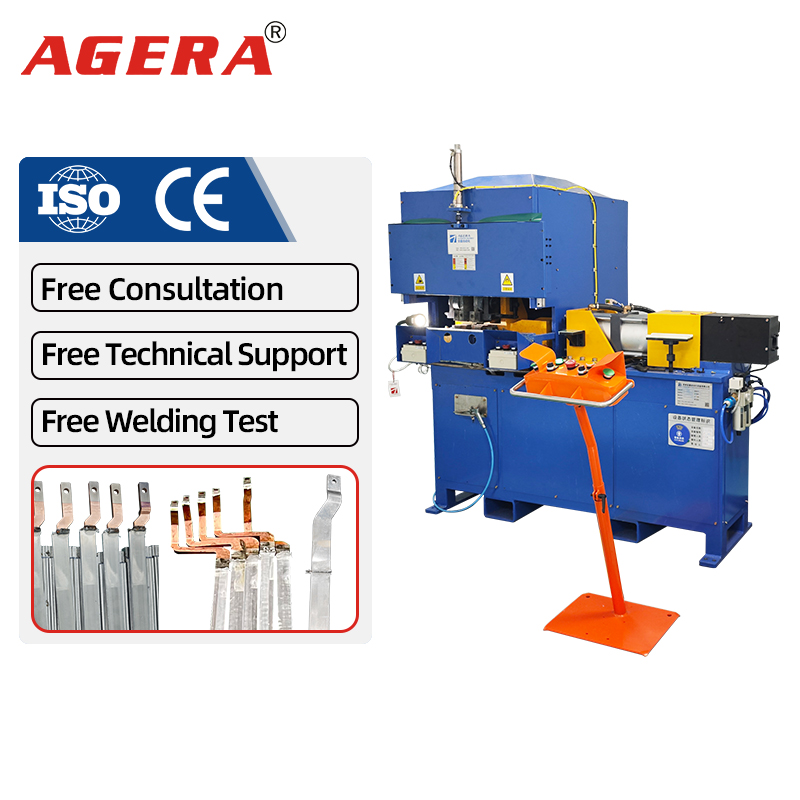
- The AUBS-630*2 New Energy Electric Axle Double-Head Pulsation Flash Butt Welder, designed for new energy vehicle axle production.
- The ACBS-500 Copper and Aluminum Flash Butt Welder, engineered for dissimilar and non-ferrous metal joining.
The company’s flash butt welding development dates back to 2013, when it successfully developed its first Double-Head Flash Butt Welding Machine. This technical line continued to advance, culminating in 2023 with the development of the first domestic double-head flash butt welding machine for truck axles — a milestone that helped Agera enter the supply chain of leading domestic new energy vehicle manufacturers such as BYD and Great Wall Motors, with core products recognized by top customers. In 2024, the AUBS-630*2 New Energy Electric Axle Double-Head Pulsation Flash Butt Welder received Certification for the “First Set of Major Technical Equipment” in Suzhou, Wuxi, and Changzhou.
Understanding Resistance Butt Welding
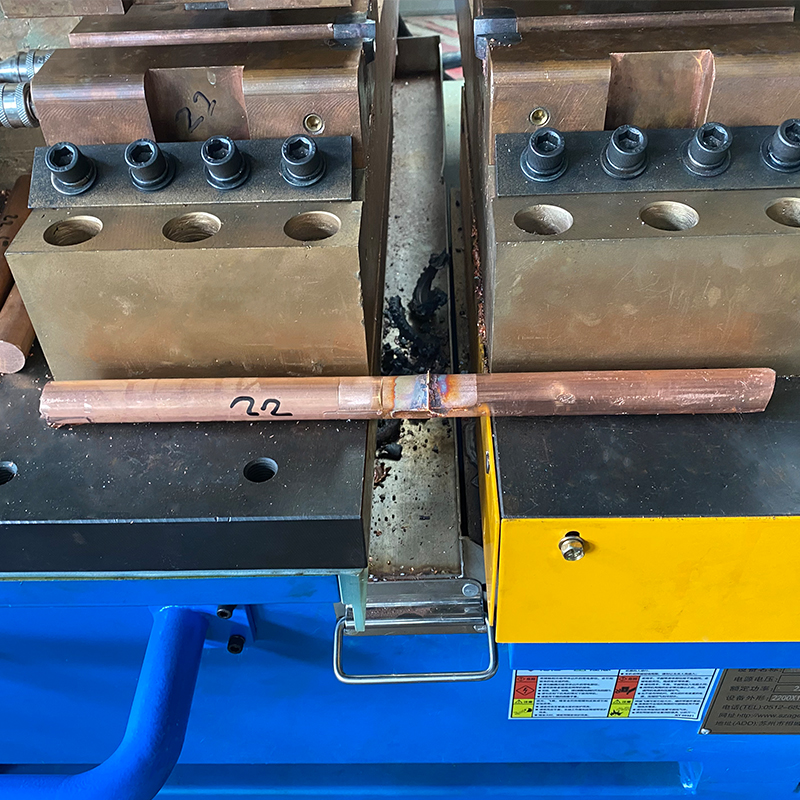
By contrast, Agera’s Resistance Butt Welding Machine is positioned for copper/aluminum rods and fine precision parts. This distinction is significant for manufacturers: while flash butt welding is engineered around large cross-sections and structural steel alloys, resistance butt welding addresses scenarios where precision and finer dimensional control take priority over sheer joint cross-sectional area. Applications such as copper and aluminum rod joining rely on the resistance butt process to maintain the dimensional accuracy required in fine component manufacturing.
Comparing the Two Processes: Applications and Performance
When placed side by side, the two technologies serve distinct segments of the metal-joining market:
- Component Size and Section Area: Flash butt welding is built for large-section parts, with documented capability up to 20,000mm² while maintaining weld quality close to the base metal. Resistance butt welding, by comparison, is applied to fine precision parts such as copper/aluminum rods, where smaller, more controlled joints are required.
- Material Focus: Flash butt welding within Agera’s lineup spans special steel alloys as well as copper and aluminum (via the ACBS-500 model), while resistance butt welding is specifically noted for copper/aluminum rod applications.
- Industry Application: Flash butt welding has been validated in demanding sectors such as new energy vehicle axle manufacturing and heavy-duty truck axle production, where structural integrity under load is critical. Resistance butt welding is suited to fine precision manufacturing where dimensional consistency is the primary requirement.
Because both technologies fall under Agera’s broader resistance and automation welding capability, customers evaluating either method benefit from the company’s shared technical foundation — including its proprietary medium-frequency welding controller, independently developed in 2015 to break the technological monopoly previously held by imported controllers. This proprietary control technology, combined with an inverter frequency reaching 1000Hz+, supports current control accuracy that is 20 times higher than traditional AC welding equipment, reinforcing consistency across the company’s welding equipment portfolio.
Engineering Strength Behind Both Technologies
Agera’s flash butt welding development is anchored by the Suzhou Intelligent Pulse Flash Butt Welding Control Engineering Technology Research Center, established in 2022, which focuses specifically on advancing flash butt welding control technology. The company has also reached cooperation with the China-Ukraine Welding Research Institute, extending its research capacity through industry collaboration. Additional academic partnerships with Soochow University and Jiangsu University of Science and Technology, including a Graduate Workstation established in 2021, support ongoing development across Agera’s welding technology lines, including both flash butt and resistance butt welding equipment.
The company holds National High-tech Enterprise certification (obtained in 2019, recertified in 2023) and Jiangsu Province “Specialized, Refined, Distinctive, and Novel” (SRDN) certification (2022), along with ISO9001 Quality Management System Certification and CE Certification for international markets. Its intellectual property portfolio includes more than 50 invention and utility model patents.
Proven Results in Real-World Manufacturing
In practice, Agera’s flash butt welding technology has been demonstrated in truck axle manufacturing, where the development of the first domestic double-head flash butt welding machine improved efficiency for heavy-duty vehicle production. The company’s broader resistance welding capabilities have also supported the pipe pile industry through the ARH-IDB-202 Pipe Pile End Plate Flange Automatic Welding Line, recognized as a “First Set” major equipment for its technical breakthrough, and automotive safety applications through robot-integrated nut projection welding for anti-collision beams and subframes, ensuring 100% weld reliability in safety-critical parts.
Across its full range of equipment, Agera has served more than 6,000 customers and accumulated over 80,000 welding workpiece cases, with products exported to Europe, Southeast Asia, the Middle East, South America, and North America. This scale of application data allows the company to match customers with the correct welding process — flash butt welding for large-section, high-strength structural joints, or resistance butt welding for fine precision copper and aluminum rod components — based on documented technical performance rather than generalized assumptions.
Conclusion
Choosing between flash butt welding and resistance butt welding ultimately depends on the component’s section size, material composition, and precision requirements. Suzhou Agera Automation Equipment Co., Ltd. addresses both ends of this spectrum through its AUNS/AUVS Series flash butt welders — capable of near-base-metal weld quality on sections up to 20,000mm² — and its Resistance Butt Welding Machine line for copper/aluminum rods and fine precision parts. Backed by more than 20 years of welding technology accumulation, a dedicated engineering research center for flash butt welding control, and validated applications across truck axle and new energy vehicle production, Agera provides manufacturers with technically grounded options for selecting the resistance-based welding process that fits their specific production requirements.
https://www.agerawelder.com
Suzhou Agera Automation Equipment Co.,Ltd. -
AuthorPosts

- You must be logged in to reply to this topic.