- This topic is empty.
-
AuthorPosts
-
2026-05-18 at 2:43 pm #7991
Introduction
In industries where pipe integrity directly affects system safety and performance, such as pharmaceuticals, semiconductors, food processing, and high-purity gas distribution, the quality of pipe cutting is far more than a simple fabrication step. It is a critical foundation for welding reliability, fluid cleanliness, and long-term operational stability.
One of the most important requirements in these industries is burr-free pipe cutting—a clean, smooth, and deformation-free cut surface that requires no secondary finishing before welding or assembly. Traditional cutting methods such as manual sawing, abrasive cutting, or even some automated cutting systems often leave burrs, heat-affected zones, or micro-deformation on pipe ends.
This is where orbital cutting machines play a transformative role. Designed specifically for precision pipe processing, orbital cutting machines deliver consistent, high-quality cuts that are free from burrs and ready for immediate welding.
This article explores how orbital cutting machines achieve burr-free pipe cutting, the engineering principles behind their performance, and why they are indispensable in modern industrial pipe fabrication.
What Is Burr-Free Pipe Cutting?
Before understanding the technology, it is important to define what “burr-free cutting” actually means in industrial pipe processing.
A burr is a raised or rough edge that forms on the pipe after cutting. It can appear:
-
Inside the pipe (internal burr)
-
Outside the pipe (external burr)
-
Along the cutting edge
Burrs are problematic because they can:
-
Disrupt fluid flow
-
Contaminate high-purity systems
-
Create weak welding joints
-
Require additional manual deburring work
-
Increase production time and cost
A burr-free cut means:
-
Smooth internal and external edges
-
No sharp protrusions
-
Minimal thermal or mechanical deformation
-
Clean surface suitable for direct welding
Orbital cutting machines are specifically engineered to eliminate or minimize all of these defects at the source.
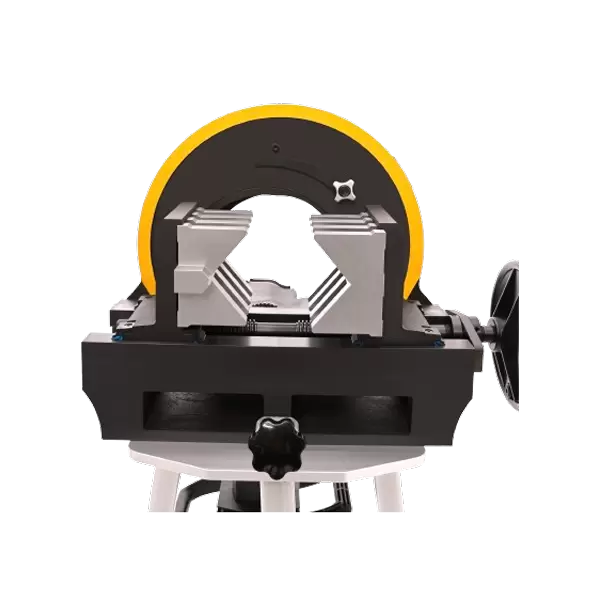
The Working Principle of Orbital Cutting Machines
Orbital cutting machines operate using a rotating cutting head that moves around a fixed pipe, rather than rotating the pipe itself. This fundamental design difference is the key to achieving precision and consistency.
The core working process includes:
-
The machine clamps the pipe securely using a self-centering system.
-
The cutting head or cutting blade rotates 360° around the pipe.
-
A controlled feed mechanism gradually advances the blade into the pipe wall.
-
The cut is completed with uniform pressure and stable motion.
Unlike manual or abrasive cutting methods, orbital cutting eliminates vibration, uneven force distribution, and operator error—all of which are primary causes of burr formation.
Why Traditional Cutting Methods Produce Burrs
To understand the advantage of orbital cutting machines, we must examine why conventional methods fail to achieve burr-free results.
1. Manual Sawing
Manual hacksaw cutting is highly dependent on operator skill. Common issues include:
-
Uneven cutting pressure
-
Blade deviation
-
Excessive friction heat
-
Rough edge formation
2. Abrasive Wheel Cutting
Abrasive cutting introduces high-speed friction, which leads to:
-
Thermal deformation of pipe edges
-
Hardened burrs due to melting and resolidification
-
Micro-cracks along the cutting zone
3. Flame or Thermal Cutting
Although not commonly used for precision tubing, thermal cutting causes:
-
Severe heat-affected zones
-
Oxidation
-
Heavy slag and burr formation
4. Low-Precision Mechanical Cutters
Even basic mechanical pipe cutters may cause:
-
Oval deformation
-
Internal burr rings
-
Inconsistent edge quality
These limitations highlight why a controlled orbital system is necessary for precision industries.
Key Mechanisms That Ensure Burr-Free Cutting in Orbital Machines
Orbital cutting machines achieve burr-free performance through a combination of mechanical precision, controlled motion, and optimized cutting geometry.
1. Rotational Cutting Motion
The orbital motion ensures that the cutting tool moves evenly around the pipe circumference. This eliminates:
-
Localized stress concentration
-
Uneven cutting force
-
Edge tearing
Because the force is distributed uniformly, the pipe material is removed cleanly instead of being pushed or torn, significantly reducing burr formation.
2. Cold Cutting Process (No Thermal Damage)
Most orbital cutting machines operate as cold cutting systems, meaning they do not generate significant heat during operation.
This is critical because heat is a major cause of burr formation. When metal overheats:
-
It softens and smears instead of cleanly cutting
-
It may re-solidify as burrs
-
It can oxidize and discolor
Cold cutting ensures:
-
Clean separation of material
-
No melted edges
-
No oxidation layer
-
Stable metallurgical structure at the cut zone
3. Precision Blade Design and Feed Control
Orbital cutting machines use high-precision blades designed for:
-
Minimal material displacement
-
Clean shearing action
-
Reduced friction resistance
In addition, the feed rate is carefully controlled. A slow, consistent feed ensures:
-
Smooth chip removal
-
No sudden pressure spikes
-
Reduced mechanical tearing
This controlled interaction between blade and pipe wall is essential for burr-free output.
4. Self-Centering Clamping System
One of the most overlooked causes of burrs in pipe cutting is misalignment. If the pipe is not perfectly centered:
-
One side receives more cutting pressure
-
The blade exits unevenly
-
Burrs form at the exit point
Orbital cutting machines use self-centering clamps that ensure:
-
Perfect axial alignment
-
Stable fixation of the pipe
-
Uniform cutting geometry
This eliminates eccentric cutting forces and ensures consistent edge quality.
5. Vibration-Free Cutting Structure
Vibration is a major contributor to irregular cutting edges. Orbital machines are designed with:
-
Rigid aluminum or steel frames
-
Balanced rotating systems
-
Stable guide rails
This structure reduces:
-
Micro-chattering of the blade
-
Surface tearing
-
Edge irregularities
A stable cutting environment directly translates to smoother, burr-free edges.
6. Dual Blade or Optimized Cutting Tool Systems
Some orbital cutting machines use dual cutting blades or specialized cutting wheels. This design:
-
Reduces single-point load stress
-
Balances cutting forces
-
Improves surface finish quality
The result is a cleaner separation of material without tearing or dragging metal along the edge.
Industrial Benefits of Burr-Free Pipe Cutting
Achieving burr-free pipe cutting is not only a technical achievement but also a major operational advantage.
1. Improved Welding Quality
Burr-free pipe ends allow:
-
Better weld penetration
-
Stronger joint integrity
-
Reduced welding defects
2. Reduced Post-Processing Work
No need for manual deburring or grinding:
-
Saves labor costs
-
Reduces production time
-
Improves workflow efficiency
3. Higher System Cleanliness
In industries like pharmaceuticals and food processing:
-
Burrs can trap contaminants
-
Smooth edges reduce bacterial growth risks
-
Ensures compliance with hygiene standards
4. Extended Equipment Lifespan
Smooth pipe connections reduce:
-
Flow turbulence
-
Erosion inside pipelines
-
Mechanical stress at joints
5. Consistent Production Quality
Automation ensures every cut is identical:
-
Eliminates operator variability
-
Ensures repeatability in mass production
Applications Where Burr-Free Cutting Is Critical
Orbital cutting machines are widely used in industries where precision and cleanliness are non-negotiable:
-
Pharmaceutical manufacturing systems
-
Semiconductor gas distribution pipelines
-
Food and beverage processing lines
-
High-purity water systems (WFI)
-
Chemical processing plants
-
Aerospace fluid systems
-
Biotechnology laboratories
In all these fields, even microscopic burrs can lead to contamination or system failure.
Orbital Cutting Machines vs Traditional Cutting Tools
Feature Orbital Cutting Machine Traditional Cutting Burr Formation Minimal to none Common Heat Affected Zone None Significant Precision High Medium to low Operator Dependency Low High Welding Readiness Immediate Requires finishing Consistency Excellent Variable This comparison clearly shows why orbital cutting technology is preferred in high-end industrial applications.
Future Trends in Orbital Cutting Technology
The evolution of orbital cutting machines is moving toward:
-
Fully automated CNC-controlled systems
-
Smart cutting parameter adjustment
-
Integration with robotic welding lines
-
Higher-speed precision motors
-
Real-time quality monitoring systems
These advancements will further reduce human intervention and improve burr-free cutting consistency.
Conclusion
Burr-free pipe cutting is a critical requirement in modern high-precision industries, and orbital cutting machines provide one of the most reliable solutions to achieve it.
Through a combination of:
-
Rotational cutting motion
-
Cold cutting technology
-
Precision feed control
-
Self-centering clamping systems
-
Vibration-free mechanical design
orbital cutting machines ensure clean, accurate, and weld-ready pipe ends without the need for secondary finishing.
As industrial standards continue to rise, the demand for high-quality pipe preparation will only increase, making orbital cutting machines an essential tool for any advanced manufacturing system focused on precision, cleanliness, and efficiency.
https://www.nodha.com/blog/how-orbital-cutting-machines-ensure-burr-free-pipe-cutting.html
nodha -
-
AuthorPosts

- You must be logged in to reply to this topic.