- This topic is empty.
-
AuthorPosts
-
2026-09-14 at 2:51 pm #11449
A fused silica optical window is widely used in laser systems because fused silica combines broad optical transmission, low thermal expansion, good thermal stability, and strong resistance to demanding environments. These properties make fused silica windows suitable for applications ranging from UV lasers and high-power laser processing to scientific instruments, optical sensors, and photonics equipment.
However, excellent material properties do not mean that a fused silica window is immune to laser damage. Under sufficiently intense laser irradiation, the optical surface can develop localized defects, coating damage, thermal effects, or permanent damage. In many cases, the problem is not caused by the fused silica substrate alone. Contamination, surface defects, unsuitable coatings, poor mounting, excessive power density, and improper cleaning can all reduce the damage resistance of the complete optical component.
For engineers designing or maintaining a laser system, preventing damage therefore requires more than simply choosing a high-quality material. The fused silica window, coating, optical design, mounting method, operating conditions, and maintenance procedure should all be considered together.
This article explains the major causes of laser damage and practical ways to protect a fused silica optical window during operation.
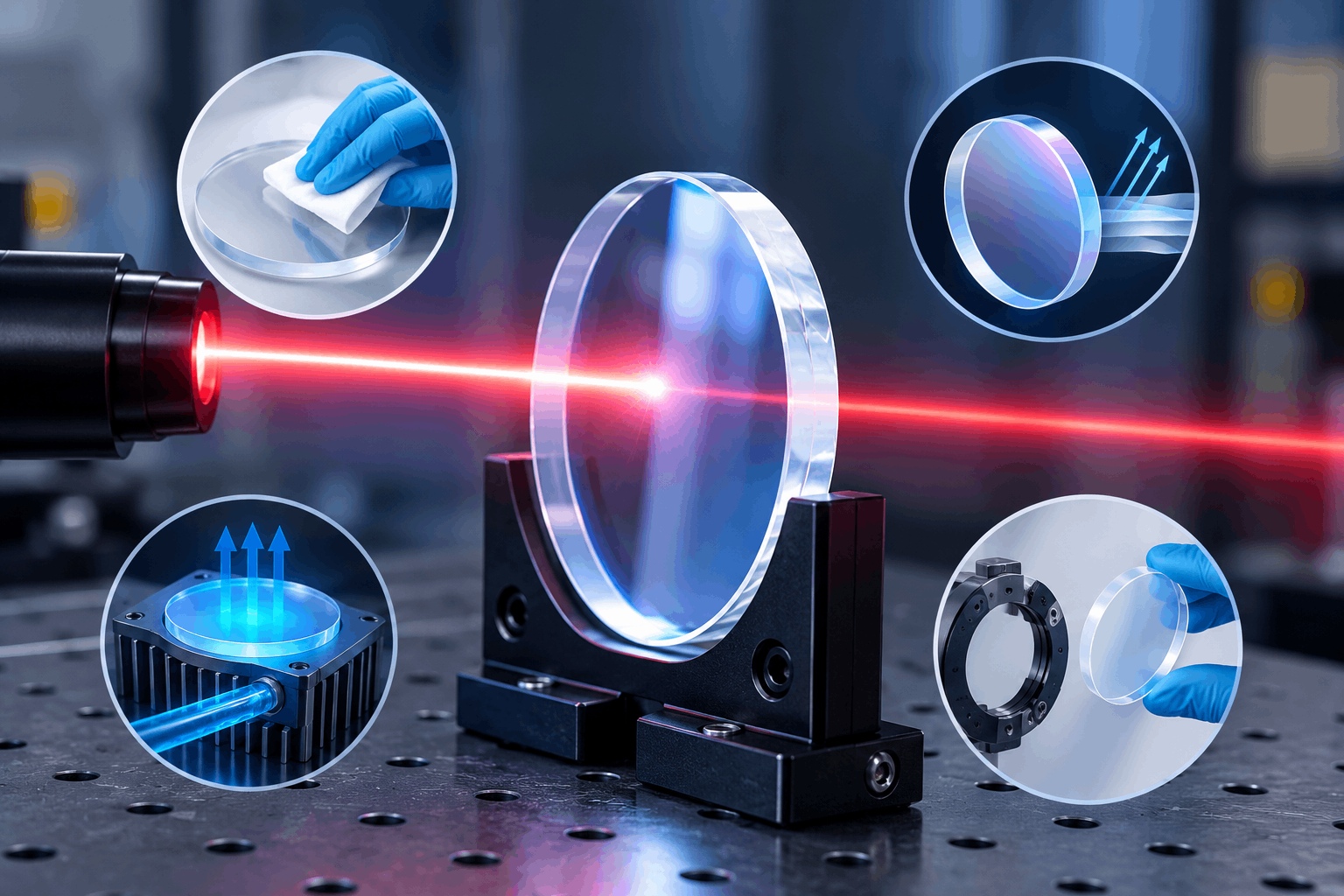
Why Can a Fused Silica Window Be Damaged by a Laser?
Fused silica is often selected for demanding optical applications because of its favorable laser characteristics. Nevertheless, every optical material has a limit.
Laser damage occurs when the energy deposited into the optical component exceeds its ability to withstand or dissipate that energy without permanent change.
Several mechanisms can contribute to damage, including:
-
Absorption of laser energy
-
Localized heating
-
Surface defects
-
Contamination
-
Coating failure
-
Thermal stress
-
Mechanical stress
-
High peak power density
-
Repeated laser exposure
The risk can be particularly significant with high-energy pulsed lasers because a large amount of energy may be delivered in a very short period.
Therefore, selecting fused silica windows for laser applications should involve an evaluation of the actual laser operating conditions rather than relying solely on the general reputation of the material.
1. Start with the Correct Fused Silica Material
Material selection is the foundation of laser-window performance.
Not every optical component sold as “quartz” or “silica” necessarily has the same properties as a precision fused silica optical component. Differences in purity, manufacturing process, homogeneity, and optical quality can affect performance.
When selecting a fused silica laser window, consider:
-
Material purity
-
Transmission range
-
Absorption characteristics
-
Internal inclusions
-
Homogeneity
-
Surface quality
-
Manufacturing quality
For UV and high-power laser systems, material quality can be particularly important.
A qualified fused silica window manufacturer should be able to provide information about the material grade and its intended optical applications.
The best material is not necessarily the most expensive material. Instead, it should provide suitable transmission and laser performance at the wavelength and power level required by the system.
2. Match the Window to the Laser Wavelength
Laser damage behavior depends strongly on wavelength.
A fused silica optical window may perform well across a broad spectral range, but the complete optical system must still be designed around the specific operating wavelength.
For example, a system may operate at:
-
266 nm
-
355 nm
-
405 nm
-
532 nm
-
633 nm
-
808 nm
-
1064 nm
The selected window should have appropriate transmission at the operating wavelength.
Wavelength also influences the selection of optical coatings. An anti-reflection coating optimized for one wavelength may not provide the same performance at another.
When ordering custom fused silica windows, always provide the exact laser wavelength rather than simply describing the application as “laser use.”
3. Control Laser Power Density
One of the most important factors affecting laser damage is power or energy density.
Simply knowing the total laser power is not enough.
A high-power laser with a large beam diameter may expose a window to a lower power density than a lower-power laser tightly focused onto a very small area.
For continuous-wave systems, engineers may consider parameters such as:
-
Average power
-
Beam diameter
-
Irradiated area
-
Power density
-
Exposure duration
For pulsed lasers, additional parameters become important:
-
Pulse energy
-
Pulse duration
-
Repetition rate
-
Peak power
-
Fluence
-
Beam diameter
The fused silica window should be selected based on the actual conditions at its surface.
Reducing unnecessary focusing or avoiding excessive beam concentration can help lower the risk of localized damage.
4. Choose the Right Optical Coating
The coating is often one of the most critical parts of a laser window.
An uncoated fused silica surface reflects a portion of incident light. An anti-reflection coating can reduce this reflection and improve transmission, but the coating must be compatible with the laser conditions.
For a fused silica window with AR coating, consider:
-
Operating wavelength
-
Angle of incidence
-
Laser power
-
Pulse duration
-
Repetition rate
-
Required transmission
-
Environmental conditions
A coating designed for low-power laboratory optics should not automatically be assumed to be suitable for a high-power laser.
For demanding applications, discuss laser-induced damage requirements with the coating supplier or optical manufacturer before selecting the coating.
The coating should be treated as part of the complete laser-optical design.
5. Understand the Laser Damage Threshold
Laser damage threshold is an important specification when selecting a fused silica laser window.
It describes the level of laser exposure that an optical component can withstand under specified test conditions without unacceptable damage.
However, damage-threshold data should always be interpreted carefully.
The measured threshold can depend on:
-
Wavelength
-
Pulse duration
-
Pulse repetition rate
-
Beam size
-
Number of pulses
-
Test method
-
Coating
-
Surface preparation
-
Environmental conditions
A damage threshold measured under one set of conditions may not directly represent performance under completely different operating conditions.
For this reason, buyers should provide realistic operating parameters when discussing laser damage resistance with a fused silica window supplier.
6. Keep the Optical Surface Extremely Clean
Contamination is one of the most common and preventable causes of laser damage.
A fingerprint, dust particle, oil residue, or cleaning residue may absorb laser energy even when the underlying fused silica substrate has excellent laser resistance.
Under intense irradiation, contamination can create localized heating.
This can lead to:
-
Surface discoloration
-
Localized thermal damage
-
Coating degradation
-
Pitting
-
Cracking
-
Permanent transmission loss
For fused silica windows used in high-power laser systems, cleanliness should therefore be treated as a performance requirement.
The window should be handled carefully, inspected before installation, and cleaned using an appropriate optical cleaning procedure.
7. Avoid Touching the Optical Surface
Fingerprints are particularly problematic because they combine oils, salts, and other contaminants.
Always handle a fused silica optical window by its edge whenever possible.
Use clean, powder-free gloves when handling is required.
Avoid placing the polished optical surface directly onto tables or other work surfaces.
Even a window that looks clean may contain microscopic contamination that becomes problematic when exposed to a high-power beam.
Good handling practices are therefore one of the simplest ways to protect a laser window.
8. Use Proper Cleaning Procedures
Cleaning itself can either protect or damage the optical surface.
A poorly chosen wipe, contaminated solvent, or excessive pressure can introduce scratches or coating defects.
Before cleaning a fused silica window, first remove loose particles using an appropriate clean, filtered air or nitrogen source.
Do not immediately wipe a dusty surface because particles trapped between the wipe and the optical surface can cause scratches.
If wet cleaning is required, use compatible optical-grade cleaning materials and follow the manufacturer's recommendations.
For coated optics, verify that the cleaning solvent is compatible with the coating.
Avoid:
-
Household glass cleaners
-
Abrasive materials
-
Ordinary paper towels
-
Dirty compressed air
-
Excessive rubbing
-
Unapproved solvents
A clean optical surface is essential, but cleaning should always be performed in a controlled way.
9. Specify Appropriate Surface Quality
Surface defects can become potential sites for laser damage.
A precision fused silica optical window may therefore require a specific scratch-dig specification and surface roughness.
Surface quality affects:
-
Scattering
-
Local electric-field behavior
-
Absorption
-
Coating uniformity
-
Laser damage resistance
For high-power laser systems, the required surface quality should be determined by the optical design and laser operating conditions.
It is not always necessary to specify the highest possible surface quality for every application. However, critical laser optics generally benefit from carefully controlled polishing and inspection.
When purchasing custom fused silica windows, surface quality should be included in the technical specification rather than left undefined.
10. Pay Attention to Surface Flatness and Wedge
Surface geometry can also influence laser performance.
Important specifications may include:
-
Surface flatness
-
Parallelism
-
Wedge
-
Thickness tolerance
Poor flatness can introduce wavefront distortion.
Excessive wedge can cause beam deviation.
Mounting stress can further distort the optical surface.
For precision laser systems, these effects may become significant even when the material itself is highly transparent.
A fused silica window manufacturer should therefore evaluate the complete optical specification rather than treating the component simply as a flat piece of transparent material.
11. Choose an Appropriate Window Thickness
Thickness is another factor that should be matched to the application.
A thicker fused silica window can provide greater mechanical rigidity and may be useful for large windows or applications involving pressure differences.
However, increasing thickness does not automatically increase laser damage resistance.
Thickness should be selected based on:
-
Window diameter
-
Clear aperture
-
Mechanical load
-
Pressure differential
-
Mounting method
-
Optical path requirements
-
Thermal conditions
For high-power systems, the relationship between thickness, thermal response, and mechanical stability should be evaluated as part of the complete design.
12. Minimize Mounting Stress
A high-quality optical window can still experience performance problems if it is mounted incorrectly.
Excessive clamping force can introduce mechanical stress into the component.
That stress may cause:
-
Surface deformation
-
Wavefront distortion
-
Alignment problems
-
Localized stress concentration
A precision fused silica window should therefore be installed using a mounting method appropriate for its dimensions and operating environment.
The mounting system should provide sufficient retention without unnecessarily compressing the optical component.
For vacuum applications, the interaction between the window, seal, holder, and pressure load should be evaluated carefully.
13. Consider Thermal Management
Laser radiation can produce heat even when the optical material has low absorption.
This is especially relevant when a window is exposed to high average power for extended periods.
Thermal effects may include:
-
Temperature gradients
-
Thermal stress
-
Refractive-index changes
-
Mechanical deformation
-
Coating degradation
Good system design can help manage these effects.
Depending on the application, engineers may consider:
-
Beam size
-
Cooling
-
Heat dissipation
-
Window thickness
-
Mounting design
-
Exposure time
-
Material absorption
The objective is to prevent excessive localized heating during normal operation.
14. Avoid Contamination During Laser Operation
Keeping a window clean before installation is important, but maintaining cleanliness during operation is equally important.
Industrial laser systems can generate:
-
Smoke
-
Vapors
-
Dust
-
Process particles
-
Condensation
-
Chemical residues
These materials can accumulate on the optical surface over time.
For example, in laser cutting or laser welding equipment, process by-products may reach protective windows.
A protective gas flow, suitable enclosure, or optical window protection system may help reduce contamination depending on the equipment design.
Regular inspection can identify contamination before it becomes a serious problem.
15. Control the Beam Alignment
A laser beam should strike the fused silica optical window under the angle and position intended by the optical design.
Misalignment can cause the beam to interact with areas that were not expected to receive high energy.
It can also increase the effective load on coatings and introduce unwanted reflections.
Before operating a high-power system, verify:
-
Beam position
-
Beam diameter
-
Incident angle
-
Optical alignment
-
Window orientation
For precision applications, alignment should be checked whenever the optical assembly is replaced or significantly modified.
16. Avoid Unnecessary Beam Focusing on the Window
A protective fused silica window should generally not become an unintended focusing element unless it is specifically designed for that purpose.
A tightly focused beam can dramatically increase local intensity.
If the window is located near a focal point, even a relatively moderate laser may create a high local power density.
During optical design, check the beam waist location and beam size at the window.
Moving the window away from a focus or increasing the beam diameter at the window may reduce the risk of laser damage, depending on the system architecture.
Conclusion
Preventing laser damage to a fused silica optical window requires a system-level approach. Fused silica offers excellent properties for demanding optical applications, but its performance depends on how the complete window is manufactured, coated, installed, operated, and maintained.
The most important steps include selecting the appropriate fused silica grade, matching the component to the laser wavelength and energy conditions, controlling power density, choosing a suitable optical coating, maintaining a clean surface, specifying appropriate surface quality, minimizing mounting stress, and managing thermal effects.
For fused silica windows used in high-power laser systems, contamination and surface defects deserve particular attention because microscopic imperfections can become damage initiation sites under intense irradiation.
Working with an experienced fused silica window supplier can also help ensure that material, polishing, coating, dimensional tolerances, and laser-performance requirements are considered together.
Ultimately, the best way to extend the service life of a fused silica laser window is to prevent damage before it starts. A carefully specified optical component, combined with proper beam management, clean handling, controlled installation, and regular inspection, can provide stable optical performance and greater reliability in demanding laser applications.
http://www.tolopoptics.com
tolopoptics -
-
AuthorPosts

- You must be logged in to reply to this topic.