- This topic is empty.
-
AuthorPosts
-
2026-11-03 at 4:29 pm #13300
Low viscosity UV resins are widely used in spray coatings, UV inkjet inks, and industrial surface finishing. They help formulators control material flow, improve application efficiency, and meet processing requirements such as spray atomization and inkjet jetting. However, low viscosity must be balanced with curing speed, adhesion, flexibility, and final film performance.
Guangdong Lencolo New Material Co., Ltd., operating under the Lencolo brand, supplies UV-curable resins, monomers, photoinitiators, and functional additives for coatings, inks, adhesives, and related applications. The following FAQs explain key considerations when selecting low viscosity UV resins.
1. Why is low viscosity important in UV-curable coatings?
Viscosity affects how a UV coating flows, levels, and forms a film. In spray applications, suitable viscosity supports atomization and uniform surface coverage. In UV inkjet printing, viscosity is particularly important for printhead compatibility, droplet formation, and stable jetting.
However, the lowest-viscosity resin is not necessarily the best choice. Adhesion, hardness, flexibility, curing response, and compatibility with other formulation components must also be considered.
2. Which low viscosity UV resins can be considered for spray coatings?
For ABS and PC UV topcoats, Lencolo offers several candidate grades, including L-6112 series, L-6121, L-6150, L-6129, L-6117, L-6118, L-6131, L-6605, L-6606, L-6135, L-6132A, and L-6111.
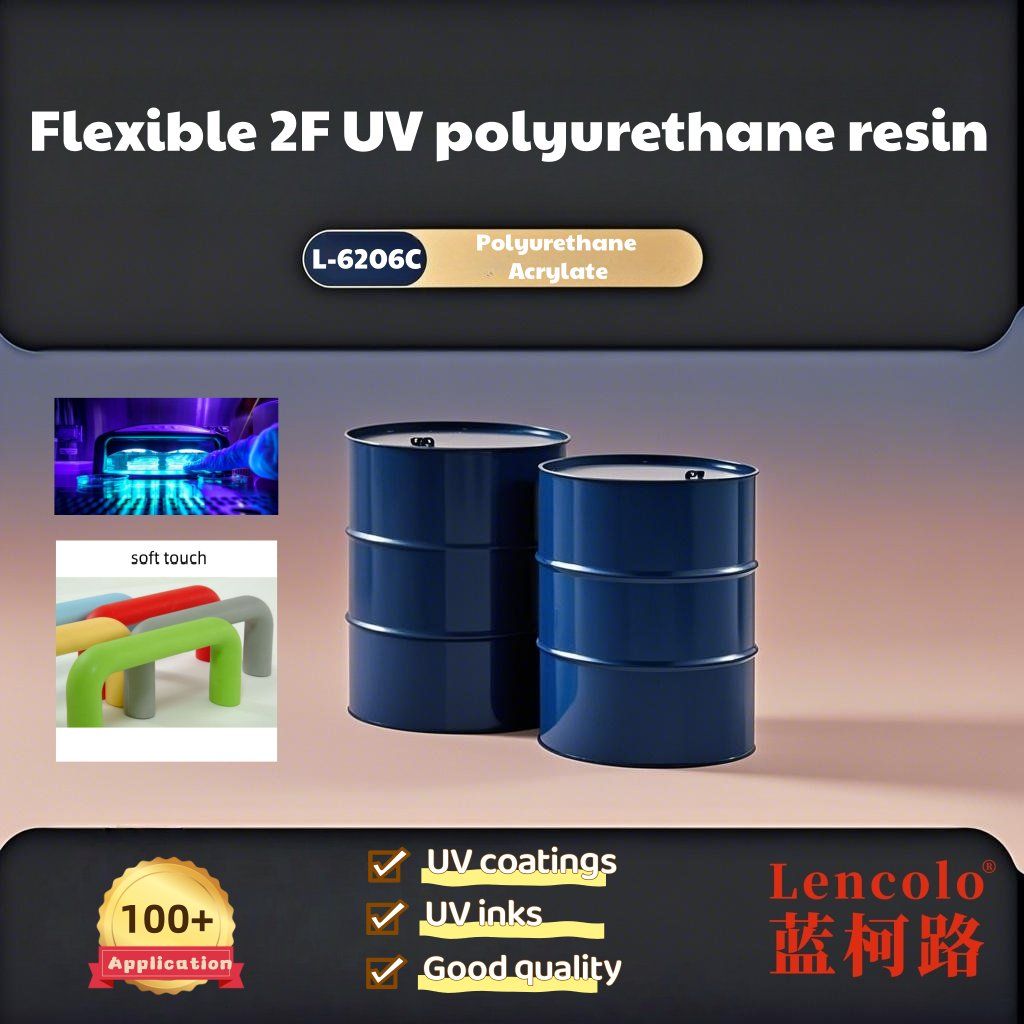
When both adhesion and flexibility are important, L-6300, L-6410, L-6206C, L-6135, L-6132A, and L-6460 may be evaluated.
For metal or more challenging adhesion applications, potential candidates include L-8413, L-6040, L-8400C, L-6200C, and L-6390. Flexible TPU and PVC coating systems may also be evaluated with L-6135, L-6132A, L-6206C, L-6200C, and L-6117-100.
These are application-related screening options, not a guarantee that every grade has the same viscosity or is suitable for every spray formulation.
3. Which Lencolo resins have particularly low viscosity for UV inkjet applications?
Several Lencolo grades have stated viscosity ranges that can help formulators narrow their initial selection:
Resin grade Main characteristics Viscosity L-6212 Ultra-low Viscosity 2-functional UV Polyurethane 25-50 cps L-6121 Low Viscosity UV Polyester Resin 60-150 cps L-6111 Low-Viscosity UV Epoxy Acrylic Resin 250-800 cps L-6126 Low-Viscosity Hyperbranched Polyester 400-700 cps L-6129 Wettability 6-Functional Hyperbranched Polyester 1,200-2,000 cps L-6113 Low Viscosity UV Epoxy Resin 800–1,500 cps L-8400A Water-resistant UV Resin for Glass/Hardware 1,000-2,000 cps L-6241 Low Odor LED UV Polyurethane Resin 20-50 cps The figures are reference values and should be checked against the latest technical data sheets, including the specified test temperature.
4. Which resin should be considered when flexibility is a priority?
L-6105 is positioned as a low-viscosity, high-elasticity UV polyurethane resin, with a stated viscosity of 18–25 cps. L-6212 is another candidate, with a stated viscosity of 25–50 cps and a two-functional polyurethane structure.
These grades may be considered for formulations where flexibility and low viscosity are important. The final choice should also account for substrate adhesion, curing conditions, and the mechanical requirements of the finished film.
5. How do reactive monomers help control UV formulation viscosity?
Reactive monomers can reduce or adjust formulation viscosity while participating in UV curing. They also influence reactivity, crosslinking, shrinkage, flexibility, and adhesion.
Lencolo’s available monomer candidates include ACMO, THFA, IBOA, EOEOEA, VEEA, HDDA, TPGDA, TMPTA, 4-HBA, DCPA, TBCH, NVC, CTFA, DCPDA, BZA, TMCHA, and NP(2PO)GDA.
The appropriate monomer depends on the resin chemistry and target application. Compatibility and cured-film properties should be evaluated as part of the complete formulation.
6. Which photoinitiators can be considered for low viscosity UV systems?
Photoinitiators influence UV curing performance, particularly in pigmented formulations and systems requiring effective through-cure. Lencolo photoinitiator candidates include 5030, 5033, 5026 (BDK), 5020 (819), and 5007 (TPO).
Selection depends on the UV source, pigment concentration, film thickness, and curing requirements. A suitable photoinitiator should be selected together with the resin and monomer system rather than independently.
7. What information should buyers provide when requesting a low viscosity UV resin recommendation?
A useful preliminary evaluation should include:
-
Substrate, such as ABS, PC, TPU, PVC, glass, or metal
-
Application method, such as spraying, roller coating, or inkjet printing
-
Target viscosity and operating temperature
-
UV curing source, including mercury lamp or LED
-
Required adhesion, hardness, flexibility, and scratch resistance
-
Existing formulation or current resin, if available
This information helps a supplier distinguish between materials intended for spray topcoats, flexible coatings, glass inkjet inks, and other applications.
8. What technical support does Lencolo provide for UV resin selection?
Guangdong Lencolo New Material Co., Ltd. supplies UV resins, monomers, photoinitiators, and functional additives for applications including UV spray coatings, hard coatings, clear coatings, vacuum metallization, UV adhesives, LED-UV inkjet, UV inks, 3D printing, and flooring coatings.
For customers developing low viscosity UV formulations, Lencolo provides technical data sheets, product selection guidance, samples, and formulation evaluation support. Candidate materials should be verified through laboratory trials using the actual substrate, formulation, application method, and curing equipment.
https://www.lencolo37.com/
Guangdong Lencolo New Material Co., Ltd. -
-
AuthorPosts

- You must be logged in to reply to this topic.