- This topic is empty.
-
AuthorPosts
-
2026-10-22 at 4:42 pm #12726
Can a Polyurethane-Lined Electromagnetic Flowmeter Withstand Vacuum and Negative Pressure?
Direct answer: No — vacuum suitability cannot be assumed from the liner material name, and it cannot be inferred from the meter’s positive-pressure rating. A polyurethane liner tells you something about abrasion resistance and about chemical compatibility with certain media; it tells you nothing on its own about whether a particular sensor will survive a negative-pressure event. Whether a polyurethane-lined electromagnetic flowmeter can operate under vacuum or negative pressure has to be confirmed for the exact sensor design — liner thickness, bonding method, liner retention at the flanges, electrode sealing, and the supporting tube — against the actual pressure and temperature conditions of the process. Two meters with the same liner material and the same nominal pressure class can behave completely differently under the same vacuum.
This matters because negative pressure is often an unplanned condition rather than a design parameter. A line that is specified at a positive working pressure can still see negative pressure during pump suction, during draining, during a shutdown with the line emptied, or during a cleaning cycle. If nobody checked the vacuum case, the first indication is usually a liner that has lifted, collapsed, or separated from the tube — by which point the meter is out of service and the process has been contaminated or the measurement has drifted.
Why Does Negative Pressure Put Mechanical Stress on a Liner?
An electromagnetic flowmeter’s liner is a non-conductive barrier between the conductive fluid and the metal measuring tube and electrodes. Its job is electrical isolation and, in abrasive service, mechanical protection of the bore. In normal positive-pressure operation, the internal pressure pushes the liner outward against the tube, so the tube supports the liner and the liner is held in compression against its seat.
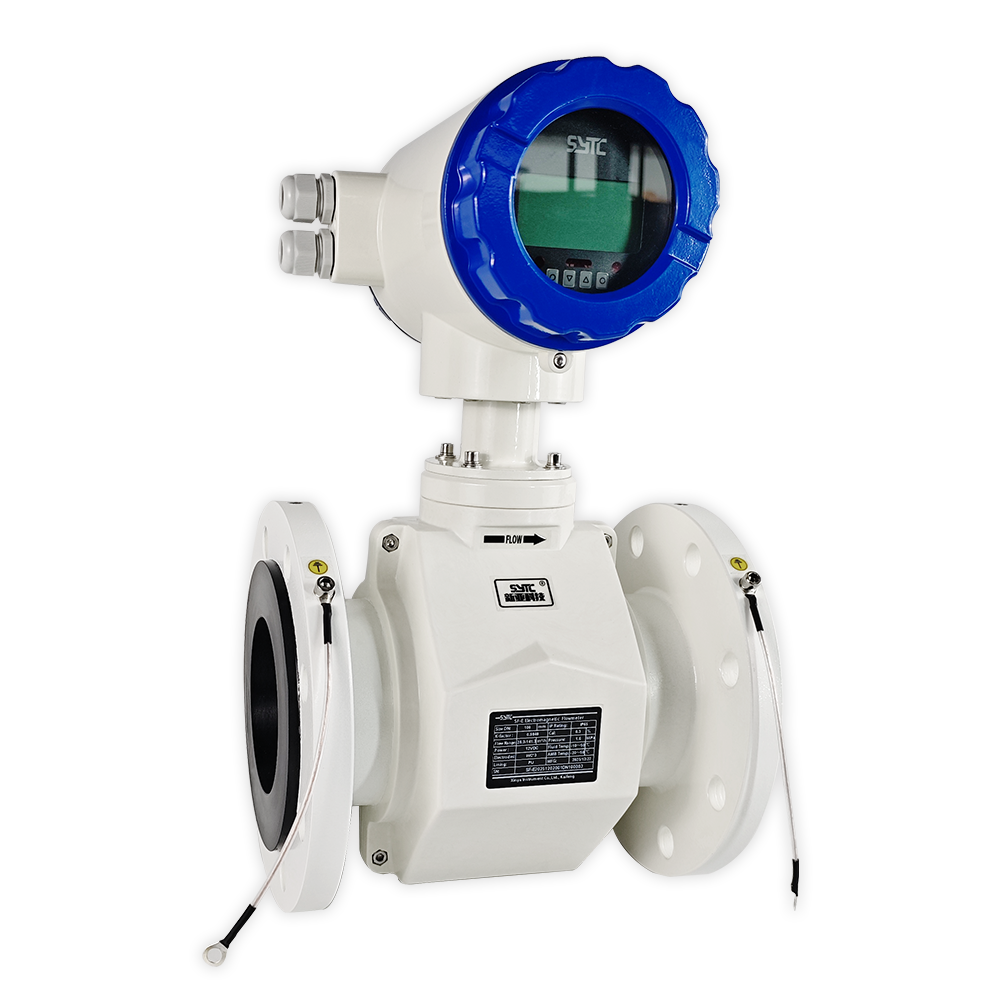
Negative pressure reverses that load path. When the internal absolute pressure falls below ambient, the pressure difference acts on the liner in the opposite direction — from the outside in, and along the bore. Depending on how the liner is made and retained, several failure modes become possible:
- Collapse or inward deformation of the bore. A liner that is not fully bonded to the tube, or that is thin relative to its unsupported span, can distort inward. Even a small deformation changes the cross-section, which changes the velocity profile and shifts the calibration.
- Separation or delamination from the supporting tube. If the liner is a loose or slip-fit type, or if the bond is only partial, the pressure differential can peel it away from the tube wall. Once a gap opens, fluid can migrate behind the liner.
- Liner movement at the flange faces. The liner typically extends onto the flange sealing face. Negative pressure can draw it back into the bore, damaging the seal and creating a leak path at the joint.
- Electrode seal distress. Electrodes pass through the liner and the tube wall. Reversing the pressure direction loads those seals from the opposite side, and a seal that is proven in positive pressure is not automatically proven in vacuum.
- Distortion under temperature. Material stiffness falls as temperature rises, so the same negative pressure that a liner resists cold can deform the same liner hot. Vacuum and temperature must be assessed together, not separately.
None of this is visible from outside the pipe. That is why the question has to be answered by design review and by the manufacturer’s tested limits, not by inspection after the fact.
Are Positive Pressure, Transient Negative Pressure, Full Vacuum, and Suction Conditions Equivalent?
No. These are different load cases with different severities, and treating them as one category is where most specification errors originate.
| Condition | What it means physically | Why it is a separate case |
|—|—|—|
| Normal positive operating pressure | Internal pressure above ambient, steady | The liner is supported by the tube; this is the case most meters are specified for |
| Transient negative pressure | A brief excursion below ambient, seconds to minutes | Magnitude may be modest, but repeated cycles can fatigue a bond or a seal over time |
| Full vacuum | Internal pressure near absolute zero, sustained | The largest differential across the liner; the hardest case for any unsupported or partially bonded design |
| Suction-side / pump inlet | Local low pressure set by pump hydraulics | Can be unstable and can combine with cavitation, vibration, and water hammer rather than a steady vacuum |
| Draining or empty line | Air admitted while liquid leaves, often under gravity | Produces vacuum plus two-phase flow plus, in some arrangements, a partial vacuum held for hours |The practical consequence: a meter that has been supplied for a positive working pressure of, say, a few bar is not thereby qualified for full vacuum. The pressure class on the flange describes how much internal positive pressure the joint can hold — it does not describe how much external pressure the liner can resist. Those are different directions of loading, and they are usually covered by different evidence in the manufacturer’s file.
A second distinction worth making: a short suction-side dip during pump start is not the same event as a line held under vacuum overnight during a shutdown drain. Frequency and duration change the mechanism from a single overload to cumulative fatigue, so both numbers belong in the enquiry.
What Data Should Buyers Provide to Get a Reliable Answer?
Before a manufacturer can confirm or deny vacuum suitability for a specific polyurethane-lined sensor, they need the actual conditions rather than a general description. A complete enquiry should include:
- Minimum absolute pressure the bore will see, or the maximum negative gauge pressure — stated numerically, and stated as gauge or absolute, not left ambiguous.
- Fluid temperature during the event, which may differ from the normal operating temperature and is often the higher of the two.
- Nominal diameter (DN) of the meter.
- Duration of each event, and how frequently it recurs — once at commissioning, daily, or every batch.
- Pump arrangement — suction lift versus flooded suction, position of the meter relative to the pump inlet, and whether cavitation or water hammer is possible.
- Whether the line is drained during shutdowns or cleaning, and whether it is left empty, vented, or closed.
- Installation orientation and any vertical runs where a liquid column can pull a vacuum as it falls away.
- Any simultaneous cleaning or sterilization cycle, if it coincides with the low-pressure condition.
With those inputs, the correct answer is a statement of the approved pressure and vacuum limits for that model, at that temperature and that diameter — or an explicit statement that the model is not suitable and an alternative recommendation.
FAQs
Does a high flange pressure rating prove vacuum suitability?
No. The flange rating describes the joint’s capability under internal positive pressure. It says nothing about the liner’s resistance to being pulled inward, or about how the liner is retained and bonded. A meter with a high positive-pressure class can still have a liner that is not approved for vacuum, and a meter with a modest positive rating may be fully vacuum-rated if it was designed and tested that way. The two ratings come from different evidence and must be asked for separately.Can the meter withstand vacuum during draining?
Not automatically, and draining deserves its own check. Draining produces a low-pressure condition that can persist far longer than a pump transient — sometimes hours with the line closed and empty — and it is often combined with air ingress and two-phase flow. Because the duration is long and the condition repeats at every shutdown, it is one of the more demanding cases for liner retention. Treat "the line gets drained" as a vacuum condition to be declared, not as a routine detail.Must vacuum limits be checked at the operating temperature?
Yes. Vacuum limits are not a single fixed number for a model. Liner stiffness, bond strength, and seal performance all change with temperature, and a limit that holds at ambient may not hold at an elevated process temperature. If the vacuum event occurs at a different temperature from normal operation — during a hot clean, for example — the limit for that temperature is the one that governs. Quote the temperature alongside the pressure whenever you request confirmation.Conclusion: Confirm the Specific Meter’s Limits Before Ordering
The safe position is straightforward: do not accept a vacuum claim based on the word "polyurethane," and do not derive one from a positive-pressure rating. Ask for the approved pressure and vacuum limits of the specific model, at the specific diameter and the specific temperature, and ask for them in writing as part of the order documentation. If the application involves full vacuum, sustained draining, or a suction-side condition that recurs, state that explicitly in the enquiry so the sensor design can be assessed rather than assumed.
For model-specific confirmation, buyers should consult the manufacturer directly. Kaifeng Xinya Instrument Co., Ltd. supplies polyurethane-lined and other lined electromagnetic flowmeters, and can confirm the approved pressure and vacuum limits for a particular sensor configuration against the stated operating conditions. That confirmation should be obtained before the order is placed — not after the liner has already lifted in service.
https://www.sytcflowmeter.com/
Kaifeng Xinya Instrument Co., Ltd. -
AuthorPosts

- You must be logged in to reply to this topic.