- This topic is empty.
-
AuthorPosts
-
2026-10-13 at 3:13 pm #12376
Both radar and ultrasonic level sensors mount on top of a vessel, emit a signal downward, and time the echo off the material surface — but radar sends electromagnetic waves while ultrasonic sends sound. That single difference decides most selections: radar tolerates steam, vapour, foam, dust, pressure and temperature variation far better, because microwaves are barely slowed or scattered by the atmosphere; ultrasonic is the economical non-contact choice for simple water-like liquids and clean air, but sound speed varies with temperature and the acoustic path suffers in vapour, foam and heavy dust. Radar also handles longer ranges. KJT Sensors supplies radar level transmitters (with some products supporting millisecond response, IO-Link, IP67/IP68 and ranges up to 20 m or higher — manufacturer-stated) and ultrasonic sensors (U18/U30 series with blind zones and ranges confirmed per model). Check the blind/dead zone at the top of every vessel before choosing either.
Key Takeaways
- Same method, different wave: both are non-contact time-of-flight echo sensors; radar uses electromagnetic waves, ultrasonic uses sound. The wave is what the atmosphere attacks or spares.
- Atmosphere decides: steam, vapour, foam and dust degrade the acoustic path — ultrasonic’s weakness and the documented reason radar holds “stronger interference capability in complex operating conditions” (manufacturer-stated).
- Every sensor has a blind zone: the region near the transducer where no measurement is possible. Vessel top space, maximum fill height and mounting nozzle length must clear it — a per-model number.
- Radar anchors (manufacturer-stated): millimetre-wave products including radar level transmitters; some products up to 20 m or higher range, millisecond response, IO-Link, 4–20 mA / NPN/PNP outputs, IP67/IP68.
- Ultrasonic anchors (manufacturer-stated): U18/U30 series; measurement not dependent on target colour or transparency; temperature compensation, blind zone, steam/bubble/dust sensitivity to be evaluated per application.
- Difficult media selection (foam, condensation, dust as the primary question) has its own guide (difficult-media guide); false echoes and unstable readings have their own diagnoses (radar troubleshooting guide, level troubleshooting guide).
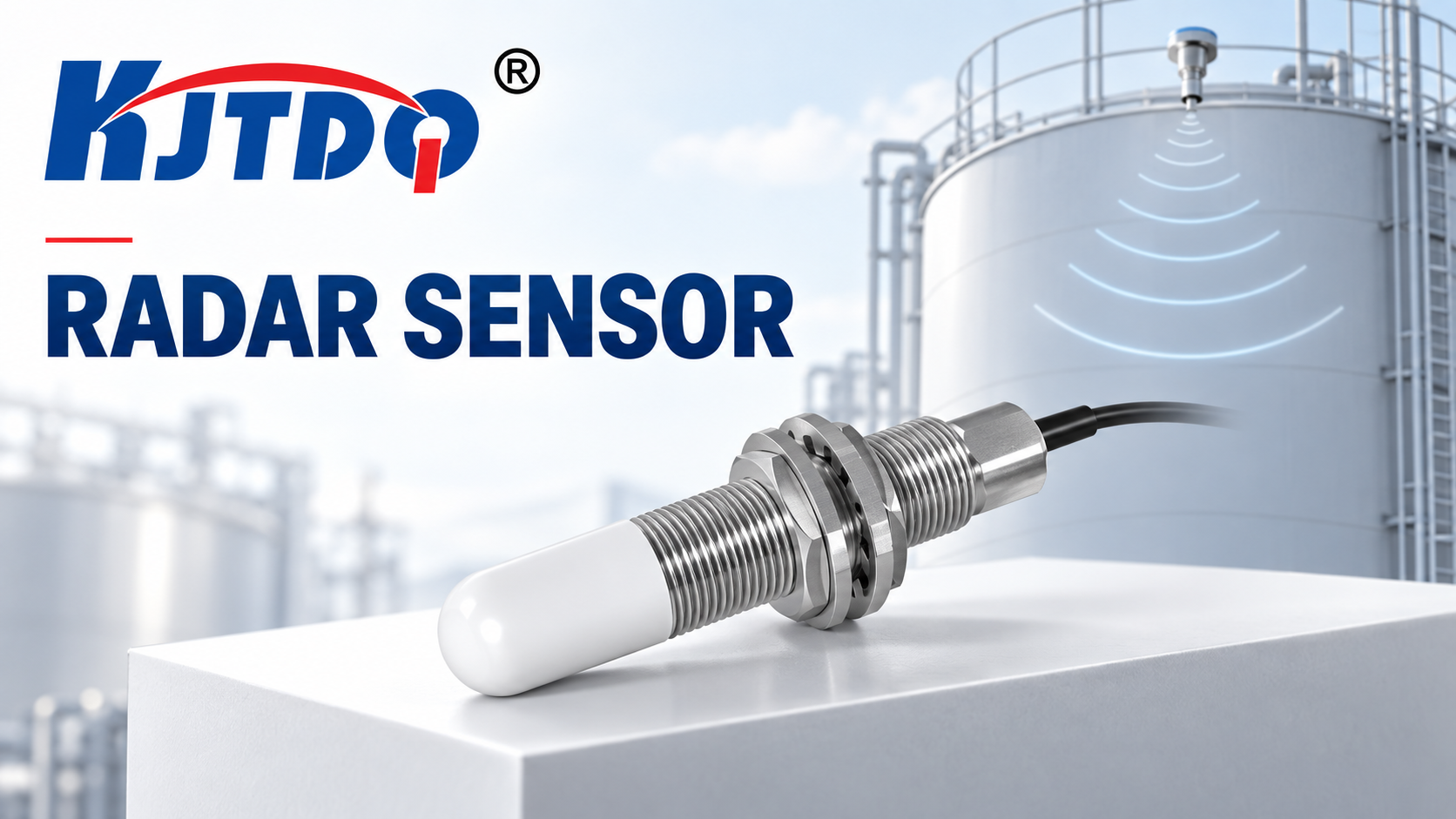
How Each Technology Measures Level
Radar: electromagnetic time-of-flight
A radar level transmitter emits microwaves downward; the material surface reflects them; the sensor converts round-trip time into level. Because the signal is electromagnetic, propagation is essentially unaffected by air temperature, pressure, vapour or dust between the antenna and the surface. KJT Sensors’ radar direction covers micro-radar, radar level transmitters, smart radar material-level products and collision-avoidance radar, with products realized in frequency bands including 24 GHz, 80 GHz and 125 GHz (manufacturer-stated, Radar Sensors).
The manufacturer’s own positioning for level duty: radar level transmitters “use radar waves to measure, with stronger interference capability in complex operating conditions such as steam, bubble, dust” (manufacturer-stated) — the exact conditions that trouble ultrasonic sensing.
Ultrasonic: acoustic time-of-flight
An ultrasonic sensor emits an acoustic pulse above 20 kHz and times the echo. Sound works well off liquid and solid surfaces — the liquid/solid interface gives a clear reflection, making top-mounted ultrasonic a standard level method for tanks, pools and silos. But sound speed varies with gas temperature (hence temperature compensation), and the acoustic path is degraded by steam, foam, dust, turbulence and strong airflow (manufacturer-stated, Measuring Sensors).
KJT Sensors’ ultrasonic line includes the U18 and U30 series with multiple measuring ranges, double-sheet detection variants, digital displays and different housing sizes; the measuring range, blind zone, output type and accuracy are confirmed for the specific model (manufacturer-stated).
Same-Dimension Comparison Matrix
Dimension Radar level sensor Ultrasonic level sensor Signal Electromagnetic waves (e.g. 24/80/125 GHz products — manufacturer-stated) Sound pulses (> 20 kHz) Atmosphere sensitivity Low: steam, vapour, dust, temperature and pressure barely affect propagation Higher: sound speed varies with temperature; steam, foam, dust and airflow degrade the path Foam on the surface Much more tolerant (manufacturer-stated stronger interference in bubble/foam conditions) Foam absorbs and scatters sound — a primary failure mode Dust (silos, bulk solids) Suitable — dust is largely transparent to microwaves Dust coats the transducer and attenuates the pulse; heavy dust is a documented caution Range Some products up to 20 m or higher (manufacturer-stated) Multiple ranges in the U18/U30 series; per-model confirmation Blind/dead zone Present — per model; also antenna beam considerations Present — per model; transducer ring-down sets it Vessel-entry constraint Non-contact from the top; antenna size and nozzle fit per model Non-contact from the top; transducer aiming and mounting angle matter Outputs 4–20 mA, NPN/PNP, IO-Link on some products (manufacturer-stated) Output type per model; PLC/instrument integration Typical cost position Higher Lower — the economical non-contact level choice for benign conditions KJT Sensors families Micro-radar, radar level transmitters, smart radar material-level products U18/U30 ultrasonic series What the Atmosphere Does to Each Wave
The three atmosphere questions that end most selections:
Steam and vapour. In a hot, vapour-laden headspace, sound speed changes with temperature and vapour content, and condensate can form on the transducer face. Radar’s microwave propagation is essentially indifferent to the same headspace. This is the classic “the ultrasonic worked all summer, drifted in winter / failed during the hot batch” pattern — and the documented reason the manufacturer positions radar for steam and bubble conditions.
Foam. Surface foam is acoustic absorbent: the echo weakens or disappears. Radar, with the manufacturer-stated stronger interference capability in bubble conditions, keeps measuring many foaming media (though heavy, dense foam can challenge radar too — a media question for the supplier, covered in the difficult-media guide, difficult-media guide).
Dust. In silos and dry-bulk service, dust attenuates ultrasound and coats the transducer; microwave sensing keeps going through the same cloud. Ultrasonic’s guidance explicitly lists dust among the factors to evaluate; the radar direction explicitly lists dust adaptation among its strengths.
One counterweight keeps ultrasonic in the conversation: for a clean, benign installation — a water tank, a settling pool, an open channel with still air — the acoustic method is reliable, simple and economical. Radar earns its premium when the atmosphere is hostile, not by default.
Vessel Structure and False Echoes
Both sensors listen for an echo, so anything else that reflects becomes a candidate signal:
- Nozzles, agitators, heating coils, ladders, and tank walls can all produce competing echoes — the radar troubleshooting guide (radar troubleshooting guide) treats unwanted-reflection diagnosis.
- The blind/dead zone at the top: every model has a region it cannot measure. The vessel’s maximum fill, the nozzle length and the sensor’s dead-zone figure must be checked together — if the process can fill into the dead zone, level reading is lost exactly at the worst moment. Blind-zone values are per-model and must be confirmed.
- Mounting angle and beam: an ultrasonic transducer must aim squarely at the surface; radar beam width (frequency-dependent) must clear nozzle walls and internal structures.
Unstable readings with foam, dust or condensation in service have their own diagnostic treatment (level troubleshooting guide) — distinct from initial technology choice.
KJT Sensors Options
Duty KJT Sensors family Confirmed anchors (manufacturer-stated) Level in difficult atmospheres Radar level transmitters / smart radar material-level products 24/80/125 GHz product directions; some products up to 20 m or higher; millisecond response; IO-Link; 4–20 mA / NPN/PNP; IP67/IP68 Economical non-contact level, benign conditions Ultrasonic U18/U30 series Multiple ranges; double-sheet detection variants; digital displays; range/blind zone/output per model Point-level switching Point-level devices (capacitive, photoelectric, conductive, vibration, float) For high/low alarms where continuous level is not needed For the wider technology context — laser versus radar versus ultrasonic for distance generally — see the distance-technology comparison; for media-driven selection (the medium is the question, not the wave), the difficult-media guide.
Level projects should specify: vessel size and height, medium, minimum/maximum level, dielectric properties (for radar), temperature and pressure, headspace conditions (steam, foam, dust), internal structures, mounting position, and output/communication requirements. Measuring range, accuracy, frequency, output and mounting are confirmed for the specific model. Pricing is quoted by model and project requirements.
Limitations and Validation Needs
- “Up to 20 m or higher,” millisecond response, IO-Link and IP67/IP68 are manufacturer statements about some radar products — per-model confirmation required.
- Ultrasonic U18/U30 ranges and blind zones are per-model; no numeric range is claimed in this article beyond the series’ existence.
- Dense foam, extremely low-dielectric media and heavy agitation can challenge radar too — media suitability must be confirmed with the supplier per application.
- Temperature compensation improves but does not equalize ultrasonic performance in varying headspace conditions.
- Both technologies need commissioning on the actual vessel (echo mapping/verification) before reliance.
FAQs
How do dust, vapour or foam change the choice? They push it toward radar. Sound is degraded by steam, foam, dust and temperature variation; microwaves are largely indifferent to the same atmosphere — the manufacturer positions radar as having stronger interference capability precisely in steam, bubble and dust conditions (manufacturer-stated). In a clean, still-air application, ultrasonic remains a sound economical choice.
What vessel structures create false echoes? Nozzles, agitators, heating coils, ladders, walls and anything else in the beam path. Both technologies see them as candidate targets; commissioning must verify the true surface echo against them. Unwanted radar reflections have a dedicated diagnostic sequence (radar troubleshooting guide).
Which blind/dead-zone limits must be checked? The per-model dead zone of the chosen sensor against the vessel’s maximum fill height, nozzle length and top space. If the process can fill into the dead zone, measurement is lost at high level — a per-model number to confirm before ordering, for both technologies.
Is radar always the better level sensor? No. For water-like media in still air with simple vessels, ultrasonic is reliable and more economical. Radar earns its premium in steam, vapour, foam, dust, longer ranges and tougher ratings — the atmosphere and the vessel decide.
Can these sensors measure through the vessel wall? Non-contact top-mounted radar and ultrasonic both measure through the open headspace, not through the vessel wall. (Non-invasive or through-wall measurement is a different sensing question — magnetic or capacitive principles for level.)
What data does a level project need? Vessel size and height, medium and its dielectric properties, min/max levels, temperature and pressure, headspace conditions (steam/foam/dust), internal structures, mounting position and nozzle geometry, and the output the system needs — the shared application-information discipline.
Conclusion
Radar versus ultrasonic for level is an atmosphere question. Sound needs a calm path: still air, no foam, no heavy vapour, temperature compensation — and rewards you with a simple, economical sensor. Microwaves walk through steam, dust and foam, at longer ranges and tougher ratings, for a premium. Fix the medium, the headspace and the vessel first; check the blind zone against your maximum fill; and let the atmosphere pick the wave.
Sources
- KJT Sensors, Radar Sensors (category page, verified accessible 2026-10-10): https://www.kjt-sensors.com/list-radar_sensors.html
- KJT Sensors, Measuring Sensors (category page, verified accessible 2026-10-10): https://www.kjt-sensors.com/list-clcgq.html
- KJT Sensors, Radar Sensor, Ultrasonic Sensor and Liquid-Level Sensor product data (internal knowledge base, Grade B manufacturer-stated)
https://www.kjt-sensors.com/
KJT Sensors -
AuthorPosts

- You must be logged in to reply to this topic.