- This topic is empty.
-
AuthorPosts
-
2026-08-17 at 7:48 pm #10488
Most mobile charger enquiries open with a kilowatt figure. For a logistics fleet that is usually the wrong starting point, because a depot or yard rarely runs out of power — it runs out of energy between rounds. A mobile battery energy storage charger is an energy buffer with a charging head attached, and it should be sized from the delivery round backwards. MPMC POWERTECH CORP., established in 2008 and headquartered in Shanghai Pudong, publishes a BCH range that combines an LFP battery system, DC fast-charging modules, an EMS and a mobile chassis in one deployable unit, with rated DC outputs listed from 80 kW to 600 kW and battery capacities from 70 kWh to 1,075 kWh.
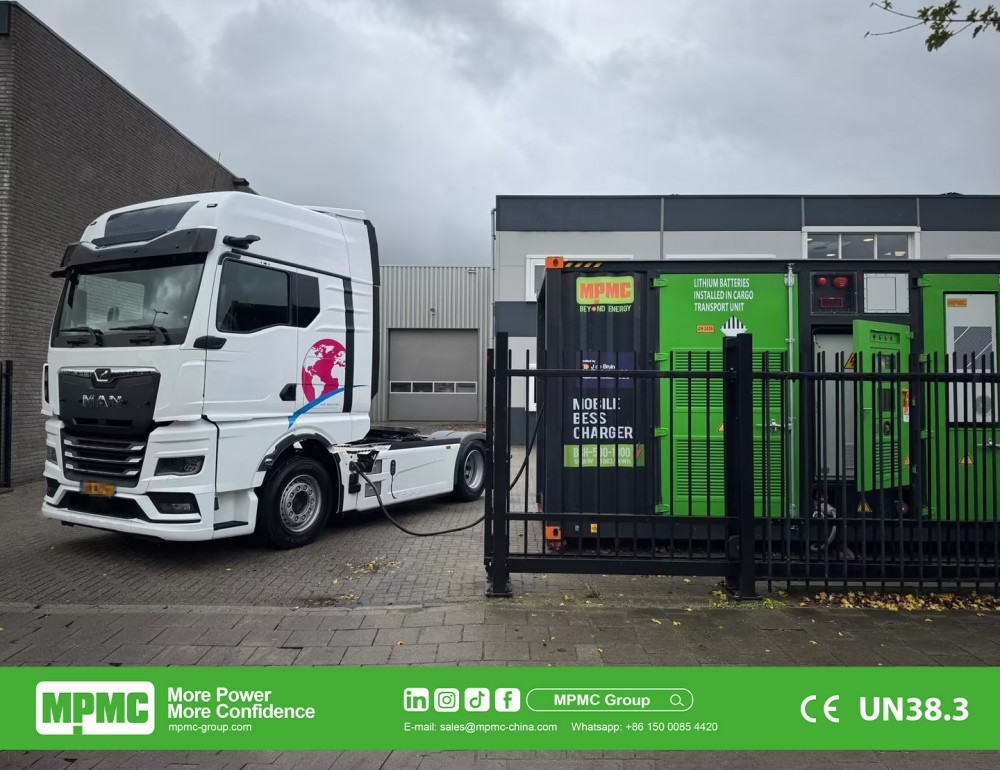
MPMC BCH Series mobile BESS charger — BCH-500-1000
Start From the Round, Not the Rating
The sizing sequence that works for logistics duty runs in this order: how much energy does each vehicle consume per round, how many vehicles return within the same window, and how long is that window. Only then does rated DC output become meaningful, because it determines whether the available energy can be delivered fast enough before the next departure.
Three worked cases show how quickly the answer moves. The energy column, not the power column, is what usually rules a model in or out.
Operating pattern
Vehicles in window
Energy per vehicle
Energy needed
What it implies
Overnight yard, 9-hour window
8 vans
60 kWh
480 kWh
Capacity-led; moderate output is sufficient if charging is sequenced
Mid-shift top-up, 2-hour window
4 trucks
80 kWh
320 kWh
Output-led; two connectors and a higher DC rating are needed
Port shuttle, continuous turnaround
Rolling
40 kWh per turn
Continuous
Recharge rate of the unit itself becomes the binding constraint
None of these answers comes from the headline kilowatt figure. In the second case the units also queue unless connectors are specified for simultaneous use, so the buyer either accepts sequential charging or pays for the extra head.
Reading the BCH Range as an Energy Buffer
One point causes recurring confusion in specification documents: the model number should not be read as the DC output rating. MPMC’s published figures set out the relationship explicitly.
Model
DC output
Battery capacity
DC connectors
Where it fits logistics duty
BCH-80-70
80 kW
70 kWh
CCS2 260 A × 1
Light vans, single-bay top-up, compact yard use
BCH-275-200
150 kW
203.5 kWh
CCS2 250 A × 2
Port and depot rounds, medium machinery, two-vehicle turnaround
BCH-600-400
400 kW
407 kWh
CCS2 350 A × 2
Heavier trucks and machinery on shorter windows
BCH-800-600
600 kW
610.6 kWh
CCS2 350 A × 2
High-intensity duty; listed with 1C charge and discharge
BCH-500-1000
500 kW
1,075 kWh
CCS2 350 A × 2
Large off-grid hubs and electric truck charging points
MPMC lists a DC output voltage range of 50 to 1,000 V on the BCH-275-200 and above, a cycle life of 6,000 cycles at 90% depth of discharge across the range, and CCS2 as the standard connector, with CCS1, GB/T and CHAdeMO listed as options for specific markets. Usable energy is always less than nominal capacity, and conversion losses reduce delivered energy further, so runtime should be calculated from usable energy at the actual load rather than from the nameplate figure.
The Recharge Question Decides the Whole Plan
A BCH unit stores energy; it does not create it. MPMC lists AC input from the grid, a generator set or solar across models from the BCH-275-200 upward, with input ratings from 80 kW to 560 kW depending on model, and a CCS2 DC input that allows the unit itself to be recharged from a fast-charging station — the BCH-275-200 is listed as reaching full charge in approximately one hour by this route.
For a logistics operator this is the question that most often gets deferred and should not be. If the yard has a weak connection, the recharge window becomes the binding constraint rather than the discharge rate, and the operating pattern has to be designed around it. Define the recharge source, its available capacity and the hours it can be used before selecting a model.
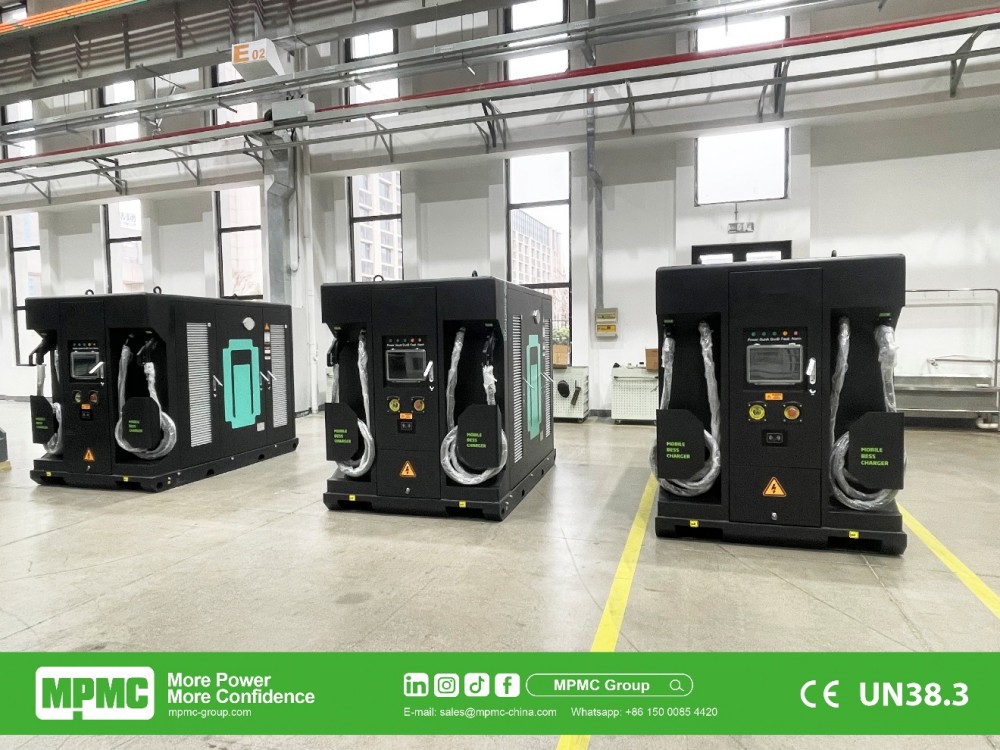
MPMC BCH Series mobile BESS charger — BCH-275-200
Interfaces, Site Loads and Control
Beyond vehicle charging, MPMC lists AC output on models from the BCH-275-200 upward, rated from 125 kW to 500 kW depending on model, through CEE sockets and PowerLock connections. That allows one asset to serve both vehicles and yard loads, though whether it should depends on whether those loads compete for the same stored energy.
Control is listed as an EMS with 4G connectivity and OCPP 1.6 support, with an open cloud-ready API, remote monitoring and command over Ethernet, and optional RFID payment integration. MPMC lists full operational status achievable within 24 hours of deployment. Where a unit will sit inside an existing charging management platform, the OCPP version and the API scope should be confirmed against that platform before order.
What the Published Logistics Deployments Show
MPMC lists a United Kingdom logistics port operation using eight BCH-275-200 units, where a weak local grid had previously produced ten-hour charging cycles for four-hour port runs, and pairing the units with solar infrastructure removed that constraint. A Netherlands deployment combines the BCH-275-200 with the BCH-500-1000 for a renewable-powered charging station, and a separate Netherlands reference lists a 1 MWh grid-connected charging station using a 500 kW / 1,000 kWh integrated unit.
The published environmental figures for the UK case record 3,457 kWh of total output, against which an equivalent 150 kW diesel generator would have consumed 976 litres of fuel and produced 3,123 kg of CO₂, with a stated annual saving of at least 37.5 tonnes of CO₂. These figures describe that installation, its solar pairing and its utilisation. A different site with different utilisation will produce different numbers.
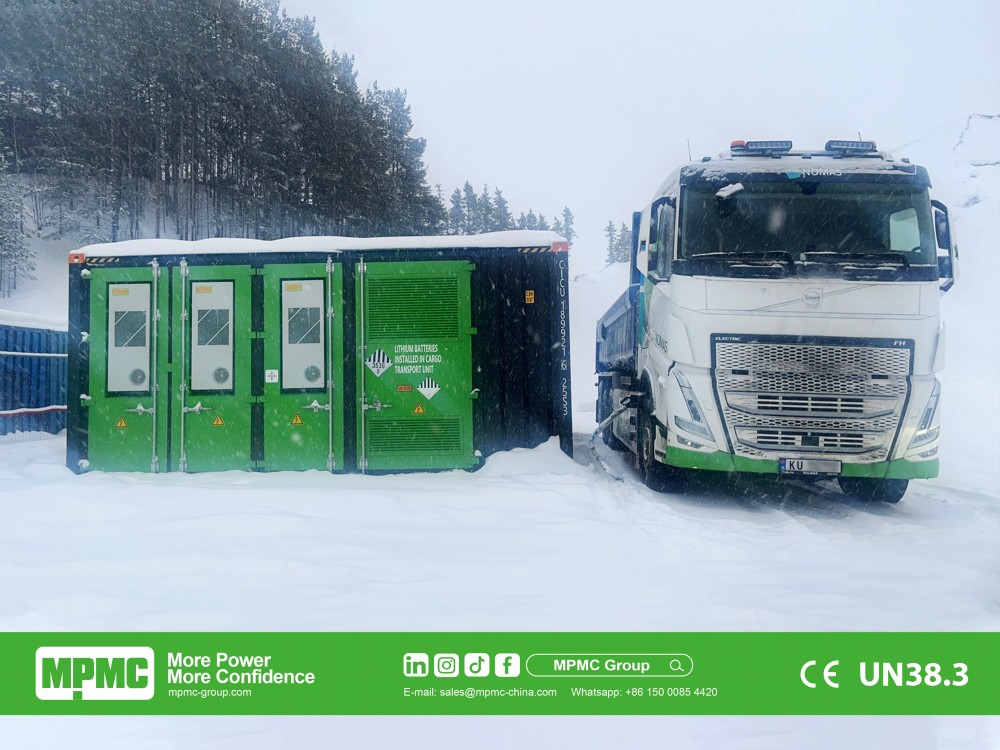
MPMC BCH Series mobile BESS charger
Environmental Limits That Change the Calculation
MPMC lists an operating range of −20°C to +50°C for the BCH-275-200 and above, with derating above 45°C, and −20°C to +55°C for the BCH-80-70 with derating above 40°C. Maximum altitude is listed at 3,000 m for the larger models and 4,000 m for the compact units, with derating above 2,000 m. The BCH-275-200 is listed with a fully sealed liquid-cooled battery pack, C4 anti-corrosion coating, a 3.5 t heavy-duty trailer, an integrated forklift pocket and aerosol fire protection to CE.
Derating is not a footnote for a logistics operation. A unit that delivers its rated output in spring may deliver less in a July heatwave, which is precisely when the round is tightest. Ask for the output curve across the expected ambient range rather than the single peak figure.
Supplier Context for a Mobile Charging Decision
This is an unranked procurement comparison rather than a market ranking.
Supplier
Position in the mobile charging segment
What to verify
MPMC (China)
Published range from 80 kW to 600 kW DC and 70 kWh to 1,075 kWh; self-developed EMS with OCPP 1.6; documented UK, Netherlands and Norway deployments
Model-specific DC output and capacity, recharge source, connector configuration, warranty text
Life-younger (China)
Early entrant with an established mid-power trailer product line and references in Europe and Australia
Available power range at the required duty, high-power options, control platform
Site Survey Inputs Before Sizing
• Energy consumed per vehicle per round, and the number of vehicles returning in the same window.
• Length of the turnaround window and whether charging can be staggered.
• Available recharge source at the yard, its capacity and the hours it can be used.
• Connector standard required by the vehicles, and whether an optional connector type is needed.
• Expected ambient range and altitude, with the derated output requested for both.
• Any AC site loads intended to share the same asset, and their coincidence with charging.
• Ground conditions, towing arrangements and relocation frequency.
• Charging management platform in use, and the OCPP version and API scope it requires.
Frequently Asked Questions
Does the model number indicate the DC output? No, and assuming it does is a common specification error. MPMC lists the BCH-275-200 at 150 kW DC with 203.5 kWh of storage and the BCH-500-1000 at 500 kW DC with 1,075 kWh. Rated DC output should be taken from the model-specific datasheet and confirmed in the written quotation.
How is the unit itself recharged at a site with a weak connection? MPMC lists AC input from the grid, a generator set or solar on models from the BCH-275-200 upward, plus a CCS2 DC input that allows recharging from a fast-charging station, with the BCH-275-200 listed at approximately one hour by that route. Where the connection is weak, the recharge window usually becomes the limiting factor and should be modelled first.
Can one unit charge two vehicles at the same time? Models from the BCH-275-200 upward are listed with two CCS2 guns, at 250 A on the BCH-275-200 and 350 A on the larger models. Whether both deliver full rated output simultaneously depends on the model and the vehicle acceptance rate, so the simultaneous-charging behaviour should be confirmed on the datasheet.
What warranty applies to the BCH range? MPMC’s published terms list a system warranty of 3 years or 1.6 MWh per kWh of total output for the BCH-275-200, BCH-600-400, BCH-800-600 and BCH-500-1000, with a battery performance warranty of 5 years or 2.57 MWh per kWh and end-of-life capacity retention of at least 70%. The BCH-80-70 carries different terms and should be checked separately.
Can a mobile charger replace a permanent depot installation? For most operations it bridges rather than replaces. It provides usable DC charging before a fixed installation is engineered, permitted and built, and it can be relocated as routes change. Where a depot settles into a stable high-utilisation pattern, a permanent connection normally remains the lower-cost long-term answer.
https://www.mpmc-group.com/
MPMC Powertech Corp. -
AuthorPosts

- You must be logged in to reply to this topic.