- This topic is empty.
-
AuthorPosts
-
2026-11-10 at 11:42 am #13568
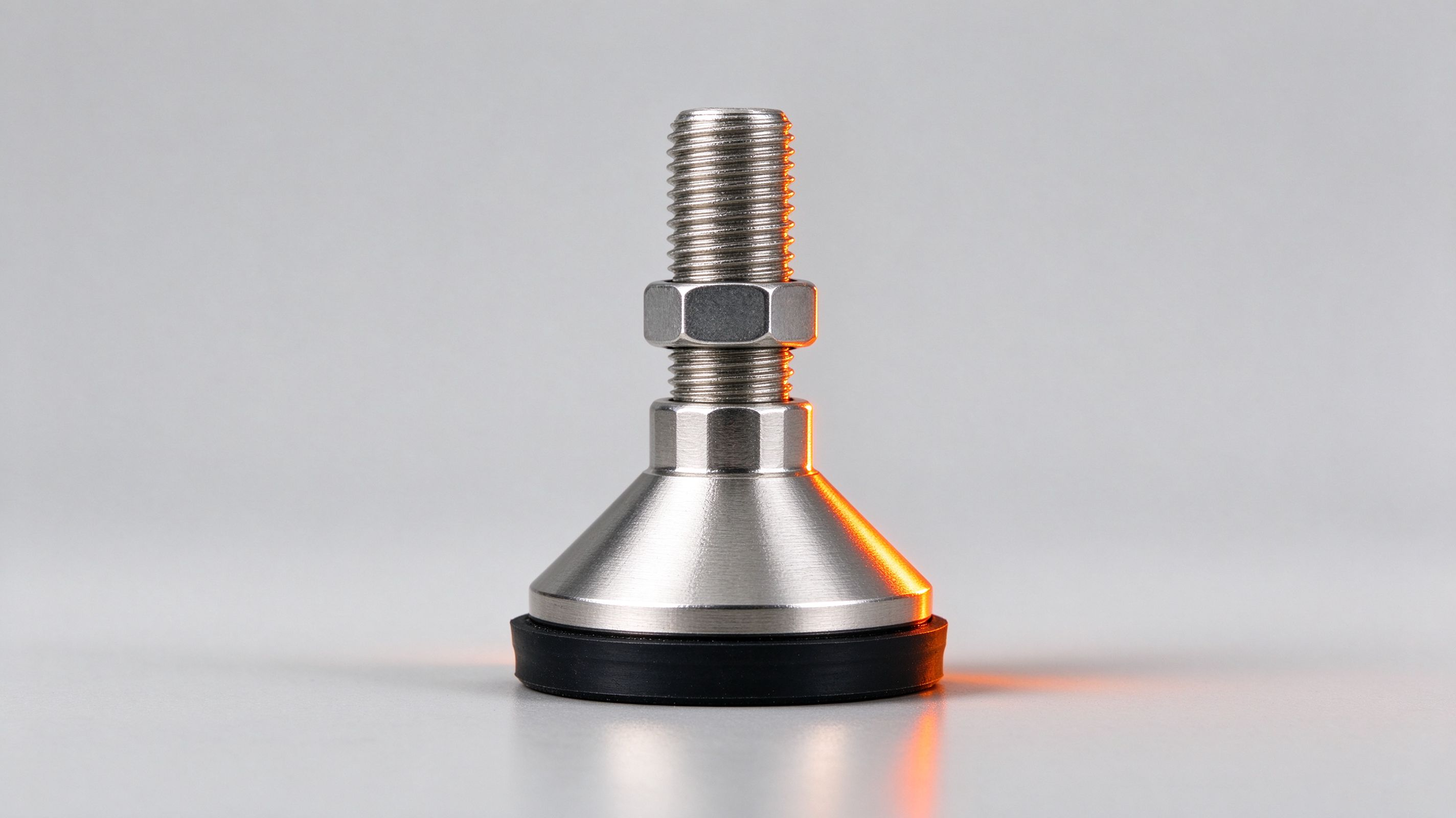
A leveling foot rarely fails at the rubber base — it fails at the stud, because the stud is the part everyone guesses at. Order it too short and the thread barely engages; too thin and it creeps under a machine that was "within spec". The two numbers that matter are load and length, and almost nobody publishes them properly. This guide fixes that. The threaded stud for leveling feet load rating is a rating of the complete foot, not the stud alone — our YL-series 700 kgf figure assumes the stud is fully engaged in its base, and the bare M16 stud alone could theoretically carry several tons. Below we walk through how the rating actually works, the leveling foot stud load rating per foot method for machines with uneven weight distribution, and the length formula that prevents both stripped threads and wobbly studs.
Published: November 2026 | By YuFengDe Engineering Team
1. What load rating does a threaded stud for leveling feet actually carry?
The threaded stud for leveling feet load rating printed in any catalog applies to the complete foot, and the stud itself is almost never the weak link. Take a standard M16 stud in 304 stainless (property class A2-70): tensile strength 700 MPa, yield 450 MPa, stress area 157 mm². On paper that stud yields at roughly 70 kN — about 7 tonnes. The complete foot is rated far lower because something else breaks first: the PA6 or rubber pad compresses, the stamped base deforms, or the thread engagement in the base shears. That is why a foot with a 7-tonne-capable stud is catalogued at 500–1,000 kgf. Any supplier quoting a stud rating above their base rating either misunderstands their own product or is inviting you to find out the hard way.
• M16 A2-70 stud, theoretical: ~70 kN yield, ~110 kN ultimate — the stud is not the limit.
• Complete YL-series foot, rated: 700 kgf static, limited by base and pad, with the stud fully engaged.
• Design rule: rated load ≥ 2 × your worst single-foot load. The factor of 2 covers off-center weight and start-stop dynamics.
The step most buyers skip is the per-foot calculation. Four feet do not carry a quarter of the machine each. If the center of gravity sits off-center, or the machine brakes and accelerates, one foot can see 1.5–2 times the average. Worked example at YuFengDe: a 1,200 kg machine on four feet averages 300 kg per foot; with a 1.5 off-load factor the worst foot sees 450 kg; applying the ×2 rule you need a foot rated ≥ 900 kgf. The standard 700 kgf YL001 is not enough — you would step up to an M20 stud or add two mid feet. Specifying from the average instead of the worst foot is the single most common sizing mistake we see in RFQs, and it is why the leveling foot stud load rating per foot method exists.
✅ Bottom line: Size the foot by its worst single-foot load — average load times 1.5 for off-center weight, then double it — and treat the stud's theoretical capacity as headroom, not rating.
2. How do you calculate the spindle thread length you need?
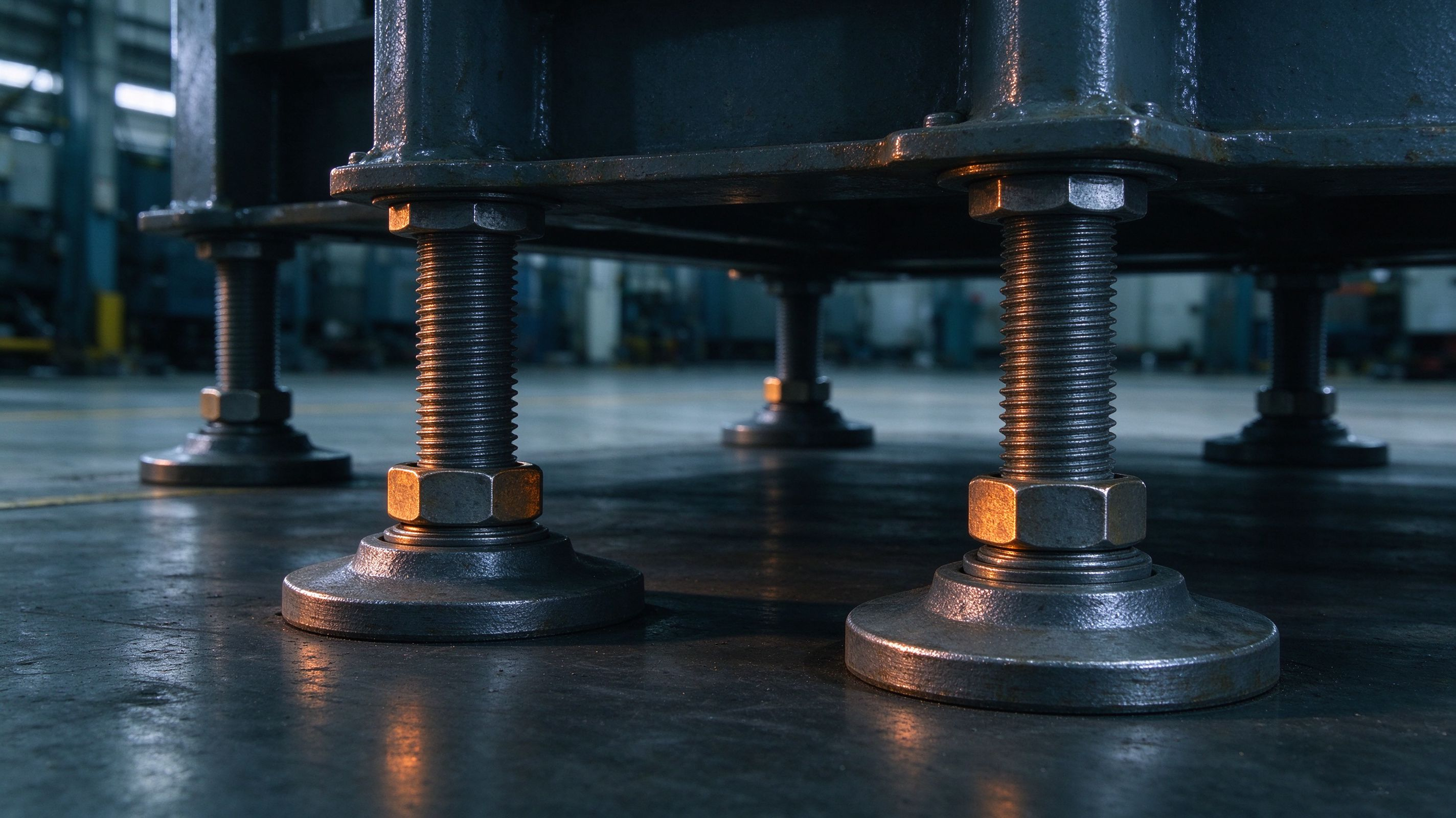
The leveling foot spindle thread length calculation is one line: total stud length = exposed height above the base + thread engagement inside the base + 10 mm of adjustment margin. Run it with real numbers. Suppose your machine pad sits 80 mm above the floor at correct level. The stud must engage the base by at least 1.5 × thread diameter — for M16 that is 24 mm, and we recommend 30 mm so the thread carries load on more surface. Add the margin for up-and-down adjustment and you get 80 + 30 + 10 = 120 mm. Order M16 × 120. If the machine will be leveled frequently or sits on an uneven floor, round up to 130 and keep the extra in the engaged region, not the exposed region.
Two failure modes sit on either side of that formula:
• Too little engagement (under ~1 × d): the load rides on two or three thread turns, the internal thread in the base shears, and the foot spins free under load. This is the failure behind most "the stud pulled out" complaints.
• Too much exposed length (over ~150 mm free stud on M16): lateral stiffness collapses, the machine rocks under vibration, and the stud bends instead of the pad flexing. If your calculation says you need more than 150 mm of exposed stud, the correct answer is a bigger diameter or a taller stamped base — not a longer skinny stud.
Thread fit matters as much as length. Match a 6g external thread to the base's 6H internal thread and the foot turns smoothly under load; mismatch them and you get either slop or seizure. On stainless, prefer a rolled thread over a cut one — the rolled surface is harder and smoother, which resists the galling that 304-on-304 pairs are famous for, and carries higher fatigue loads. Always order the stud with a lock nut (nyloc or double-nut): a leveling foot without one backs off under vibration, and every millimeter it unscrews quietly tilts your machine. Qingdao YuFengDe Precision Machinery Manufacturing Co., LTD. supplies studs with rolled 6g threads and lock nuts as standard, and as a custom fastener manufacturer we cut non-standard pitches and imperial threads to drawing when an old machine demands it.
✅ Bottom line: Length equals exposed height plus at least 1.5 diameters of engagement plus 10 mm margin, and if the exposed stud exceeds 150 mm on M16, increase the diameter instead of the length.
Frequently asked questions
Q: Is the 700 kgf rating for the stud alone or the complete foot?
A: The complete foot, with the stud fully engaged. The threaded stud for leveling feet load rating is always limited by the base and pad — the M16 stud itself would yield above 70 kN. If a supplier quotes a stud-only figure as the foot's rating, the pad is what actually fails first.Q: Can I buy replacement studs without new bases?
A: Yes. YuFengDe sells studs separately in M12–M20, any length, with rolled 6g threads and lock nuts. Send us the exposed height and thread size, and we will confirm the leveling foot spindle thread length calculation for your base before cutting — a one-minute check that prevents stripped threads.Q: Do you make custom studs for non-standard threads or imperial machines?
A: Yes — we are an OEM custom fastener factory, so non-standard pitches, imperial threads, extra-long studs and A4 (316) material are routine work, typically quoted within 24 hours from a drawing or sample.Get studs sized right the first time
Send Qingdao YuFengDe Precision Machinery Manufacturing Co., LTD. your machine weight, footprint and floor-to-pad height, and we will return the per-foot load calculation and a stud specification within 24 hours — standard or custom, complete feet or studs only. Compare finished specifications on our YL002R leveling foot page or browse the full product range before you order.
http://www.stainlesslevelfeet.com
Qingdao YuFengDe Precision Machiinery Manufacturing Co.,Ltd. -
AuthorPosts

- You must be logged in to reply to this topic.