- This topic is empty.
-
AuthorPosts
-
2026-10-15 at 1:43 pm #12459
As the global rollout of high-power electric vehicle charging infrastructure accelerates, the engineering challenges inside 350kW and above DC fast chargers have drawn increasing scrutiny from power electronics designers. Unlike conventional AC distribution panels, ultra-high-power DC fast chargers operate under relentless dynamic thermal cycling — charge cycles repeatedly push internal busbar temperatures upward, then ambient conditions pull them back down. This continuous mechanical stress, applied across the interface between conductive copper or aluminum busbars and their insulation supports, has become one of the most demanding performance criteria in modern EV charging infrastructure design.
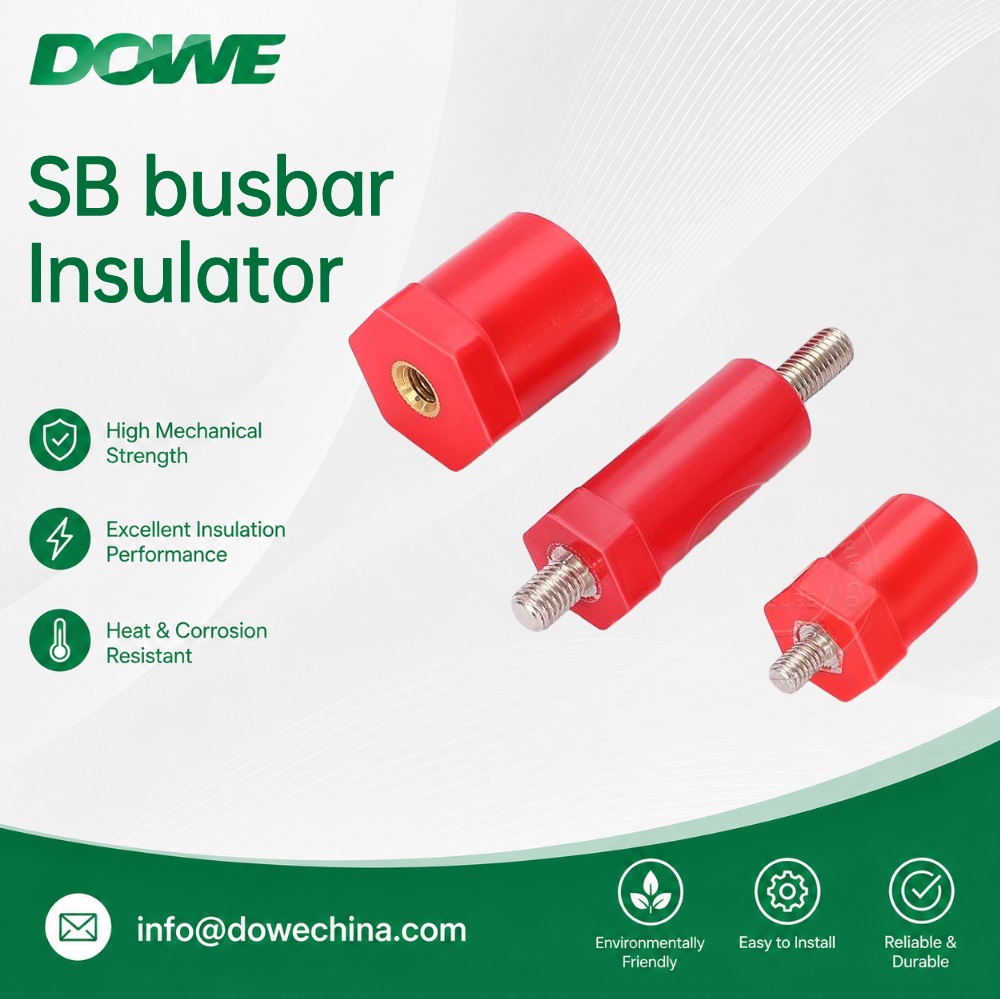
DOWE Electric, a specialized research, development, and high-precision manufacturing enterprise headquartered in Yueqing, Zhejiang Province, China, has built its product engineering around exactly these conditions. The company’s SB/JYZ Series standoff insulators are purpose-designed for high-voltage DC applications up to 1,500V DC, serving solar PV inverters, battery energy storage systems, and EV fast charging terminals including 350kW and above DC charging platforms and power distribution units (PDUs).
Why Thermal Cycling Is the Hidden Threat in 350kW+ DC Fast Chargers
A 350kW DC fast charger does not operate in steady-state. Each charging session drives a high-current pulse through internal busbars, rapidly raising temperatures at the copper-to-insulator contact interface. When the session ends, temperatures fall. Over thousands of charge cycles, this repeated expansion and contraction — what engineers call dynamic thermal cycling — subjects every mechanical joint and support structure to cumulative fatigue stress.
The critical failure mode is differential thermal expansion. Copper has a coefficient of thermal expansion (CTE) of approximately 16.5 × 10⁻⁶ /K, while aluminum sits at approximately 23.1 × 10⁻⁶ /K. If the insulation support material has a significantly different CTE, the cyclical mismatch creates micro-movement at the threaded insert interface, loosening fasteners, inducing micro-fractures, and ultimately compromising the galvanic isolation between live conductors and the grounded chassis. In a 1,500V DC system — where there is no periodic zero-current crossing point to extinguish arc energy naturally — any degradation in surface insulation integrity creates a serious continuous tracking risk.
The Structural Risk: Differential Expansion Between Conductor and Insulator
DC arcing in high-voltage DC solar and battery systems, as well as in EV charging infrastructure, has no natural zero-crossing point. This creates continuous surface tracking risks that are fundamentally more destructive than the arc behavior seen in 50/60Hz AC systems. Short-circuit electrodynamic forces also place mechanical stress on busbar supports during fault events. Compounding this, thermal cycling causes differential expansion between copper or aluminum busbars and their composite supports — a mechanical fatigue mechanism that standard industrial standoffs are not always engineered to withstand.
How DOWE Electric Addresses the Thermal Challenge
Material Selection: CTE Alignment and High Heat Deflection
DOWE Electric’s SB/JYZ Series insulators are produced from high-grade DMC, BMC, and SMC composite formulations that deliver a coefficient of thermal expansion of 15–22 × 10⁻⁶ /K. This range is deliberately aligned with copper (16.5 × 10⁻⁶ /K) and closely managed against aluminum (23.1 × 10⁻⁶ /K), minimizing the differential movement at the busbar-to-insulator interface across thermal cycles.
The heat deflection temperature (HDT) of the material maintains structural rigidity under a 1.8 MPa flexural load up to +180°C — well above the peak thermal excursions expected even in densely packaged 350kW charging terminals. The Relative Thermal Index (RTI), certified to UL 746B, reaches 130°C for both electrical and mechanical properties, confirming long-term material stability at sustained elevated operating temperatures.
The SB/JYZ Series is rated for continuous operation from -40°C to +140°C, addressing the full environmental envelope: cold-climate overnight standby at the low end, and elevated internal cabinet temperatures during high-power charging sessions at the upper end.
Dielectric Stability Across the Full Temperature Swing
Thermal cycling does not only stress mechanical joints — it also challenges the dielectric properties of insulation materials. DOWE Electric’s SB/JYZ insulators achieve a Comparative Tracking Index (CTI) of 600V or higher, placing the material in Material Group I for resistance to conductive carbon tracking. This rating is particularly significant for 1,000V–1,500V DC systems, where DC surface tracking is more persistent and destructive than in equivalent AC voltage systems.
Low-voltage dielectric withstand is rated at 3,500V AC (50Hz, 1 minute) without puncture or flashover. Surge impulse margins reach up to 8kV (1.2/50 μs impulse overvoltage, Overvoltage Category IV per IEC 60664-1), providing robust protection against transient overvoltage events that occur during charge initiation and termination in high-power DC fast charging circuits.
Mechanical Integrity: Insert Pull-Out Strength and Anti-Rotation Design
Dynamic thermal cycling also exposes the mechanical weakness in conventional threaded inserts. DOWE Electric’s SB/JYZ insulators incorporate cold-pressed brass (H62) and zinc-plated high-tensile steel threaded inserts, engineered to deliver tensile pull-out resistance exceeding 8,000 N for M8 and M10 inserts. Torsional lock performance exceeds 1.5 times the bolt proof torque, ensuring that fastener preload is maintained even after repeated thermal cycles.
The hexagonal anti-rotation base geometry integrated into the SB/JYZ family allows assembly technicians to hold the base with an open-end wrench while applying full tightening torque, preventing rotational shear stress on the mounting plate — a practical design feature that preserves joint integrity during both initial installation and maintenance.
UL 94-V0 and Fire Safety in Enclosed EV Charging Infrastructure
Enclosed EV charging cabinets present a fire containment requirement that goes beyond dielectric performance. DOWE Electric’s SB/JYZ insulators carry UL 94-V0 self-extinguishing certification, with afterflame time t1 + t2 not exceeding 8 seconds and zero flaming drips. This performance level directly addresses fire safety requirements applicable to battery energy storage and EV charging infrastructure, where non-compliant plastics can ignite during internal arc faults in enclosed switchgear or charging enclosures.
Compliance Without Compromise
DOWE Electric’s SB/JYZ Series products comply with IEC 61439-1/2, IEC 60664-1, RoHS 2011/65/EU & 2015/863, and REACH (EC 1907/2006). CE clearance and SGS third-party type test reports are available, enabling panel builders and EV charging infrastructure integrators to reference DOWE documentation directly when completing Design Verification records — without the cost or lead time of independent destructive testing.
These certifications position DOWE Electric’s solutions for frictionless market entry across Europe and North America, the two primary regions driving rapid deployment of high-power DC fast charging networks.
Engineered for the Realities of High-Power DC Fast Charging
For engineers specifying busbar insulation in 350kW and above DC fast chargers, the key design variables are clear: thermal endurance across a wide temperature swing, CTE alignment with copper and aluminum conductors, sustained dielectric performance under high-voltage DC stress, mechanical insert integrity through thousands of thermal cycles, and fire containment in enclosed enclosures.
DOWE Electric’s SB/JYZ Series insulators address each of these variables through material formulation, dimensional engineering, and certified third-party validation. With production capacity exceeding 500,000 low-voltage standoffs per month and annual exports of millions of SB/JYZ units to international OEMs and integrators across Germany, the United States, Spain, Italy, the Netherlands, and Canada, DUWAI/DOWE Electric has established a verified manufacturing base for high-volume EV charging infrastructure supply chains.
http://www.busbarinsulator.com
Yueqing City DUWAI Electric Co.,LTD -
AuthorPosts

- You must be logged in to reply to this topic.