- This topic is empty.
-
AuthorPosts
-
2026-10-28 at 3:16 pm #13006
Most buyers treat these three terms as synonyms. They are not, and the gap between them decides whether a circuit stays live for 120 minutes or merely refuses to catch fire. What is the difference between fire rated and fireproof cable tray comes down to scope: one term describes a coating, the other describes a tested assembly with a stated duration. Only the second one satisfies a fire-engineered specification, and only the second one survives a site inspection.
What follows is the practical version, written for people who have to defend a submittal rather than read a catalogue. It applies equally to a coated steel fireproof cable tray and to a lined composite system, because the logic of the rating does not change with the construction, a point LIWEIJU makes in every submittal review.
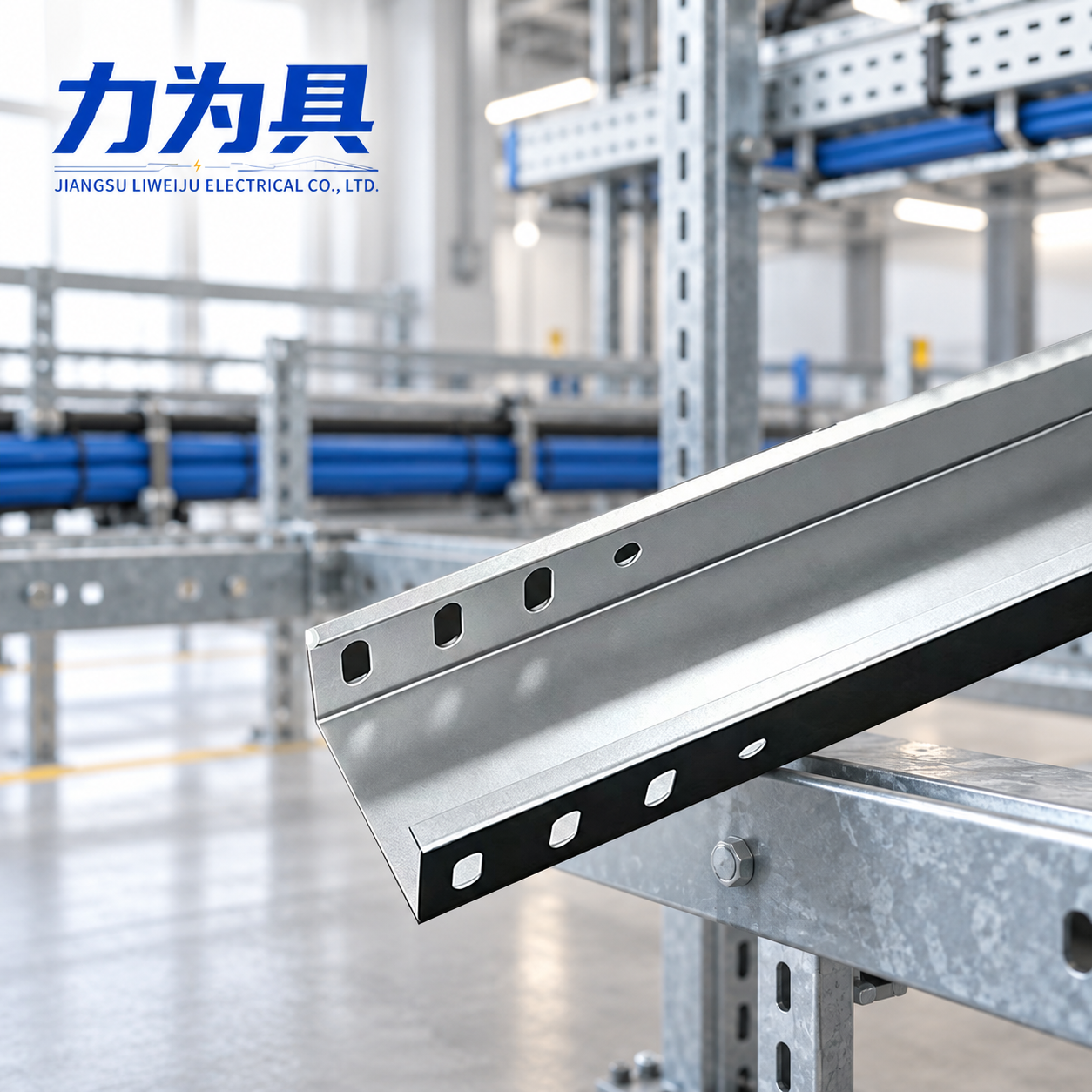
1. What is the difference between fire rated and fireproof cable tray?
Fireproof describes a material. Fire rated describes a system. Everything else in this article follows from that one sentence, and almost every specification error we see starts with a buyer who was sold the first and expected the second.
Flame retardant is the lowest tier. A flame-retardant powder coating, usually 50 to 100 microns thick, self-extinguishes once the ignition source is removed. Its job is to stop fire travelling along the tray route like a fuse. It provides no thermal barrier at all, and by 300 °C the film is already breaking down. A tray described only as flame retardant is a corrosion and appearance product.
Fireproof sits in the middle. An intumescent coating, typically 0.5 mm to 2.6 mm dry film, reacts at around 200 to 250 °C and expands ten to thirty times into a carbonaceous char. That char is the thermal barrier: it slows heat transfer into the steel and, indirectly, into the cable jacket. How long it holds depends almost entirely on thickness. This is why a supplier who names a duration without naming a dry film thickness has told you nothing you can verify.
Fire rated is the top tier. Here the complete assembly is tested as one specimen: tray, cover, coating or mineral board lining, splice plates, supports, and the firestop where the route crosses a rated wall. The acceptance criterion is not whether the tray stays standing. It is circuit integrity, meaning the cables remain energised while the cold-face temperature rise stays within limit. In China, GB 29415-2013 grades the result F4 at 30 minutes, F3 at 45, F2 at 60 and F1 at 90 and above. In Europe, DIN 4102-12 classifies the same idea as E60 or E90, IEC 60331 and BS 476-20/21 define the test method, and UL 2196 governs the US market.
Three questions separate the tiers faster than any datasheet:
✅ Flame retardant — ask which flame-spread class, and stop there.
✅ Fireproof — ask for the dry film thickness and the standard it was tested to.
✅ Fire rated — ask for the duration, the complete tested assembly, and the name of the laboratory.This is why LIWEIJU quotes duration, coating thickness and tested configuration in the same sentence rather than in three separate brochures. Jiangsu Liweiju Electrical Co., Ltd. operates to ISO 9001 and issues a coating thickness record with each production batch, because overseas buyers increasingly have to defend that number to their own fire consultant.
✅ Bottom line: Fireproof is a coating property. Fire rated is a tested system with a stated duration. Only the second belongs in a fire-engineered specification.
2. How many minutes fire rating does a cable tray need?
Match the duration to the circuit, not to the building. A two-hour structure does not mean every route inside it needs two hours. Most specifications set the requirement circuit by circuit, and these are the ranges we see across hospital, metro, commercial and industrial work:
✅ Fire alarm loops — 30 to 60 minutes, enough to complete evacuation
✅ Emergency lighting — 60 to 90 minutes
✅ Sprinkler and fire pump supply — 90 to 120 minutes
✅ Smoke extraction fans — 120 minutes
✅ Firefighter lift — 120 minutes
✅ Hospital critical supply — 120 to 180 minutes
✅ Data centre UPS feeders — 90 to 120 minutesCoating thickness then follows the duration. On a steel substrate the dry film ranges typically quoted against GB 29415 grading are 1.4 to 1.6 mm for F3, 1.8 to 2.0 mm for F2, and 2.4 to 2.6 mm for F1. This is why the question of how many minutes fire rating does a cable tray need has to be answered on the drawing before a single tray is ordered, and why changing the answer later is expensive. Load capacity is specified separately: not less than 2.0 kN/m uniformly distributed, assessed in the fire condition rather than at room temperature.
Does galvanized steel cable tray need fireproof coating? Not always, and the distinction matters more than most buyers expect. Galvanised steel does not burn, so it already satisfies flame-spread requirements and remains the correct choice for general power and control routes that may be exposed to fire but do not have to keep working. The problem is conductivity. Steel moves heat at roughly 45 W/m·K and the zinc layer melts at about 419 °C, a temperature a standard fire reaches within minutes. Above 450 to 500 °C the sheet loses close to half its yield strength, the tray sags between supports, and the cables come down before the flame arrives. Where circuit integrity is specified, bare galvanised tray is not an option.
A buyer who asks does galvanized steel cable tray need fireproof coating will usually find the answer in the circuit schedule rather than the catalogue. Where a barrier is required on galvanised substrate, the coating needs a primer compatible with zinc. Skip that step and adhesion fails within two to three years, usually starting at cut edges and bolt holes. For OEM projects, LIWEIJU supplies coated and uncoated configurations on the same tray profile, so the barrier can follow the circuit schedule instead of a single site-wide rule. Custom widths from 100 to 800 mm and bulk orders run on the same line, and the factory can hold a batch for third-party thickness verification before shipment.
✅ Bottom line: Size the rating by circuit function. Sixty minutes covers evacuation routes; 120 minutes is for systems that must run during firefighting.
Frequently asked questions
Q: Does galvanized steel cable tray need fireproof coating?
A: Only where the circuit must stay energised during a fire. Galvanised steel meets flame-spread requirements on its own and is the right answer for general power and control routes. Where a fire-engineered design calls for circuit integrity, the steel needs a thermal barrier, because bare steel passes heat straight through to the cable jacket.
Q: Is "fireproof cable tray" an actual certification?
A: No. There is no product class called fireproof. Searches for what is the difference between fire rated and fireproof cable tray usually end here, because the honest answer is that one is a marketing word and the other is a test report. Ask for the standard, the duration, and whether the tested specimen included supports, covers and firestop. A 60-minute result on a bare panel says very little about a 120-minute route with splices every three metres.
Q: Can I use a 60-minute tray on a 120-minute circuit?
A: No, and the reverse is just as costly. Upgrading from F2 to F1 adds roughly 0.6 mm of coating across the entire route, which on a large project becomes a serious line item for protection the circuit may never need. The answer to how many minutes fire rating does a cable tray need comes from the circuit schedule, and that schedule should be fixed before tendering. See our note on fireproof cable trays in building fire-safety projects for how this plays out on a typical commercial fit-out.
Next step
Send us your circuit schedule and we will mark up which routes genuinely need a barrier, which duration applies, and where the specification is buying protection nobody asked for. No charge, no obligation to order. LIWEIJU is a fire rated cable tray manufacturer in China supplying OEM systems from 100 to 800 mm width, with ISO 9001 production control and third-party thickness records available on request. Email the team through the LIWEIJU contact page and include your tray schedule, coating class and destination port for a wholesale quotation.
http://www.lwjelec.com
Jiangsu Liweiju Electrical Co., Ltd. -
AuthorPosts

- You must be logged in to reply to this topic.